
Mavic Chijioke Okeugo
By Funke Osae-Brown
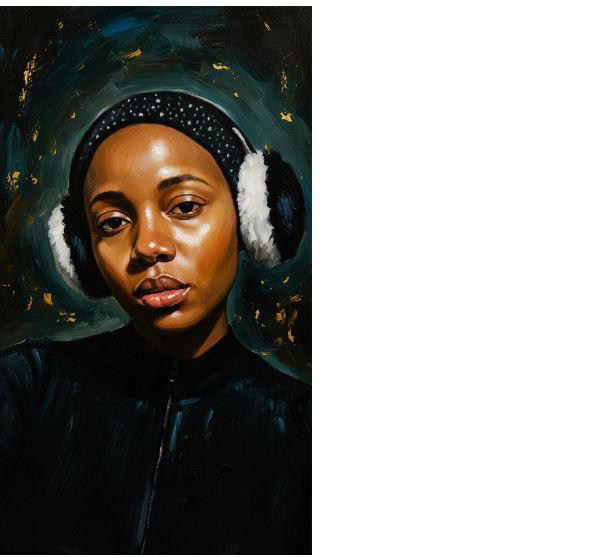
In Where Light Learns Our Faces, Mavic Chijioke Okeugo offers a portrait that feels more like a meditation on how visibility itself is formed; light, history, and interior life negotiating the emergence of a face. The photograph is a fine art portraiture, reaffirming Okeugo’s growing commitment to photography as a medium of emotional density rather than mere optical diary.
As part of the works displayed in his Solo Exhibition at the Africa Centre in London on January 18, 2026, Okeugo presents a frame with a young Black woman at the center, her face rendered with a luminous precision that immediately arrests the gaze. Light pools on her forehead, nose, and cheeks, sculpting her features into a quiet topography of reflection. This is not dramatic chiaroscuro in the classical sense; instead, it is a soft, learning light, as the title suggests, light that does not dominate but studies, discovers, and gently reveals. The face appears to emerge from darkness, not in struggle, but in calm negotiation.
The background is a deep, swirling field of greens and blacks, punctuated by flecks of gold that read like distant stars or fragments of memory. This painterly treatment collapses spatial certainty: we are not in a room, nor a landscape, but within an atmospheric psyche. The face floats, suspended between presence and dissolution. Okeugo’s use of this abstract ground resists narrative anchoring, allowing the portrait to exist as a contemplation of timelessness.
Formally, the composition is intimate and frontal, yet slightly tilted, introducing a subtle asymmetry that destabilizes any sense of static perfection. The subject’s gaze does not confront; it rests. Her eyes meet the viewers’ with a quiet gravity that is neither inviting nor withdrawn. This refusal of overt emotion becomes the image’s emotional core. The portrait does not ask to be consumed; it asks to be stayed with.
The earmuffs are white, textured, almost halo-like, framing her head and introducing a delicate symbolism. They suggest insulation, protection, perhaps even withdrawal from noise. In a world saturated with visual and sonic excess, this figure seems to inhabit a private acoustics, listening inward rather than outward. They also function formally as compositional brackets, containing the face within soft borders of light against the darker field.
Color is restrained yet potent. The warm, glowing browns of the skin contrast with the cool, shadowed greens of the background, creating a chromatic tension that holds the image in balance. Okeugo’s control of tone is meticulous: highlights are never harsh, shadows never empty. The face becomes a site of tonal orchestration, where every gradation contributes.
What distinguishes this work within contemporary African portrait photography is its refusal of spectacle. There is no costume, no overt cultural signifier, no performative gesture. Instead, Okeugo turns toward interiority, toward the face as a terrain of quiet endurance and self-possession. In doing so, he aligns with a lineage of portraiture that values psychological presence over sociological description.
Yet, the title insists on a broader reading. Where Light Learns Our Faces suggests that visibility is not neutral, that light itself must be taught how to see us. In a historical context where Black faces have often been misread, flattened, or rendered invisible, Okeugo’s portrait becomes an ethical proposition: that representation is an act of learning, not claiming. Light here is not a tool of exposure but a student learning humanity.
The photograph’s painterly surface, visible in the brush-like textures and softened edges further complicates its status as photography. Okeugo seems to push the medium toward painting, not as imitation, but as a way of insisting on material presence. The image does not pretend to be transparent; it declares itself as surface, as constructed vision. In this way, the work participates in contemporary debates about photography’s ability to carry the weight of fine art seriousness in an age of digital excess. Within the context of his solo exhibition at the Africa Centre, London, the piece reads as a manifesto of sorts. It proposes a photography rooted in slowness, care, and attention, values increasingly rare in visual culture.
The portrait does not shout its relevance, it whispers necessity.
Ultimately, Where Light Learns Our Faces is a study in how a face can become a landscape of reflection, how light, when handled with restraint and empathy, can transform portraiture into a space of encounter rather than capture. Mavic Chijioke Okeugo here demonstrates a mature sensitivity to the ethics and poetics of seeing. He reminds us that to photograph a face is not merely to record it, but to enter into a quiet agreement with light, time, and the dignity of presence. This is a portrait that does not end when you look away. It lingers like a face remembered not for how it looked, but for how it allowed itself to be seen.
Funke Osae-Brown, media expert, writes from London.
Disclaimer
Comments expressed here do not reflect the opinions of Vanguard newspapers or any employee thereof.