
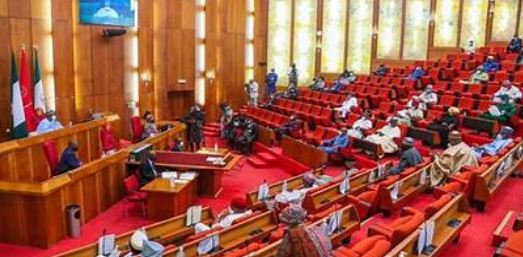
Senate
By Emmanuel Elebeke
The Chairman of the Senate Committee on Science, Innovation and Technology, Sen. Aminu Abbas has emphasized the vital role of science, technology, and innovation (STI) in driving Nigeria’s economic growth and national productivity during the three-day stakeholders’ consultation workshop on the operationalization of the National Research and Innovation Council (NRIC).
He said the senate would grant speedy passage to the bill considering it’s critical importance to the national development.
The Chair highlighted that the NRIC Bill is a key legislative instrument aimed at modernizing Nigeria’s innovation governance framework and fostering a robust ecosystem for research and development.
He listed the key objectives of the NRIC include:
Establishing a National Research and Innovation Council to oversee research funding and coordination.
Providing sustainable funding for research and innovation across sectors.
Enhancing coordination between academia, government, and industry to accelerate knowledge transfer and commercialization.
Empowering young innovators, startups, and creative entrepreneurs to contribute meaningfully to national development.
He reaffirmed senate’s commitment to the smooth passage of the NRIC Bill, pledging strong legislative leadership and bipartisan support to ensure its timely enactment and effective implementation.
Declaring the workshop open, the Minister of Innovation, Science and Technology, Kingsley Udeh reaffirmed the Federal Government’s commitment to strengthening Nigeria’s research and innovation ecosystem.
The Minister stated this while declaring open a three-day stakeholders’ consultative workshop on the operationalisation of Nigeria’s National Research and Innovation Council (NRIC) in Abuja.
According to Udeh, the current administration is deliberately repositioning science, technology and innovation as key drivers of national development, economic diversification and global competitiveness.
He explained that the establishment of the National Research and Innovation Council (NRIC) is aimed at centralising funding, policy direction and coordination of research and innovation activities across the country.
The Minister also highlighted the creation of the National Research Council (NRIC), noting that President Bola Ahmed Tinubu has approved ₦5 billion as initial funding to provide sustainable financial support for research and innovation.
Udeh, represented by Permanent Secretary further disclosed that an Inter-Ministerial Committee on Research and Innovation has been inaugurated to harmonise national research priorities, with strategic focus on critical sectors such as agriculture, energy, healthcare and industrial development.
He added that the government has introduced tax incentives for organisations utilising local raw materials, as part of efforts to stimulate innovation, enhance value addition and promote economic growth.
In his own remarks, the Minister of Education underscored the Federal Government’s commitment to leveraging education as a catalyst for innovation, science and technology, in line with the objectives of the National Research and Innovation Council (NRIC).
The Minister said Nigeria’s education sector is being strategically repositioned to empower young people to translate ideas and research outcomes into viable economic ventures that can drive national development.
According to him, a major focus of the Ministry is the promotion of STEM education and research commercialisation, aimed at enabling students and young innovators to transform creative ideas into scalable, wealth-generating enterprises.
The Director-General of SHEDA Science and Technology Complex, SHETSCO, Prof. Paul Onyenekwe, said that the ongoing three-day stakeholders’ engagement is designed to establish a clear operational framework for the National Research and Innovation Fund (NREF).
According to him, the workshop is expected to produce comprehensive operational guidelines that will define how the Fund will be managed, disbursed and monitored once it becomes law.
Prof. Onyenekwe explained that a key outcome of the engagement is the identification of beneficiaries, including eligible researchers, academic institutions, industries and innovators, to ensure inclusivity and broad-based participation.
He noted that the workshop will also outline procedures for fund utilisation, accountability and monitoring, in order to guarantee transparency and value for money in the administration of the Fund.
Speaking on the proposed legislation, he said the bill seeks to increase national funding for research and innovation to attend least 0.5 per cent of Nigeria’s Gross Domestic Product (GDP), a significant improvement from the current 0.2 per cent allocation.
He identified private sector participation as a core element of the bill, noting that incentives and benefits have been built in to encourage industry involvement in research funding and innovation development.
The Keynote Speaker, Prof. Abubakar Sambo, described the ongoing stakeholders’ engagement on the operationalisation of the National Research and Innovation Council (NRIC) as a historic milestone in Nigeria’s research and innovation journey.
Professor Sambo, said the Academy is particularly pleased with the meeting, noting that it represents a decisive step towards strengthening Nigeria’s competitiveness, productivity and prosperity in the 21st-century global knowledge economy.
On the legislative process, Prof. Sambo disclosed that the NRIC bill has been passed by the House of Representatives and has undergone first reading in the Senate, with expectations that the relevant Senate committee will conclude its review and facilitate passage before the end of the year.
According to him, the engagement clearly acknowledges the central role of science, technology and innovation as critical drivers of economic growth, national development and global relevance.
He said, “the Academy views the meeting as a significant advancement in fulfilling its mandate of promoting scientific excellence and supporting evidence-based policymaking in Nigeria.”
Drawing international comparisons, Professor Sambo expressed concern over Nigeria’s low investment in research and development, noting that China currently invests about 8.7 to 8.9 per cent of its Gross Domestic Product (GDP) in research and development, compared to Nigeria’s 0.2 to 0.4 per cent.
The Executive Secretary of the Academic Staff Union for Research Institutions (ASURI), Professor Theophilus Ndubuaku, drew attention to the persistent challenges confronting researchers in Nigeria, particularly inadequate funding and weak institutional support.
Professor Ndubuaku noted that Nigeria’s investment in science and technology remains critically low at about 0.2 per cent, far below the 1 per cent benchmark recommended by UNESCO and the African Union, a gap he said continues to undermine research productivity and innovation outcomes.
He identified low funding as a major constraint limiting the capacity of research institutions to deliver impactful results, adding that the problem is compounded by the poor implementation of existing policies, councils and frameworks designed to support science, technology and innovation.
According to him, the lack of adequate support has also fuelled brain drain, as many Nigerian researchers are compelled to seek better-funded and more enabling environments in other countries.
Professor Ndubuaku, however, commended the efforts of the Federal Ministry of Science, Innovation and Technology, UK International Development partners, and committed Nigerian researchers who have continued to advocate for improved funding and structural reforms within the sector.
The representative of UNESCO explained that the organisation has continued to support Nigeria’s efforts to strengthen its research and innovation ecosystem through targeted interventions focused on capacity development, policy support and funding.
According to the presentation, UNESCO’s capacity-building initiatives include training programmes designed to equip Nigerian researchers, innovators and institutions with the skills required to compete effectively in the global knowledge economy.
Disclaimer
Comments expressed here do not reflect the opinions of Vanguard newspapers or any employee thereof.