

By Rasheed Sobowale
From the rolling highlands of the Mambilla Plateau in Nguroje, Taraba State, to advanced research laboratories and innovation hubs in the United Kingdom and Europe, the academic and research journey of Innocent Benjamin reflects the power of resilience, purposeful education, and science-driven impact in rewriting destiny.
Born and raised in Nguroje, Innocent began his formal education at Pilot Primary School, Nguroje, before proceeding to Government Science Secondary School, Gembu. His academic path later took him to the South-East, where he completed part of his senior secondary education at Kings Secondary School, Ihiala, Anambra State, an experience that broadened his worldview and exposed him early to Nigeria’s cultural and educational diversity.
His formative years, however, were shaped by significant hardship. When his father retired while he was still in SS2, the family slipped into severe financial difficulty. With a father no longer in active service, a mother dependent on small-scale farming, and several siblings and relatives relying on the same limited resources, the burden of survival became overwhelming.
Despite these odds, Innocent gained admission to study Microbiology at the University of Calabar, a period he describes as one of the most demanding phases of his life. His undergraduate years were marked by night classes, hunger, unstable accommodation, and persistent financial uncertainty, often squatting with friends just to remain close to campus.
The financial strain followed him beyond graduation. Upon completing his degree, Innocent still owed three years of accumulated school fees, which he later cleared by taking on menial jobs. Even during this period, he continued to support his younger siblings, stretching limited earnings to keep education and hope alive within his family.
While at the University of Calabar, Innocent conducted a critical undergraduate research project titled “Antimicrobial Susceptibility Profiles of Bacteria and Fungi Isolated from Two Tertiary Hospitals within the Calabar Metropolis.” The study addressed one of Nigeria’s most pressing but often underreported public health threats: antimicrobial resistance. By analysing how hospital-derived bacterial and fungal pathogens respond to commonly used drugs, the research generated data relevant to clinical decision-making, infection prevention and control, and rational antibiotic use within tertiary healthcare facilities.
At a time when misuse and overuse of antibiotics are driving treatment failure across Nigeria, Innocent’s work contributed to broader conversations around evidence-based prescribing, patient safety, and hospital infection management, reinforcing the role of locally generated research in strengthening healthcare systems.
Against all odds, he graduated in the top 2% of his class with a Second Class Upper (2:1), an achievement widely regarded as remarkable given the circumstances under which it was attained.
Yet, uncertainty followed academic success. With limited employment opportunities in sight and persistent questions surrounding the employability of microbiology graduates, Innocent briefly considered retaking JAMB to pursue Medicine, a path encouraged by family expectations. However, the financial realities of medical training, coupled with his responsibility to six younger siblings and cousins, forced a critical reassessment.
Rather than starting over, he chose to redefine the value of his training and reshape the narrative around microbiology.

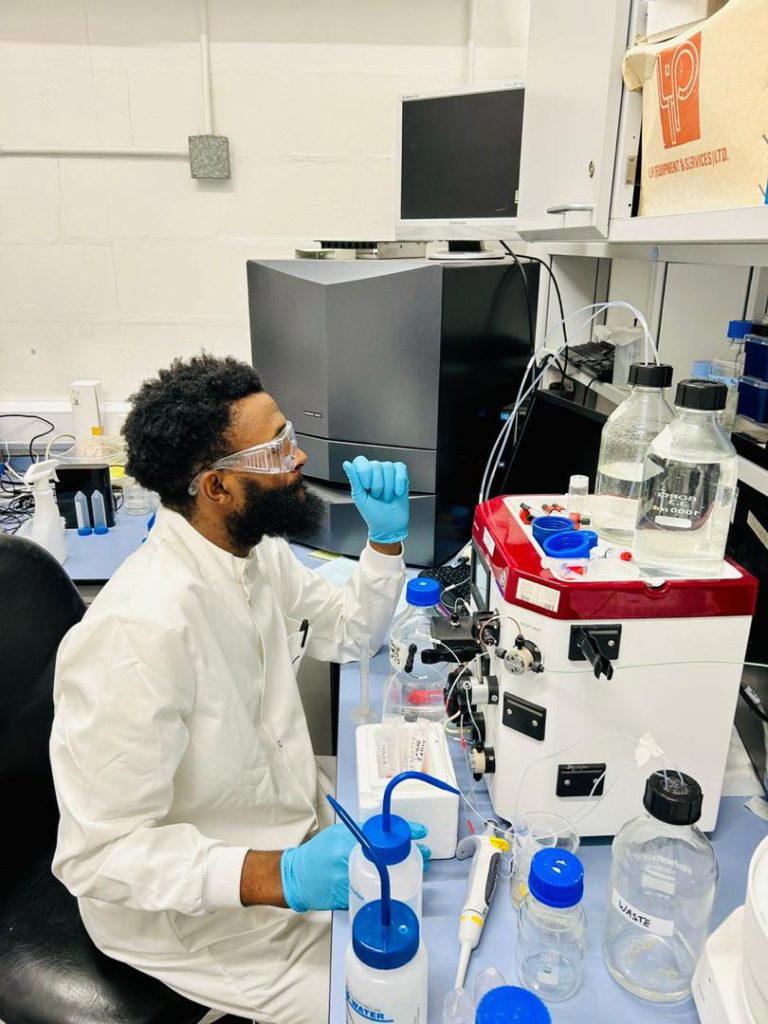
He returned to academia, joining the Viro-Bio Research Laboratory at the University of Calabar under the supervision of Professor Clement I. Mboto, where he received advanced training in virology, hepatitis research, and antimicrobial drug discovery. His work focused on the investigation of bioactive plant compounds as potential therapeutic agents, integrating experimental microbiology with computational drug design techniques, including molecular docking and Density Functional Theory (DFT) within the Computation and Biosimulation Research Group.
During this period, Innocent facilitated undergraduate research projects, supervised laboratory practicals, revised academic theses, and contributed to building early research capacity among students. His growing interdisciplinary expertise translated into peer-reviewed publications and presentations at national and international conferences, including poster presentations at the INEOS Oxford Institute for Antimicrobial Research, the American Chemical Society symposium on innovation in chemical sciences, and interdisciplinary workshops focused on drug discovery, antimicrobial resistance, and translational biomedical research.
His research trajectory gained further momentum in 2023 when he was awarded a fully funded Petroleum Technology Development Fund (PTDF) scholarship to pursue a Master’s degree in Biotechnology at the University of Portsmouth, United Kingdom. There, he graduated with a Distinction, ranking in the top 1% of his cohort.
At Portsmouth, Innocent’s research moved decisively toward biotechnology innovation and sustainability, focusing on protein nanocage self-assembly for drug delivery and nanobiotechnological applications. In parallel, he conducted research on DNA ligase as a potential antibiotic target and wastewater metagenomics, applying 16S rRNA sequencing and bioinformatics tools to characterise microbial communities relevant to environmental sustainability and circular bioeconomy transitions.
In his final semester, he enrolled in Biotechnology Enterprise, a course designed to bridge science and commercialisation. Working in multidisciplinary teams, he was elected Chief Executive Officer and co-founded RapidCRISPR Diagnostics. The team proposed SnapUTI, a CRISPR-based diagnostic kit for urinary tract infections, designed to deliver results in under ten minutes and remain affordable for low-resource regions such as Sub-Saharan Africa, South Asia, and Latin America.
Beyond the technical challenges, Innocent notes that the project revealed deeper social and operational realities. Understanding cultural contexts, healthcare access barriers, and user behaviour became as important as scientific design, reinforcing the need for empathy-driven innovation alongside technical excellence.
Under his leadership, the team developed a comprehensive business plan, projecting revenue growth from $547,500 in Year One to $2.6 million by Year Seven, with a funding requirement of $10 million covering product development, manufacturing, and market entry. The project sharpened his biotechnology project management and innovation strategy skills, employing a hybrid Agile–Waterfall framework, Kanban boards, SCRUM meetings, and team development models to deliver a coherent and scalable innovation proposal.
In 2024, Innocent and collaborators secured a National Open University of Nigeria Senate Research Grant for a project on drug repositioning strategies for urinary tract infections, further reinforcing his interest in cost-effective therapeutic innovation.
Today, Innocent Benjamin’s career focus reflects the convergence of science, innovation, and sustainability. He is particularly interested in roles that bridge research and development, biotechnology project management, innovation and business model design, and sustainability-oriented product or process development. With experience spanning wet-lab science, technology evaluation, and cross-functional collaboration, he is focused on contributing to forward-looking biotechnology and life-science organisations seeking to translate research into measurable impact across health, industry, and the environment.
Professionally, he holds memberships with the Royal Society of Chemistry, American Chemical Society, Nigerian Society of Microbiology, and the Society for Learning Technologies, reflecting an interdisciplinary identity aligned with modern biotechnology ecosystems. He is also the founder of BioMalGuard, a non-profit organisation he intends to deploy biotechnological solutions to infectious disease control and environmental challenges in Nigeria.
From Nguroje to global research and innovation platforms, Innocent’s story mirrors a broader shift in Nigerian science toward research that informs innovation, supports sustainable industry, and contributes meaningfully to national and global development.
Disclaimer
Comments expressed here do not reflect the opinions of Vanguard newspapers or any employee thereof.