
By Samuel Oyadongha & Emem Idio, Yenagoa
The Nigerian Content Development and Monitoring Board, NCDMB, has commended some Indigenous firms for actualizing and maximizing the Nigerian Oil and Gas Industry Content Development Act, NOGICD Act 2010.
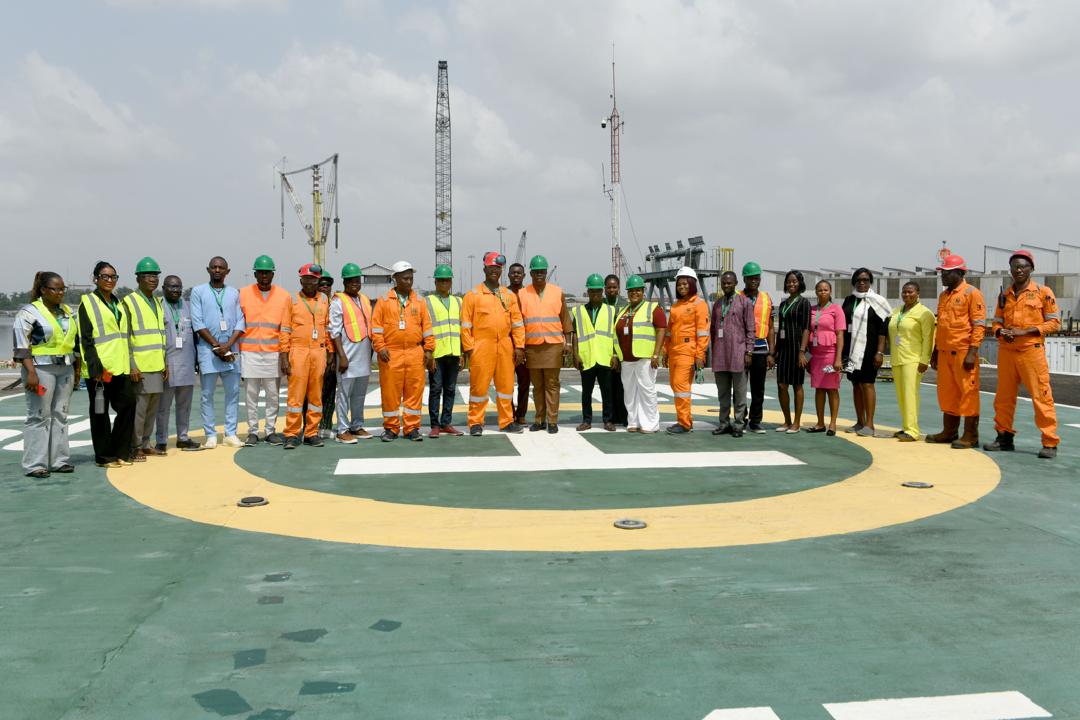
The General Manager Corporate Communications, NCDMB, Dr Obinna Ezeobi, made the commendation when he led media stakeholders on a tour to Bunorr Integrated Energy Limited, Marconi EPC Ltd, and PE Energy, all in Port Harcourt, Rivers State.
Speaking at the Congress Hall of Marconi EPC Ltd, Port Harcourt Dr Ezeobi, commended the firms for their success stories, saying that the media tour offers the opportunity to showcase indigenous companies that are doing well.
He said the media tour was aimed at exposing media practitioners to practical oil and gas activities, pursuant to the provisions of Section 67 and 70 of the NOGICD Act 2010, which harps on communication and engagement of stakeholders.
He said: ” This is one of the things we promised we will do to build the capacity of media stakeholders, to expose our media people to practical oil and gas activities. In the past eight years we have built some kind of capacity of our media stakeholders through workshops and trainings that we do every year.
“But we thought that we needed to go one step further, which is take you to the field and have you experience, in fact, how the process actually works, so that you can actually marry the theories of what you hear with the real things happening in the field, as they would say, put your boot on the ground, to enable you to actually become experts as you were in media reporter.
“And what better partner to work with than Marconi, which as we heard today is the biggest servicing company in Nigeria. Interestingly, the Content Act in section 67 and section 70 talked about communication, talked about engaging stakeholders, and the media is a major stakeholder, which is why in the past 15 years we have made a lot of effort to work with the media, build and sustain our relationship, and we have done very well in that.
“But we are going one step further in taking you to the field and taking you to Marconi, which as we heard today has 1 million square meters with activities spread out in the various value chain of the industry, as we heard today. So what do we take out from this? we want our media friends to understand practically how the industry works, we want to deepen our relationship with the media, and we want to showcase companies, showcase them when they are doing very well, and Marconi is an example, a case study.
“We talk about local content being about domesticate value. We say it is not trying to nationalize, it’s about having value being domesticated, and that they have done in becoming a whole Nigerian company.”
The Managing Director of Marconi NG EPC (Engineering , Procurement and Construction) Ltd, Gian Fabio Del Cioppo, said the company was incorporated in 2024 and in 2025 took over yard facility from Saipem, and was now in possession of one of the leading EPC contractors in the world, not only in Nigeria.
He said: “And keeping this facility alive for the future, for the benefit of Nigeria because this Yard is one of the few remaining Yards for fabrication in Nigeria and it is very important for the local content, for the future of the country, let’s say, keep works and keep jobs in Nigeria for employment, for possibility and for the future,
“This is the biggest Yard in Nigeria, it’s 1 million square meters, it’s 100 hectares of land and it’s an hub where you can execute a project for oil and gas, EPC, oil and gas in the same environment because we have office space, we have accommodation, we have a lay-down area, we have fabrication facility. We can do fabrication in excess of 20,000 tons in a year.”
At Bunorr Integrated Energy Limited, an indigenous firm, who is leading Nigeria’s drive in energy circularity by recycling Used Engine Oil (UEO) into base oil and other valuable by-products. Its work supports national goals in environmental sustainability, local content development, and import substitution.
The Managing Director, Ikechukwu Okeke, noted that the company’s recent achievements were made possible through NCDMB’s support, oversight, and strategic partnership—assistance he said boosted Bunorr’s credibility with vendors, financiers, and technical collaborators.
The MD called for a clear national legislation that will allow the official sale and regulated recovery of Used Engine Oil (UEO), describing it as a critical step toward reducing environmental pollution and strengthening Nigeria’s circular energy economy.
He stressed that billions of naira in potential value are lost every year due to indiscriminate disposal of used oil.
He said, “This material is too valuable to be wasted. A structured framework for its sale and recovery will protect the environment, support industry growth, and improve raw material supply.”
Okeke also highlighted unstable power supply as one of the major operational challenges facing the company, noting that unreliable electricity increases production costs and interrupts output.
He outlined the company’s progress over the past six months, including improved production efficiency, enhanced plant reliability, new technical committees, and its highest revenue recorded in November. Bunorr currently employs 37 Nigerians and plans to expand as production increases.
At PE Energy Limited, the Nigeria Content Coordinator of the company, Anie Udom, said the company has benefited from several NCDMB initiatives, even though direct funding is still in process.
He reiterated the need for stronger policy support and increased patronage to scale up in-country manufacturing capabilities in Nigeria’s oil and gas industry.
He said that despite its significant investment in local capacity, Nigerian operators still procure many components abroad, slowing the growth of indigenous manufacturing.
Udom explained that PE Energy has enrolled in multiple NCDMB-enabled funding programmes, including Project 100 and other recently announced schemes, with positive feedback from the Board. According to him, the Board has consistently issued approvals, response letters and investment-support guidance as the company expands its manufacturing capacity.
He stressed, however, that what the company requires now is acceleration.“The only thing we want NCDMB to do more for us are the things that should be scaled up — and one of those things is in-country manufacturing activities, which we know we have the capability to do,” he said.
Udom added that the NCDMB has shown commitment through policy support, training opportunities and representation during facility visits within and outside Nigeria, helping demonstrate that Nigerian engineers are fully capable of delivering world-class manufacturing.
Vice President of PE Energy, Chukwuemeka Igilar, also highlighted the Board’s ongoing development of oil and gas parks intended to deepen local manufacturing.
He said the parks will create collaboration and joint-venture opportunities among Nigerian companies with manufacturing capabilities.
“As soon as that project is completed, there will be synergy. We won’t need to get most of these items outside the country. We have the capability in-country,” he said.
Earlier, Igilar described PE Energy as a 100 per cent local content-driven organisation with competencies across flow drive, flow control, flow measurement and supply chain services.
He said the company has invested heavily in its workshops to assemble and manufacture valves, measurement systems and related process equipment for the industry.
However, he warned that investment alone cannot sustain the facility without business.
“One of the challenges we see is business. Patronage is what I mean by business — patronage from operators,” he said, noting that despite participating in conferences and industry events, many operators still award jobs to companies without similar infrastructure.
He also identified funding as a major challenge, stating that access to bank loans remains difficult for local companies.
“We are grateful that NCDMB is bringing up various schemes to help Nigerian companies, but funding and patronage remain key,” he added.
Disclaimer
Comments expressed here do not reflect the opinions of Vanguard newspapers or any employee thereof.