
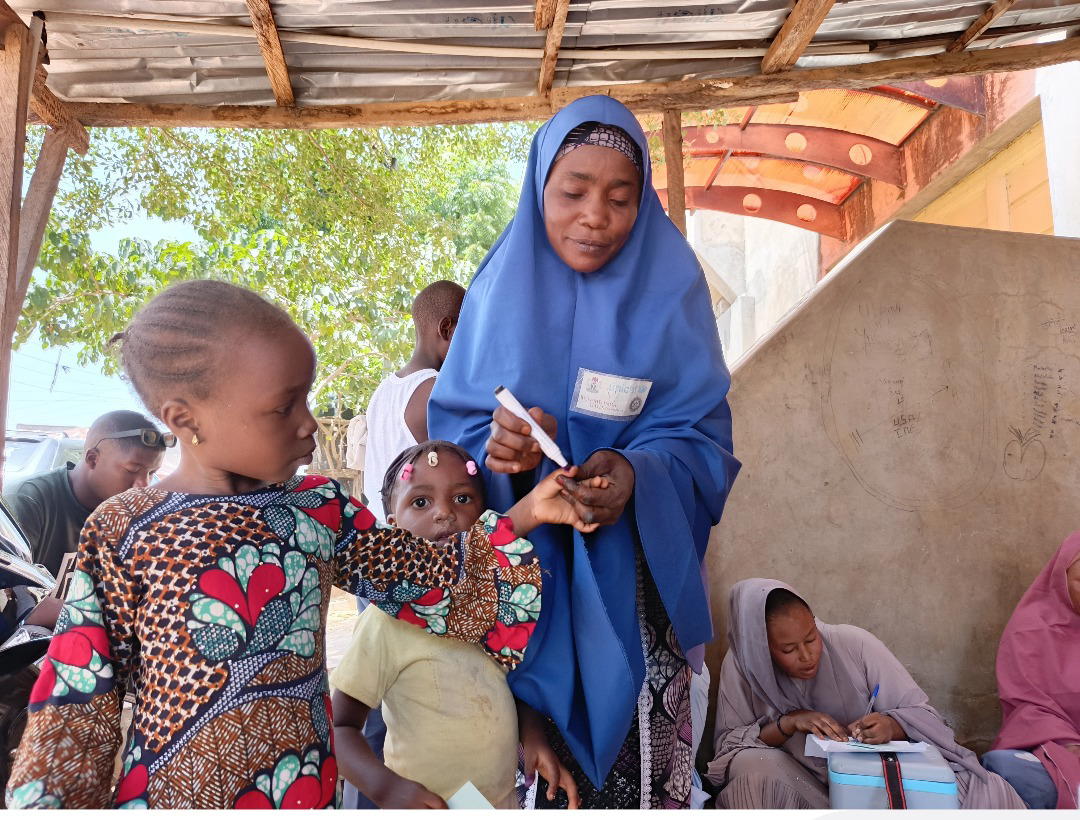
In October 2025, Nigeria set an ambitious goal of vaccinating 106 million children in a bold national integrated vaccination campaign dubbed as Africa’s largest integrated health campaign. In this report, Seun Akioye chronicles how the exercise took place in Kano, Kaduna and Borno states and the role of development partners.
In October 2025, Nigeria’s First Lady, Senator Oluremi Tinubu launched Africa’s largest integrated health campaign in a measured tone. It would be an ambitious target, by all standards, to vaccinate 106 million children with two million of these children taking any sort of vaccination for the first time, they are categorized as zero-dose.
The National Integrated Campaign was Nigeria’s answer to its vaccination uptake challenges including children in hard-to-reach and conflict-prone areas. The campaign would include the administration of measles-rubella (MR) human papillomavirus (HPV), polio and other routine immunisations (RI) to children aged 9 months to 14 years.
“Measles can cause blindness, permanent disability, and in too many cases, death,” the First Lady said to a gathering that included traditional and religious leaders, scientists, development workers and partners and ordinary Nigerians many of whom agreed with her.
“Its twin disease, rubella, though often silent, is equally harmful, especially to unborn children of infected pregnant women who may be born with blindness, deafness, or serious heart defects. The consequences are profound, families are devastated, communities are weakened and the nation suffers,” Senator Tinubu said.
Routine Immunisation coverage in Nigeria was considered generally low. In 2021, the national average for fully immunised children was 36%, while the Penta 3 Coverage averaged 57%, falling short of all targeted outcomes. But in four years, Nigeria has managed to double its numbers with a high -60% range which however still falls short of the national target of 80 % coverage of all routine antigens by 2028.
In 2025, the national integrated campaign aims to cover the gap. According to Senator Tinubu, it is time to end the devastation caused by measles-rubella. “These diseases steal the future of our sons and daughters. This flag-off signals a collective national resolve to end the devastation caused by measles and rubella,” she said.
Yusuff Yusufari, Deputy Director, Immunisation and Disease Control at the Gates Foundation Nigeria knows the challenges. His organization has partnered with the Nigerian government to improve health systems, eradicate diseases that causes preventable deaths of mothers and children and was key partners to Nigeria’s government in the fight to eradicate polio and Yusufari, has been part of it all.
“The challenges are real,” he told the gathering. “More than two million Nigerian children remain “zero-dose”, the second highest number in the world. These children are completely unprotected. And too many continue to be missed, fueling outbreaks of measles and the spread of the circulating variant polio virus type 2. This is the urgent gap we must close,” Yusufari said.
Many of the zero-dose children remain in hard-to-reach communities, while some were in conflict prone areas. But Muhammad Pate, Nigeria’s Coordinating Minister of Health and Social Welfare, said the country is determined not to leave any child behind.
“This is not just a vaccination drive but “a reimagination of how health services reach every Nigerian,” he said. “It is about reimagining how we deliver health services to our people, getting as close to them as we can, and ensuring that no one is left behind.”
Religious leaders like Daniel Okoh, the president of Christian Association of Nigeria (CAN) said the organisation is fully in support of the vaccination drive and has “mobilised the five major blocks of CAN in readiness for the mass roll-out.”
FG and Gates: Partnership for National Development
Since the Gates Foundation opened its offices in Nigeria in 2012 in Abuja, the federal capital, it has been leading in the delivery of high-impact, evidence-based interventions that save lives and provide economic opportunities for Nigerians. As a major development partner to the government, it has helped to address various health and developmental challenges, including support for the eradication of polio, increased agricultural production, family planning, nutrition and strengthening the primary health care and public health systems.
The Foundation’s imprints are strong in immunisation and disease control. Through technical partnerships and funding, it supports the implementation of large-scale campaigns to reach unvaccinated children, provides technical support to strengthen Routine Immunization (RI) systems with organizations and state governments, signing multi-year partnerships with six northern governors of Borno, Bauchi, Kaduna, Kano, Gombe and Sokoto States.
“Nigeria’s immunization journey is a true story of resilience,” Yusufari said. With the support of the Foundation, Nigeria has made gains in its efforts to eradicate polio and increase the uptake of vaccination. “Routine Immunisation has risen from just 33 per cent in 2016 to more than 60 per cent in 2025, protecting millions more children. New vaccines have also been added to include pneumococcal, rotavirus, HPV and now the measles-rubella vaccine, a landmark step to prevent two deadly diseases at once,” Yusufari stated.
An Ambitious National Campaign
Nigeria’s goal to vaccinate 106 million children in 2025 may seem like a tall order, but volunteers, community health extension workers, and supervisors at the local level have taken the “national order” seriously. One of them is Abbah Ahmad, the Primary Health Care Centre Coordinator in Nasarawa local government area of Kano State.
Vaccinating nearly half a million children in hard-to-reach areas and many zero-dose is no easy task in Nasarawa, a densely populated community with many difficult terrains. It was also the melting point for people with many ethnic nationalities who have called Kano home, making their livelihood there. In Kano, Nasarawa is not called mini-Nigeria for nothing.
But in 10 days, Ahmad has achieved what many would later call a miracle. With a set of 195 teams, each team comprising 11 personnel spread across the local government, he achieved 90 percent immunization coverage.
“We achieved a lot,” Abbas boasted in a soothing but fulfilling voice while he addressed his core team. “We have done measles-rubella in 10 days, now we are doing mop-up. We have immunized 426,813 children, which is 90 percent coverage,” he echoed.
One of those who made this possible is Aliyu Musa, the Local Immunisation Officer for the local council, a position he has held for three years. He is responsible for the coordination of the immunization team and curating data to track defaulters.
“We are tracking every immunization and community to ensure no one is left behind. What we are doing now is mop up by our team of sweepers who will go house-to-house and bring out children yet to receive the vaccines. And our strategy is having different units including health educators, the advocacy team, the sweepers, the vaccinating team, etc.,” Musa said.
Kano’s success lies in the advance and comprehensive use of data. “We were making up the data as we go,” Musa shared very proudly, showing on his laptop several rows of spreadsheets with numbers and communities. “Once we conclude on an area, the immunization team transmits the data to us, and we input it into our spreadsheet. That shows us where the gap is, and we deploy our sweepers to those areas to ensure compliance,” he said.
Borno: Rising from the Ashes of Insecurity; Mothers Embrace Vaccination
Elsewhere in the northeast state of Borno, Andrew Stein, Deputy Director in charge of Polio at the Gates Foundation and Shina Aladeshawe, Senior Officer, Polio were visiting communities, meeting mothers who had brought their children for vaccination and spreading hope.
Borno state has long been at war with terrorism, trapping millions of children behind terrorist lines without access to vaccinators. For many years, vaccine uptake has been upset, leaving millions of children totally unprotected.
Stein recognized the challenges and declared that it would be the largest immunization campaign yet: “This is the biggest campaign in Africa, and we are targeting over 100 million children. Borno has one of the highest burdens of measles, so many cases of variant polio threatening children, and so this campaign is about saving the lives of children in the state.”
But Borno is moving slowly towards progress. Aladeshawe praised the government for adopting the integrated approach, which he said is “efficient and cost-effective.” He said, “We are seeing mothers moving from long distances to different centres just to be vaccinated. It is encouraging to see the government of Borno owning and managing this campaign.”
Shettima Maina Mohammed, Permanent Secretary, Ministry of Health, agreed with him. The state, he said, is leaving no stone unturned to reach every child and has adopted some innovative approaches to ensure that. Schools have been temporarily shut down to allow for full participation, and the military has been brought in as partners. “Some of the military personnel fighting terrorism have been trained to administer the vaccine, so we have a lot of improvement in that regard,” he revealed.
But Baba Mustapha, the focal person for Maisandari PHC was very excited. “This is impressive,” he declared. “We have never had such a large turnout in terms of mobilisation, logistics and support supervision from outside the state. This enthusiasm was shared by Zanna Bolorima Masu, the village head of Bolori community.
“We have been sensitized, and you can see the large number of children who have already been vaccinated,” he noted. The National Integrated Campaign in Borno was like no other as it was an investment in hope, survival and the future of the children of the state, and hundreds of volunteers travelled through rough territories and difficult communities to ensure that the state achieved its target of not leaving any of its two million targeted children behind.
Kaduna: A Stitch in Time Saved “More Than Nine.”
The discovery of three isolated cases of vaccine-derived polio in Giwa local government area in Kaduna State sent the state health officials into overdrive to contain it. “We have declared a state of emergency on immunization,” Professor Bello Jamon, the Executive Secretary of Kaduna State Primary Health Care Board, told journalists.
In Kaduna, the Gates Foundation is working with all the stakeholders to conduct aggressive sensitization and increase uptake of vaccines. But there are challenges, isolated cases of polio variant and the large population of nomadic citizens made tracking zero-dose children difficult, if not impossible.
But the state has found a way out, according to Jamon: “We have achieved improved coverage to our nomadic population through, Reaching Every Settlement programme (RES) and the Integrated Mobile Outreach (IMO) strategy. We have also improved community-based surveillance in high-risk areas,” Jamon said.
The state commissioner for health, Hajiya Umma Ahmed, was emphatic when she decreed the war on polio and other childhood diseases. “No child should be disabled through polio,” she cried. “Vaccination is safe, free and cost-effective, and it remains our most effective tool against diseases,” she said.
For Nigeria’s national integrated campaign, the mission is simple: ending deaths and disability from polio, measles and other diseases, ensuring infectious diseases are eliminated through the strengthening of health systems and lifting people who are now free from diseases out of poverty through economic empowerment.
At the end, what has been tagged “mother of all campaigns” achieved substantially its main goal with 92 % national coverage rate of its target. Breaking it down, measles-rubella immunization reached 92 % while 39 million children under five years old got the polio (n0PV2) vaccination. For zero-dose children, 378,677 children were reached and 677,789 adolescent girls were given the HPV vaccine. In high-burden areas, 949,401 children got the malaria vaccine.
Muyi Aina, the Executive Director, National Primary Health Care Development Agency (NPHCDA) believes Nigeria will do even better in the next phase. He said Phase 1 included 19 northern states, the FCT and Oyo state in the southwest while Phase 2 is scheduled for January and February 2026 and would cover the rest of the country.
Officials say the national integrated campaign is not just about vaccination, but also about building the country’s comatose health systems and community resilience. “This integrated campaign is about more than vaccines, it’s about protecting futures, building resilient communities, and ensuring that every child in Nigeria has a fair chance to live and thrive,” Aina stated.
Disclaimer
Comments expressed here do not reflect the opinions of Vanguard newspapers or any employee thereof.