
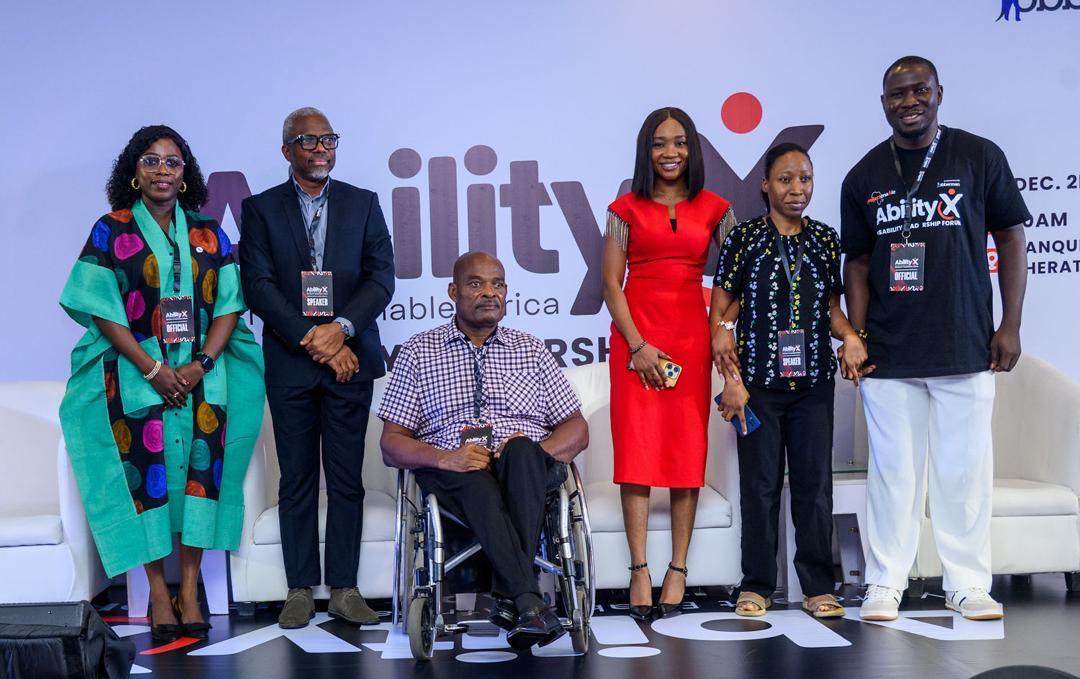
L-R: Senior Strategy Consultant, Jobberman; Oladoyin Kolawole, Acting Country Director, BudgIT; Joseph Idaosha Aminahon, Founder and Chief Executive Officer, Cosmas Okoli, Mobility Aid and Appliances Research and Development Centre (MAARDEC); Glory Aiyegbeni, MERL Lead, Jobberman; Tobiloba Ajayi, Disability Management Advocate; Olalekan Owonikoko, Executive Director, Project Enable Africa, during the 2025 AbilityX, organised in collaboration between Mastercard Foundation and Jobberman Nigeria recently.
By Chioma Obinna
To reshape Nigeria’s disability landscape, Lagos played host to AbilityX by Project Enable Africa 2025, a first-of-its-kind, innovation-focused disability leadership forum convened through a strategic partnership between Mastercard Foundation and Jobberman Nigeria.
The event brought together policymakers, private sector executives, innovators, donor agencies, civil society leaders, and persons with disabilities to map out a new future for inclusive development in the digital era.
Formerly the Disability Inclusion and Leadership (DIAL) Forum, AbilityX marks a transformative leap, shifting national disability conversations from advocacy to actionable innovation.
In the views of the Executive Director at Project Enable Africa, Mr. Olalekan Owonikoko, AbilityX is a breakthrough in results-driven convening.
“One of the core promises of AbilityX was to shift from traditional advocacy conversations toward innovation-driven and technology-enabled empowerment,” Owonikoko said.
“Coming out of this conference, we are proud to say the platform delivered on that commitment in very concrete ways.”
He explained that all breakout sessions were engineered to identify clear sector-specific barriers and produce implementable solutions:
“Rather than generic discussions, each group identified the specific challenges persons with disabilities face — in employment, policy, health, digital access, mental health, innovation financing — and generated actionable strategies to address them.”
Owonikoko also announced the development of a High-Level AbilityX Action Plan summarizing outcomes, responsibilities, and timelines:
“This ensures the ideas generated here don’t remain conceptual — they become trackable commitments.”
He said to sustain momentum, Jobberman and partners will coordinate a structured six-month engagement cycle:
“We will follow up with every partner, measure progress, and help unblock challenges. Our goal is for the energy and creativity from Lagos to translate into real investments, new opportunities, and measurable improvements for the disability community.”
He explained that the event is part of the Mastercard Foundation and Jobberman Young Africa Works strategy, designed to support millions of young Nigerians in transitioning into dignified and fulfilling work.
Also Speaking, the Jobberman Nigeria’s Country Head of Programmes, reflecting on lessons from their national employability initiative, explained why disability inclusion became a priority:
“In the first phase of our programme, we focused on women and rural youth. But we learned that while those groups face significant barriers, persons with disabilities encounter deeply entrenched discrimination that is often overlooked.”
This insight led Jobberman to commission research earlier in the year and seek expert partnerships, culminating in AbilityX.
“We wanted to galvanise the ecosystem — government, private sector, civil society, and persons with disabilities — to drive more equitable and inclusive workspaces.”
He challenged employers to recognize that inclusion is not merely goodwill: “Private sector leaders must understand that communities are not homogeneous. It makes business sense to be inclusive. And morally, we’re all one incident away from becoming a person with a disability.”
He stressed the need for incentive-driven public policy: “Penalties have their place, but rewards change mindsets faster. A tax rebate for disability-inclusive companies would go a long way. Thinking from an incentive perspective, not just compliance, can transform the landscape.”
For some of the persons with disabilities, inclusion means they can get access without stress.
For Ms. Olowu Oluwakemi, an amputee and disability advocate, the physical accessibility of the Lagos venue sent a strong signal.
“Inclusion means I do not have to go through the stress of climbing stairs. Today, I walked in easily. The space was accessible, and that made me feel welcome.”
She emphasised the economic argument for inclusion: “Persons with disabilities make up about 15% of the population — that’s a massive market. Organizations should be intentional. Everything about this event showed intentionality.”
But she highlighted key barriers still facing persons with disabilities: “People assume persons with disabilities are sick and need healing. That attitudinal barrier is huge. Policies and accessibility standards still need improvement.”
For Jessica Hyacinth, a content creator and a person with albinism, the Lagos forum was both insightful and inspiring.
“Hearing people with lived experiences discuss real-life solutions gives me hope.”
She recalled her experience working in a bank with visual impairment: “When I got the job, I had to adjust everything myself because I wasn’t considered from the start. True inclusion means systems are modified to support you — like better screens or bigger devices — rather than expecting you to struggle.”
Her biggest concern remains misinformation: “Stigmatization comes from poor information. If people know better, they do better. Policymakers should engage persons with disabilities before shaping policies — not expect us to adapt afterward.” She stressed that there is no one-size-fits-all approach to disability inclusion, as tailored accessibility remains critical.
For majority of the stakeholders who spoke during the panel sessions, AbilityX 2025 has set a new benchmark for disability inclusion forums in the country, combining research, innovation, policy dialogue, and lived experiences in one ecosystem.
With its Action Plan, multi-sector partnerships, and six-month implementation tracking mechanism, they say AbilityX could become the most influential driver of disability inclusion in Nigeria’s digital future.
They said the AbilityX has achieved something long overdue: It has shifted the national conversation from awareness to action and from possibility to implementation.
Disclaimer
Comments expressed here do not reflect the opinions of Vanguard newspapers or any employee thereof.