
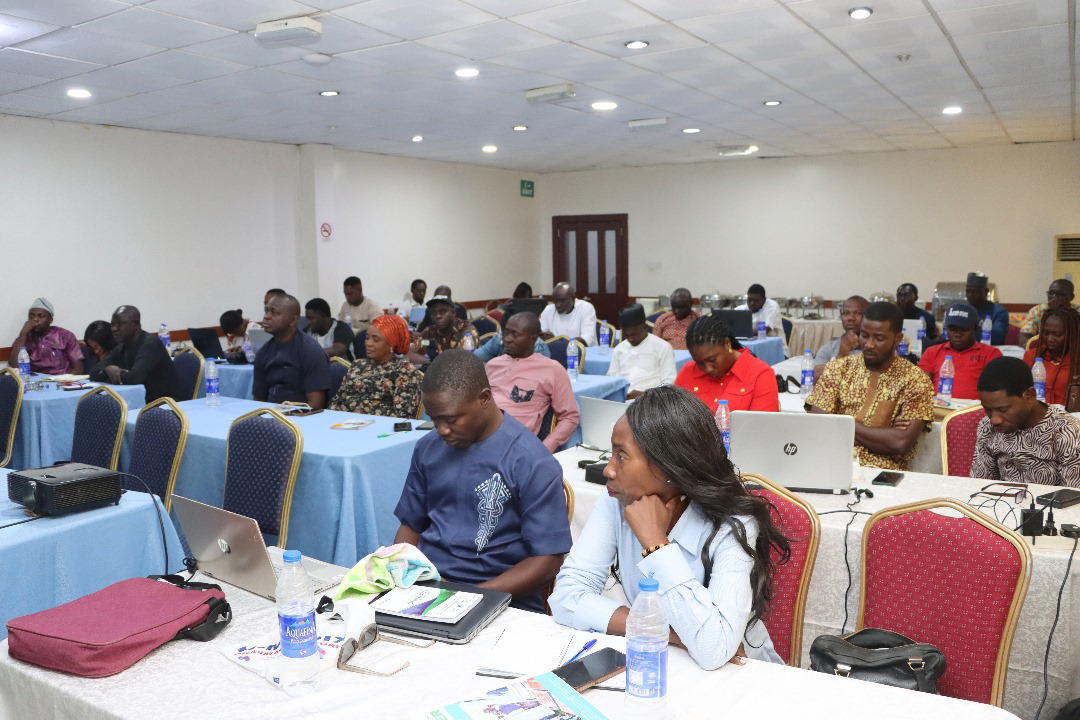
Participants at the meeting
By Peter Duru, Makurdi
The Federal Government of Nigeria (FGN), in partnership with the International Fund for Agricultural Development (IFAD), has created no fewer than 11,890 permanent jobs through the Value Chain Development Programme (VCDP), strengthening agribusiness development and improving rural livelihoods in thecountry.
The VCDP, Nigeria’s flagship agricultural intervention, is currently being implemented in nine states of Anambra, Benue, Ebonyi, Niger, Ogun, Taraba, Kogi, Nasarawa and Enugu, with a strong focus on empowering women, youth and smallholder farmers along the rice and cassava value chains.
Speaking at a media roundtable, the National Programme Coordinator of IFAD/VCDP, Dr. Fatigue Aliyu, said the jobs created cut across different age groups and genders, with 3,128 women, 2,710 men and 6,052 youths now owning and managing various agribusiness enterprises.
“The intervention has helped to reduce rural-urban migration, particularly among young people, while also empowering vulnerable women through sustainable income-generating activities,” Dr. Aliyu stated.
She explained that the programme had improved the livelihoods of smallholder farmers by increasing productivity, expanding market access and investing in critical rural infrastructure in participating states.
According to her, over 5,248 youths had been gainfully engaged in agribusiness ventures, including seed production, mechanised equipment leasing, extension services, agro-input distribution and marketing of processed farm produce.
“VCDP has fuelled unique income-generating opportunities for women and youth, enabling them to actively participate across the agricultural value chain,” she said.
Dr. Aliyu further disclosed that 1,987 women had been trained in producing value-added food products from pro-vitamin A cassava and brown rice, aimed at improving household nutrition and boosting income.
To enhance rice self-sufficiency, she said the programme invested heavily in land development in collaboration with host communities, expanding access for landless women and youth.
“With over 2,250 hectares of land developed, VCDP has increased access to productive farmland for women and young people, and this success has encouraged strong state government buy-in and ownership of the programme,” she added.
Beyond job creation, Dr. Aliyu noted that the programme had significantly reduced post-harvest losses and improved product quality through investments in infrastructure, including the development of over 6,900 hectares for dry-season irrigation, surpassing initial targets.
She added that the construction and rehabilitation of rural feeder roads, markets, processing centres and storage facilities helped farmers move their produce more efficiently. Processors, particularly women, also benefited from modern equipment such as energy-efficient “false-bottom” rice parboilers, which improve quality and lower energy costs.
On capacity building, Dr. Aliyu said VCDP focused on strengthening farmer organisations and equipping beneficiaries with modern agricultural and business management skills.
“Thousands of farmer organisations have been registered and strengthened, improving their bargaining power, access to inputs and linkages to markets,” she said.
She added that women and youth had also received specialised training in value-added enterprises, including briquette production from agricultural waste, as well as access to digital tools for market information and agribusiness services.
Addressing climate challenges, Dr. Aliyu explained that the programme had mainstreamed climate-smart agricultural practices such as flood and drought-tolerant crop varieties, improved drainage systems and sustainable soil management techniques to enhance resilience.
She also highlighted the Commodity Alliance Forum (CAF) as a key innovation that links smallholder rice and cassava farmers with reliable buyers, financial services and quality inputs. “Through CAF, we are building inclusive and sustainable value chains that enhance productivity, improve incomes and strengthen national food security,” she said.
Earlier, the IFAD/VCDP Knowledge Management and Communication Advisor, Mrs. Vera Onyeaka-Onyilo, commended the media for its partnership with the programme, explaining that the roundtable was organised to promote idea-sharing, ensure visibility and guide accurate reportage of VCDP activities.
Disclaimer
Comments expressed here do not reflect the opinions of Vanguard newspapers or any employee thereof.