
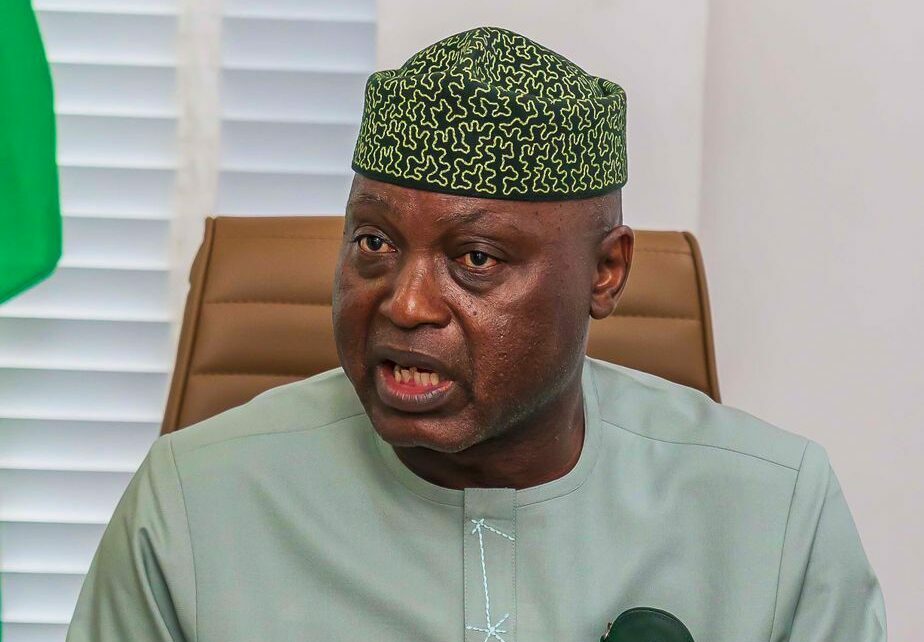
Gov Biodun Oyebanji of Ekiti State
Just three years into his tenure, Governor Biodun Oyebanji’s leadership in Ekiti State has been a breath of fresh air. At the helm in Okebareke, Ado-Ekiti, he’s been dishing out purposeful governance with a populist twist that’s got the people nodding in approval. The doubters have been proven wrong, and public confidence is soaring. ROTIMI OJOMOYELA takes a closer look at the Oyebanji administration’s report card after three years in office.
In October 2022, when Biodun Oyebanji took the oath of office as the seventh democratically elected governor of Ekiti State, otherwise known as “Fountain of Knowledge”, he promised continuity with consolidation.
The governor, in his inaugural speech before mammoth crowd at the sprawling Ekiti Parapo Pavillion, Ado-Ekiti, the state capital pledged deepening the arteries of governance, finishing inherited projects, building a future anchored on shared prosperity and delivering the superlative dividends of democracy to the people irrespective of social status, religion and political leanings.
Three years down the line, Ekiti people are feeling the positive impacts of good governance under Oyebanji. His imprints are perceptible in all the nooks and crannies of Ekiti State
The governor, fondly called ‘BAO’ by his admirers, is really walking the talk on the promises he made to the people during the electioneering period. Since he took over the baton of power, he has been consistent in implementing life changing programmes and strategic policies. So, the citizens are ecstatic that they made the right choice at the ballot.
Oyebanji, through his actions and deeds, has been providing the leadership and courage required to reposition the state on the surest path of greatness through strategic interventions and meaningful executions of progressive action plans.
He came forth with a deep knowledge of Ekiti having served in different positions under former governors Adeniyi Adebayo and Kayode Fayemi. So, he understand the nuances of governance like the wavy lines on his palm.
Oyebanji has been consistently matching policy with developmental actions and working tirelessly with the intention to transform into reality his administration’s shared prosperity agenda of making Ekiti epicentre of development and model for good governance.
When he took over mantle of leadership, the governor immediately reeled off his area of concentrations, promising in his maiden address, to implement a 6-pillars developmental agenda to fast track rapid social and economic development of the state.
His administration’s action plan was one of the best in the country. It contains well -specified vision and mission statements subdivided under various headlines that cover practically every aspect of lives of the citizenry. The agenda cover aspects of governance, youth development and job creation,human capital development, infrastructures and industrialisation, Art, Culture and Tourism, and agriculture and rural development.
Expectedly, Oyebanji has been pursuing his agenda religiously to the admiration of the people. He did not leave any of his agenda on promissory note but walking the talk as utmost priority were accorded to all spheres of governance. To this end, public institutions have been animated to measure up to the expectations of the citizenry.
Under Oyebanji’s watch, Ekiti is wearing a new look. From standard asphalt roads, viable agricultural initiatives, youths and women empowerment, sustainable and accessible healthcare development to improved security and education sector, the general consensus is that Ekiti State is in a safe hand.
Other sectors of the economy have in one way or the other witnessed holistic overhaul to improve the living standard of the citizens. Ekiti state has become beehive of economic activities and the hitherto youth restiveness has also become thing of the past as youths and women have been engaged in self-reliance adventures.
The sentiment that resonates across towns, rural communities, markets and, public offices is that the administration of Governor Oyebanji has been unusually consistent, especially in the fulfillment of its basic responsibilities.
The administration has impacted hugely in the area of road infrastructure. Major roads and township roads across the 16 local government areas of the state have either been reconstructed, rehabilitated or newly constructed.
Inner-city roads in Ado-Ekiti have been given a facelift. They included the Jimoh Aliu–Adewumi Road, GRA Road, Hospital Management Board / Doctors’ Quarters Road, and Obisesan–Oke la Link Road, Omisanjana-Ajebandele Road, Agric-Olope Road, Ado-Ekiti Ring Road Phase 1 that transverse six major towns among others.
Outside the state capital, rural and semi-urban communities are also feeling the midas touch. Roads such as Ilawe–Ikere Road, Ado–Ilawe, Ikole township roads, Igede–Aramoko, Ayegunle–Ijurin–Iloro, Ado–Iworoko–Ifaki, Ikere-Igbara-Odo, Ogotun-Ikogosi Road, Isinbode-Ara-Ikole Road, Itawure-Okemesi Road, Omu-Ijelu-Itapa Road, and Spotless Hotel Road, among others have been reconstructed, thereby enabling smoother connectivity between towns, villages and farmlands.
Beyond the road infrastructure, health sector has also been received renewed utmost attention. For years, many Ekiti communities lived with broken public health centres, long travel distances for treatment, and crippling medical costs.
Through the revitalised Ulerawa Health Insurance Scheme, access to healthcare has expanded dramatically. Over 4,000 babies have been safely delivered and free of charge this year alone, while more than 400,000 residents have accessed free health services in public facilities.
The initiative has now been expanded to cover all 3.6 million residents, including pensioners, with more than 9,000 retirees already enrolled, a move that underscores the Governor Oyebanji-led government’s commitment to protecting its elderly population.
Clinics once known mostly for skeletal operations now record higher turnout for antenatal care, child immunization, safe deliveries and management of malaria and other common illnesses. Between January and September 2025, 778,000 free healthcare services were rendered, including 10,935 safe deliveries, 104,278 antenatal services, 200,369 child immunisations, 359,501 malaria treatments, and 40,784 family planning sessions.
To complement the universal healthcare coverage drive, the state government has revitalised 103 primary health centres across the state. Nine general hospitals have also been renovated and fitted with modern diagnostic equipment, while the flagship Ekiti State University Teaching Hospital (EKSUTH) has undergone major infrastructural uplift.
The government is also constructing an 80-bed multi-purpose modern building at EKSUTH that will house an ultra-modern pharmacy, conference centre, library, offices, and VIP suites. The facility, when completed will not only expand capacity but also enhance the quality of service and training opportunities for the healthcare professionals.
Recognising that infrastructures alone cannot heal without a motivated workforce, Governor Oyebanji has prioritised the welfare of healthcare professionals. Salaries and hazard allowances have been reviewed upward to the healthcare workers’ admiration, while new benefits have been introduced to improve morale and stem the tide of migration among health professionals, a challenge that has plagued many states.
To bridge manpower gaps, Governor Oyebanji’s administration recruited 100 health workers for primary healthcare centres and another 150 for secondary facilities, bringing renewed energy to service delivery. While EKSUTH has also received increased subvention, payment of the Medical Residency Training Fund has further encouraged continuous professional development.
In agriculture sector, the heartbeat of Ekiti’s rural economy, the Oyebanji-led administration has taken a methodical approach to boosting food productivity and food security.To advance this vision, the state strengthened investments in crop production, livestock development and rural infrastructure.
Notable interventions include an MoU with Cavista Holdings to boost cassava production, allocation of over 1,500 hectares of land to farmers, counterpart funding for the World Bank–supported L-PRES livestock project, and extensive farmer registration under the FG’s agro-pocket scheme. Thousands of farmers also benefited from free distribution of hybrid seedling,agrochemical, fertilizers, and mechanization services subsidized at 50%.
Through FADAMA Ekiti CARES, farmers received production assets, day-old chicks, livestock feed, maize, fish seeds, goats and pigs, alongside rehabilitation of 62km of farm roads and upgrades to seven wet markets. To reduce farmers–herder clash, grievance redress platform was established across all the 16 local government.
In addition,32 farm clusters were created for communities and cooperatives with government fully funding land clearing and support services to activate these clusters. The government have scaled up youth engagement in agriculture with thousands of young people through the Bring Back Our Youths to Agriculture (BBYA) project, the broiler production scheme, horticulture programmes and fishery initiatives.
To support this, the government revived several farm settlements by building modern dormitories in Iyemero, Ikere, Eporo and Aramoko. Irrigation systems are also being installed in key locations to ensure year-round farming, while over 5,000 hectares have been cleared for youth and cooperative farming. Security support was also strengthened through the deployment of Agro Marshals and Amotekun operatives to farmsteads.
To ease the movement of agricultural goods, significant road projects have been executed. Through RAAMP and FADAMA CARES, more than 160km of rural roads and over 100 culverts were constructed or rehabilitated. Major roads—such as Enu Odi–Itaeku–Igirigiri, Omisanjana–Oke Aso, Ikogosi–Aba Osun, Oye–Are, Ise–Imola, Ilupeju–Ayede, Iye–Ikun and others—are at different stages of completion. These roads are improving access to farm clusters, reducing transport costs and enhancing market linkages for rural communities.
These deliberate investments are already yielding results. Ekiti recorded the lowest food inflation rate in Nigeria as of August 2025, reflecting government impact in expanding production and improving access to food. To further make food affordable, the state established the Ilu Eye Aggregation and Trading Company and the Ounje Ekiti retail outlets, which are already selling staples like garri, beans and rice produced within the state.
Oyebanji’s administration achievements in the education sector are remarkable. Education, regarded as Ekiti’s strongest identity, has benefited significantly. Over 1,000 classrooms across the state have been fully renovated, and 30 new ones constructed to relieve the pressure on overcrowded schools.
To strengthen teaching capacity and improve access, about 1,800 teaching and non-teaching staff were recruited, ensuring even hard-to-reach schools are adequately served. New model schools have been completed in Ikere, while work continues on the Ayedun Model College.
In addition, the state had paid over N3.5 billion as UBEC counterpart funding for 2024, enabling large-scale renovation of classrooms, construction of fences and toilets, and the provision of furniture and instructional materials across primary schools. Special schools in Ido, Ikere and Ikoro have undergone rehabilitation with improved facilities, school buses, and specialized teachers.
A major milestone is the establishment of the Ekiti State Therapy Centre in Ado-Ekiti donated by Premium Trust Bank which provides essential therapies for children with disabilities. The state also opened its first inclusive school, donated by Mr. Akin Oyebode, to promote integrated learning for children with special needs.
The administration through the AGILE and IDEAS projects have significantly upgraded infrastructure in many public schools, including extensive classroom rehabilitation, school fencing, and the provision of computers, ICT tools, and solar inverters. To ease the financial burden on families, the state paid WAEC fees for 17,859 students, NABTEB fees for 800 technical students, and funded the Basic Education Certificate and Unified Promotion Exams.
Bursaries and scholarships have been consistently provided to support Ekiti students in tertiary institutions. In the past year, N57 million was given to 380 Law School students, N120 million to 1,502 undergraduates of Ekiti origin.
Tertiary institutions has also benefited from major reforms and infrastructure upgrades. A bill is before the House to elevate the College of Health Science and Technology, Ijero, into a polytechnic, alongside new electrification works on campus. At Ekiti State Polytechnic, Isan-Ekiti, the e-library, perimeter fencing, and gatehouse have been completed. A total of N6.2 bn was released as subventions to state-owned tertiary institutions.
Beyond the physical structures, the state government has invested in equipping students with technology-driven learning tools and exposing teachers to modern technologal-driven teaching methods. The government through 2024 STEAM Bootcamp trained over 250 students in robotics and coding.
Through the Ekiti Digital Academy, 2,000 students were equipped with advanced technology skills including cybersecurity, AI, software development, data analytics and blockchain,in partnership with global global technology companies such as Microsoft and Google.
The state also launched a Robotics Education Programme for 400 students and continues to strengthen the Ekiti Innovation Hub, supporting start-ups working on technology-driven solutions. These initiatives collectively aim to build a knowledge-based, innovation-driven economy for the state.
Disclaimer
Comments expressed here do not reflect the opinions of Vanguard newspapers or any employee thereof.