
-Understanding the powers of a Nigerian Minister
“He who stands by the law must follow the law” – Hon. Justice Mohammed Lawal Garba, JSC in Pan Ocean Oil Cop. Ltd V. RCADD (2025) 14 NWLR (Pt. 2006) 445.
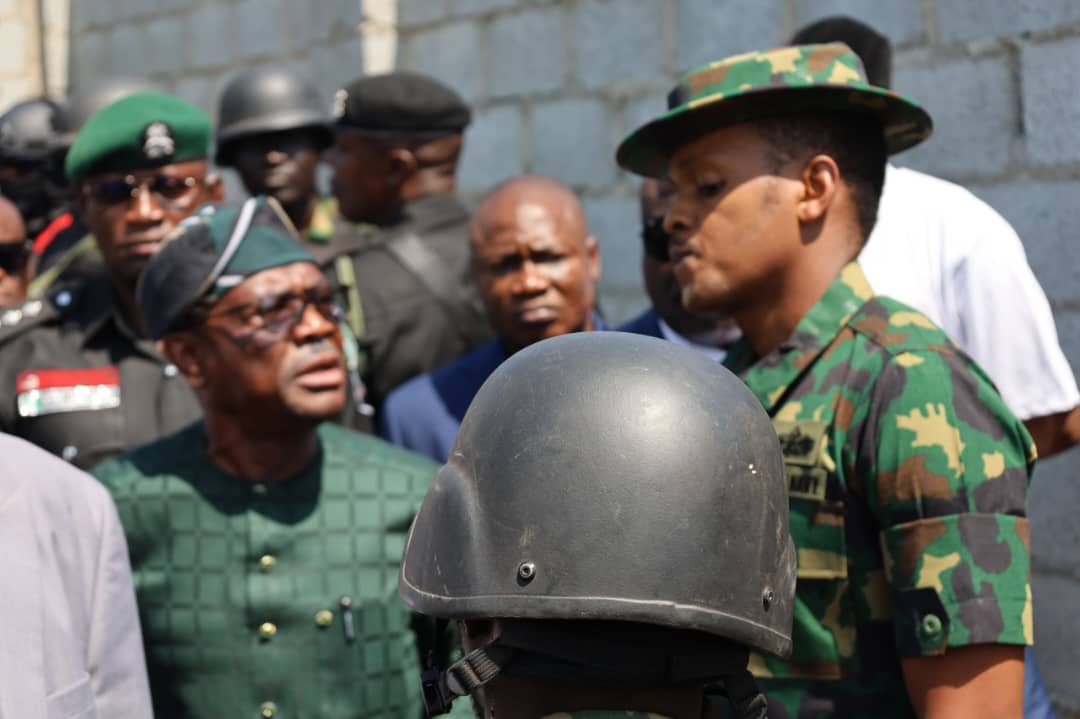
So much dust has been generated and almost engulfed the action of the FCT Minister, Barrister Esenwo Nyesom Wike, CON, in confronting a military officer in the course of official duty.
Interestingly, both Barrister Nyesom Wike and Navy Lt. Ahmed Yerima are enforcement officers imbued with the statutory duty to execute relevant laws for the peace, order and good government of Nigeria.
They belong to the Executive branch of government. Any conflict in the process of carrying out their statutory duties should be seen as an internal affair within the executive branch of government. This is not a conflict between the executive and the legislature, neither is it a conflict between the executive and the judiciary. It is a conflict (or conflagration, if you like) within the executive; involving officers of the Federal Republic of Nigeria engaged in their official duty. The bone of contention is the right to own and develop property in Nigeria and the corresponding duty to respect and obey urban and regional planning
Section 42 of the Nigerian Constitution (1999) stipulates and guarantees the right of every citizen to own and develop land in Nigeria. However, the ownership and structural development of our urban areas are regulated and structured. It is in the public interest and society’s good that property development should be done in a manner that aligns with urban planning rules and regulations. Anything done to the contrary can only result in haphazard and unwholesome urban development with its concomitant danger of flooding, blocking of drainages and waterways, overcrowding, congestion and uncontrollable population density in our urban centres and cities – the very urbanization ills which led to the movement of the nation’s capital from Lagos to the Federal Capital City, Abuja. It is therefore imperative that the urban and regional planning laws and regulations be enforced without fear or favour, affection or ill will. This is squarely a matter for the Executive branch of government as personified by Mr. President
The protection, defence and enforcement of every law, rule and regulations in the Federal Capital Territory of Nigeria is vested in the President, by virtue of Section 130(1)(2) of the Constitution.
The President wields pervasive and wide-ranging executive powers, and these powers are exercised by him personally or through delegation to officers of the executive branch. In the process of exercising executive powers, conflicts are bound to arise and this may test the conflict resolution mechanism existing within various appendages of the executive organ.
The executive powers of the Federation are clearly spelt out in the Constitution.
By Section 5(1) of the 1999 Constitution of the Federal Republic of Nigeria:
“Subject to the provisions of this constitution, the executive powers of the Federation
(a) shall be vested in the President and may subject as aforesaid and to the provisions of any law made by the National Assembly, be exercised by him either directly or through the Vice-President and Ministers of the Government of the federation or officers in the public service of the Federation;
And
(b) shall extend to the execution and maintenance of this constitution, all laws made by the National Assembly and to all matters with respect to which the National Assembly has, for the time being, power to make laws.
In a more elaborate form, the executive powers of the Federal Republic of Nigeria are encapsulated in three parts of Chapter VI of the 1999 Constitution. Part I deals with the Federal Executive (Sections 130-175), Part II deals with the State Executive (Sections 176 – 212), Part III deals with the Supplemental (Sections 213 – 229). The Armed Forces of the Federation fall under the Supplemental.
Section 130(1) provides: There shall be for the Federation a President.
(2) the President shall be the Head of State, the Chief Executive of the Federation
and Commander-in-Chief of the Armed Forces of the Federation.”
As could be seen above, the Constitutional provision makes it clear that the President wears 3 caps – the Head of State, the Chief Executive, and the Commander-in-Chief. As Chief Executive, he has delegated lawful authority to Hon. Minister Wike, but as Commander-in-Chief he could only command Navy Lt. Ahmed Yerima to perform executive functions relating to military and operational duties. Section 218 of the Constitution provides that:
“(1) The power of the President as the Commander-in-Chief of the Armed Forces of the Federation shall include power to determine the operational use of the armed forces of the federation;
(2) The power conferred on the President by sub-section (1) of this section shall include power to appoint the Chief of Defence Staff, the Chief of Army Staff, the Chief of Naval Staff, the Chief of Air Staff; and Head of any other branches of the armed forces of the federation as may be established by an Act of the National Assembly;
(3) The President may, by directions in writing and subject to such conditions as he may think fit, delegate to any member of the armed forces of the Federation his powers relating to the operational use of the Armed Forces of the Federation.”
The interesting scenario is that though Minister Wike and Navy Lt. Yarima derive presidential authority from the constitution, the exercise of that authority must at all times be legitimate and uncompromised.
That being the case, the scene which played out between Minister Wike and the Navy Lt. can be likened to an obstruction of official duty, and in this particular instance, it
can be characterized as an obstruction of presidential duty. Wike derives executive authority from section 148(1) of the Constitution: “The President may, in his discretion, assign to the Vice-President or any Minister of the Government of the Federation responsibility for any business of Government of the federation, including the administration of any department or government, Wike was carrying out a Presidential assignment of the government of the federation which ought to be complemented and not obstructed by any member of the Armed Forces. Navy Lt. Yerima derived his authority from Section 217 of the Constitution which clearly stipulates the scope and extent of the powers of the Armed Forces in a democratic dispensation.
“(1) There shall be an armed force for the Federation which shall consist of an Army, a Navy, an Air Force and such other branches of the armed forces of the Federation as may be established by an Act of the National Assembly.
(2) The Federation shall, subject to an Act of the National Assembly made in that behalf, equip and maintain the armed forces as may be considered adequate and effective for the purpose of:
(a) defending Nigeria from external aggression;
(b) maintaining its territorial integrity and securing its borders from violation on land, sea or air;
(c) suppressing insurrection and acting in aid of civil authorities to restore order when called upon to do so by the President, but subject to such conditions as may be prescribed by an Act of the National Assembly; and
(d) performing such other functions as may be prescribed by an Act of the National Assembly.”
Though the Nigerian Constitution also makes provision for the National Defence Council under Section 153(1)(g): – Establishment of National Defence Council and the Third Schedule to the Constitution (Part 1) – Composition of the National Defence Council- paragraph 16, its composition is equally sufficiently infused with an overriding civilian presence and dominance which signposts the intendment of makers of the Constitution to subject the Armed Forces to democratic ethos.
The National Defence Council shall comprise the following members:
a. The President who shall be the Chairman
b. The Vice-President who shall be the Deputy Chairman
c. The Minister of Government of the Federation responsible for defence
d. The Chief of Defence Staff
e. The Chief of Army Staff
f. The Chief of Naval Staff
g. The Chief of Air Staff; and
h. Such other members as the President may appoint.
The composition of this body is deliberate and instructive. Though, a military body, its membership is “civilianized” and not overly militarized, and this is to underscore the underlying policy and principle that in a democracy, the military needs to submit to the authority of the “bloody civilians”, those entrusted with the mandate to lead the people in whom sovereignty resides.
It is however remarkable that Minister Wike’s manner of expression or choice of words while addressing the military officer was clearly below his dignity, yet it should not becloud the substance of his clear message that, no one is above the law of the land; and the enormous authority and responsibility of his high executive office as a Minister of the Government of the Federation in carrying out the Presidential mandate should not be lightly esteemed.
Though, the Armed Forces of the federation is subject, and should always submit to the authority of Mr. President as represented by the Honourable Minister of the Government of the Federation, it represents a critical organization within the executive branch of government. No government can survive without the Armed Forces. It is noteworthy that the Armed Forces is equally a creation of the Constitution as established under Part III (supplemental)(C) of the constitutional provisions governing the executive branch of government. The Presidential power which dovetails to the Ministerial powers is established under Part I (Federal Executive). This presupposes that in the normal scheme of things, the Minister should take pre-eminence over any member of the armed forces in the executive hierarchy. The specialized nature of military operations has placed them on very high pedestal in terms of national service and patriotism, yet it is equally instructive that the President is first and foremost Mr. President, the
That being the case, whoever is exercising presidential power as Head of State and Chief Executive ought to be accorded some measure of respect. This is because his authority as President, Head of State and Chief Executive are all derivatives of the popular mandate he derived from the people who voted him into office. Sovereignty of the people is personified in the President who holds office as the representative of the people. If the President wields such executive powers of the Federal Republic of Nigeria, it stands to reason that the person to whom his power is delegated, be it civilian or military, deserves the same level of authority and pre-eminence in carrying out his presidential assignment. This calls for co-operation and collaboration within the Executive, in the overall interest of the people whose interest they serve. That is the beauty and sanctity of our democratic system of government where sovereignty derives from, and belongs to the people. Section 14(1) of the Constitution is very apt on th
to the people of Nigeria from whom government through this constitution derives all its powers and authority.”
Recently, on Friday 7th February, 2025, the Supreme Court of Nigeria in the case of A-G, Abia State v. Imo State Trans. Co. Ltd restated this critical feature of democratic government in unmistakable terms as follows: “The defining feature of a democracy is that sovereignty belongs to the people from whom government derives all its powers and authority which must be exercised for the benefit of the people.” – Per Hon. Justice Emmanuel Akomaye Agim (2025) 16 NWLR (Pt. 2012) 471.
In conclusion, we must take home the notable summation of the whole saga in the words of the Chief of Defence Staff, General O. O. Oluyede, OFR when he said- “The officer’s response reflects admirable composure and emotional intelligence- qualities that lie at the heart of military leadership training. His ability to remain calm, firm, and respectful under verbal provocation demonstrates discipline and professionalism.”
The General’s emphasis on the twin virtues of “composure and emotionally intelligence” is very instructive. Our public officers should not only be right in their actions but must strive not to be wrongly right.
I must add though, that I do not share the view as eloquently expressed by the CDS that Hon. Minister Wike’s action and utterance in the peculiar circumstances can be rightly characterized as a “verbal provocation.” There was no iota of provocation. At best, it was a verbal altercation, and at worst, it was a verbal vituperation, and verbal vituperation in the heat of anger or passion is understandable and permissible even in the law of slander.
In all this saga, the manner of the messaging should not be allowed to becloud the clear message by Hon. Minister Wike, that no one, no matter how highly placed, is above the law of the land.
Okon N. Efut, SAN
Abuja.
WIKE WAS WRONGLY RIGHT
– Understanding the powers of a Nigerian Minister
“He who stands by the law must follow the law” – Hon. Justice Mohammed Lawal Garba, JSC in Pan Ocean Oil Cop. Ltd V. RCADD (2025) 14 NWLR (Pt. 2006) 445.
So much dust has been generated and almost engulfed the action of the FCT Minister, Barrister Esenwo Nyesom Wike, CON, in confronting a military officer in the course of official duty. Interestingly, both Barrister Nyesom Wike and Navy Lt. Ahmed Yerima are enforcement officers imbued with the statutory duty to execute relevant laws for the peace, order and good government of Nigeria. They belong to the Executive branch of government. Any conflict in the process of carrying out their statutory duties should be seen as an internal affair within the executive branch of government. This is not a conflict between the executive and the legislature, neither is it a conflict between the executive and the judiciary. It is a conflict (or conflagration, if you like) within the executive; involving officers of the Federal Republic of Nigeria engaged in their official duty. The bone of contention is the right to own and develop property in Nigeria and the corresponding duty to respect and obey urban and regional planning
Section 42 of the Nigerian Constitution (1999) stipulates and guarantees the right of every citizen to own and develop land in Nigeria. However, the ownership and structural development of our urban areas are regulated and structured. It is in the public interest and society’s good that property development should be done in a manner that aligns with urban planning rules and regulations. Anything done to the contrary can only result in haphazard and unwholesome urban development with its concomitant danger of flooding, blocking of drainages and waterways, overcrowding, congestion and uncontrollable population density in our urban centres and cities – the very urbanization ills which led to the movement of the nation’s capital from Lagos to the Federal Capital City, Abuja. It is therefore imperative that the urban and regional planning laws and regulations be enforced without fear or favour, affection or ill will. This is squarely a matter for the Executive branch of government as personified by Mr. President
The protection, defence and enforcement of every law, rule and regulations in the Federal Capital Territory of Nigeria is vested in the President, by virtue of Section 130(1)(2) of the Constitution.
The President wields pervasive and wide-ranging executive powers, and these powers are exercised by him personally or through delegation to officers of the executive branch. In the process of exercising executive powers, conflicts are bound to arise and this may test the conflict resolution mechanism existing within various appendages of the executive organ.
The executive powers of the Federation are clearly spelt out in the Constitution.
By Section 5(1) of the 1999 Constitution of the Federal Republic of Nigeria:
“Subject to the provisions of this constitution, the executive powers of the Federation
(a) shall be vested in the President and may subject as aforesaid and to the provisions of any law made by the National Assembly, be exercised by him either directly or through the Vice-President and Ministers of the Government of the federation or officers in the public service of the Federation;
And
(b) shall extend to the execution and maintenance of this constitution, all laws made by the National Assembly and to all matters with respect to which the National Assembly has, for the time being, power to make laws.
In a more elaborate form, the executive powers of the Federal Republic of Nigeria are encapsulated in three parts of Chapter VI of the 1999 Constitution. Part I deals with the Federal Executive (Sections 130-175), Part II deals with the State Executive (Sections 176 – 212), Part III deals with the Supplemental (Sections 213 – 229). The Armed Forces of the Federation fall under the Supplemental.
Section 130(1) provides: There shall be for the Federation a President.
(2) the President shall be the Head of State, the Chief Executive of the Federation
and Commander-in-Chief of the Armed Forces of the Federation.”
As could be seen above, the Constitutional provision makes it clear that the President wears 3 caps – the Head of State, the Chief Executive, and the Commander-in-Chief. As Chief Executive, he has delegated lawful authority to Hon. Minister Wike, but as Commander-in-Chief he could only command Navy Lt. Ahmed Yerima to perform executive functions relating to military and operational duties. Section 218 of the Constitution provides that:
“(1) The power of the President as the Commander-in-Chief of the Armed Forces of the Federation shall include power to determine the operational use of the armed forces of the federation;
(2) The power conferred on the President by sub-section (1) of this section shall include power to appoint the Chief of Defence Staff, the Chief of Army Staff, the Chief of Naval Staff, the Chief of Air Staff; and Head of any other branches of the armed forces of the federation as may be established by an Act of the National Assembly;
(3) The President may, by directions in writing and subject to such conditions as he may think fit, delegate to any member of the armed forces of the Federation his powers relating to the operational use of the Armed Forces of the Federation.”
The interesting scenario is that though Minister Wike and Navy Lt. Yarima derive presidential authority from the constitution, the exercise of that authority must at all times be legitimate and uncompromised.
That being the case, the scene which played out between Minister Wike and the Navy Lt. can be likened to an obstruction of official duty, and in this particular instance, it
can be characterized as an obstruction of presidential duty. Wike derives executive authority from section 148(1) of the Constitution: “The President may, in his discretion, assign to the Vice-President or any Minister of the Government of the Federation responsibility for any business of Government of the federation, including the administration of any department or government, Wike was carrying out a Presidential assignment of the government of the federation which ought to be complemented and not obstructed by any member of the Armed Forces. Navy Lt. Yerima derived his authority from Section 217 of the Constitution which clearly stipulates the scope and extent of the powers of the Armed Forces in a democratic dispensation.
“(1) There shall be an armed force for the Federation which shall consist of an Army, a Navy, an Air Force and such other branches of the armed forces of the Federation as may be established by an Act of the National Assembly.
(2) The Federation shall, subject to an Act of the National Assembly made in that behalf, equip and maintain the armed forces as may be considered adequate and effective for the purpose of:
(a) defending Nigeria from external aggression;
(b) maintaining its territorial integrity and securing its borders from violation on land, sea or air;
(c) suppressing insurrection and acting in aid of civil authorities to restore order when called upon to do so by the President, but subject to such conditions as may be prescribed by an Act of the National Assembly; and
(d) performing such other functions as may be prescribed by an Act of the National Assembly.”
Though the Nigerian Constitution also makes provision for the National Defence Council under Section 153(1)(g): – Establishment of National Defence Council and the Third Schedule to the Constitution (Part 1) – Composition of the National Defence Council- paragraph 16, its composition is equally sufficiently infused with an overriding civilian presence and dominance which signposts the intendment of makers of the Constitution to subject the Armed Forces to democratic ethos.
The National Defence Council shall comprise the following members:
a. The President who shall be the Chairman
b. The Vice-President who shall be the Deputy Chairman
c. The Minister of Government of the Federation responsible for defence
d. The Chief of Defence Staff
e. The Chief of Army Staff
f. The Chief of Naval Staff
g. The Chief of Air Staff; and
h. Such other members as the President may appoint.
The composition of this body is deliberate and instructive. Though, a military body, its membership is “civilianized” and not overly militarized, and this is to underscore the underlying policy and principle that in a democracy, the military needs to submit to the authority of the “bloody civilians”, those entrusted with the mandate to lead the people in whom sovereignty resides.
It is however remarkable that Minister Wike’s manner of expression or choice of words while addressing the military officer was clearly below his dignity, yet it should not becloud the substance of his clear message that, no one is above the law of the land; and the enormous authority and responsibility of his high executive office as a Minister of the Government of the Federation in carrying out the Presidential mandate should not be lightly esteemed.
Though, the Armed Forces of the federation is subject, and should always submit to the authority of Mr. President as represented by the Honourable Minister of the Government of the Federation, it represents a critical organization within the executive branch of government. No government can survive without the Armed Forces. It is noteworthy that the Armed Forces is equally a creation of the Constitution as established under Part III (supplemental)(C) of the constitutional provisions governing the executive branch of government. The Presidential power which dovetails to the Ministerial powers is established under Part I (Federal Executive). This presupposes that in the normal scheme of things, the Minister should take pre-eminence over any member of the armed forces in the executive hierarchy. The specialized nature of military operations has placed them on very high pedestal in terms of national service and patriotism, yet it is equally instructive that the President is first and foremost Mr. President, the
That being the case, whoever is exercising presidential power as Head of State and Chief Executive ought to be accorded some measure of respect. This is because his authority as President, Head of State and Chief Executive are all derivatives of the popular mandate he derived from the people who voted him into office. Sovereignty of the people is personified in the President who holds office as the representative of the people. If the President wields such executive powers of the Federal Republic of Nigeria, it stands to reason that the person to whom his power is delegated, be it civilian or military, deserves the same level of authority and pre-eminence in carrying out his presidential assignment. This calls for co-operation and collaboration within the Executive, in the overall interest of the people whose interest they serve. That is the beauty and sanctity of our democratic system of government where sovereignty derives from, and belongs to the people. Section 14(1) of the Constitution is very apt on th
to the people of Nigeria from whom government through this constitution derives all its powers and authority.”
Recently, on Friday 7th February, 2025, the Supreme Court of Nigeria in the case of A-G, Abia State v. Imo State Trans. Co. Ltd restated this critical feature of democratic government in unmistakable terms as follows: “The defining feature of a democracy is that sovereignty belongs to the people from whom government derives all its powers and authority which must be exercised for the benefit of the people.” – Per Hon. Justice Emmanuel Akomaye Agim (2025) 16 NWLR (Pt. 2012) 471.
In conclusion, we must take home the notable summation of the whole saga in the words of the Chief of Defence Staff, General O. O. Oluyede, OFR when he said- “The officer’s response reflects admirable composure and emotional intelligence- qualities that lie at the heart of military leadership training. His ability to remain calm, firm, and respectful under verbal provocation demonstrates discipline and professionalism.”
The General’s emphasis on the twin virtues of “composure and emotionally intelligence” is very instructive. Our public officers should not only be right in their actions but must strive not to be wrongly right.
I must add though, that I do not share the view as eloquently expressed by the CDS that Hon. Minister Wike’s action and utterance in the peculiar circumstances can be rightly characterized as a “verbal provocation.” There was no iota of provocation. At best, it was a verbal altercation, and at worst, it was a verbal vituperation, and verbal vituperation in the heat of anger or passion is understandable and permissible even in the law of slander.
In all this saga, the manner of the messaging should not be allowed to becloud the clear message by Hon. Minister Wike, that no one, no matter how highly placed, is above the law of the land.
Okon N. Efut, SAN
Abuja.
Disclaimer
Comments expressed here do not reflect the opinions of Vanguard newspapers or any employee thereof.