
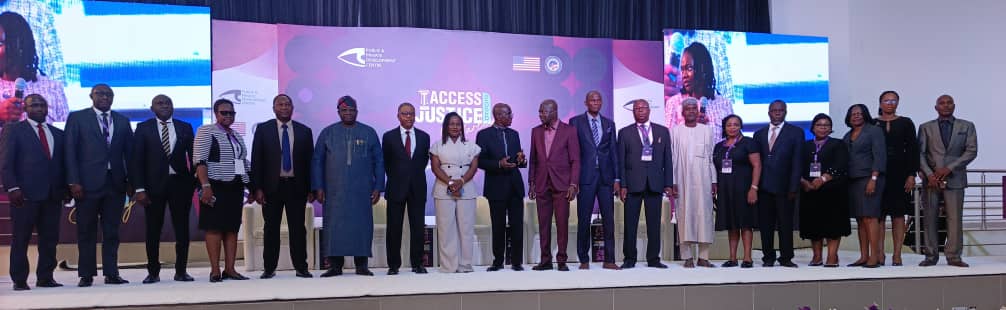
…UNODC, stakeholders reaffirm commitment to justice, security, and good governance
By Joseph Erunke, Abuja
The Public and Private Development Centre (PPDC) has reaffirmed its commitment to building a fair, transparent, and accountable justice system in Nigeria, announcing that it has empowered more than 20,000 detainees through its flagship Access to Justice Parley initiative.
Speaking at the third edition of the Access to Justice Parley Dialogue in Abuja, themed “Justice, Security, and Governance — A Unified Agenda for Nigeria’s Sustainable Development,” PPDC’s Chief Executive Officer, Lucy Abagi, said the organization is focused on ensuring that the justice system works for all Nigerians.
“At the PPDC, we believe justice must serve people, not power. Our mission is to make justice accessible, efficient, and fair for all,” she said.
Through the Reforming Pretrial Detention in Nigeria Project (Phase II), PPDC has provided free legal representation to over 20,009 detainees, resulting in the release of 8,552 individuals unlawfully detained without trial.
Its Police Duty Solicitors Scheme, now active in 50 police stations nationwide, ensures suspects receive immediate legal support from the point of arrest, reducing arbitrary detentions and easing congestion in correctional facilities.
Abagi further disclosed that the organization has paid more than N5 million in fines, securing freedom for over 60 convicted detainees, while also supporting jail delivery exercises across several states.
PPDC has advanced digital justice reforms by upgrading the Correctional Information Management System in 16 custodial centres to improve inmate data tracking and case management. In partnership with the FCT Judiciary, it has also introduced an electronic filing and case management system to digitize court processes. Its collaboration with the Legal Aid Council of Nigeria (LACON) has yielded a digital case monitoring tool that tracks legal aid cases nationwide.
Under its Court Administration and Case Management Initiative, PPDC has equipped 24 courts—soon to reach 44—in Kaduna, Nasarawa, Plateau, Ebonyi, and Oyo States with real-time speech-to-text technology, replacing slow manual recording systems. The organization has also facilitated over 2,370 virtual court sessions, distributed 3,000 policy manuals on the Administration of Criminal Justice Act (ACJA), and trained 1,746 judges, prosecutors, and investigators to strengthen justice delivery.
“We are building a justice system that is transparent, data-driven, and human-centered,” Abagi noted. “What we have achieved so far is only the beginning of the transformation Nigeria deserves.”
Delivering a goodwill message on behalf of Muchaneta Phildah Mundopa, Head of the Justice, Integrity, and Health Unit at the United Nations Office on Drugs and Crime (UNODC), Melissa Omena commended PPDC’s leadership in advancing justice reforms.
“UNODC is proud to walk alongside Nigeria in strengthening justice, security, and governance — three pillars essential to sustainable development,” she said.
Omena also lauded Nigeria’s adoption of the UN Common Position on Incarceration, which supports a shift from punitive to rehabilitative justice, and highlighted the deployment of virtual court systems in Lagos, Kaduna, Gombe, and the FCT, supported by UNODC, INL, and PPDC.
Representing the Comptroller-General of Corrections, Jerry Dauda, Esq., emphasized that justice, security, and governance are “interdependent pillars that sustain peace and development,” reaffirming the Service’s commitment to reforms rooted in rehabilitation and reintegration.
Similarly, Mrs. Pwadumdi Okoh, Esq., representing the Executive Secretary of the National Human Rights Commission (NHRC), Dr. Anthony Ojukwu, SAN, stressed that access to justice is a fundamental human right that underpins democracy and sustainable development. She urged stakeholders to continue reforms anchored on human rights, inclusivity, and accountability, noting that Nigeria’s adoption of the Voluntary Principles on Security and Human Rights would help balance national security with respect for human dignity.
In his keynote address, the Chief Executive Officer of the Nigerian Law Reform Commission, Prof. Dakas Dakas, SAN, praised PPDC for its strategic leadership in driving justice reforms and enhancing transparency across Nigeria’s justice institutions.
He stressed that sustainable development is impossible without a justice system that protects human rights and ensures equal access for all. Prof. Dakas called for stronger collaboration among government institutions, civil society, and the private sector to ensure that reforms translate into tangible benefits for ordinary Nigerians.
He explained that the Commission is currently reviewing multiple laws to align them with international human rights standards and the fast-evolving digital era. He also commended PPDC’s digital innovations, describing them as a model for African countries modernizing their justice systems through data-driven, citizen-centered solutions.
Closing the event, Abagi thanked the Legal Aid Council, judiciary, correctional authorities, security agencies, and media partners for their collaboration, reaffirming PPDC’s commitment to justice reform.
“The journey is far from over,” she said. “But together, we are ensuring that justice in Nigeria is never delayed, denied, or distorted.”
The 2025 Access to Justice Parley brought together reformers, policymakers, and development partners, who agreed that justice and security are complementary drivers of peace and progress—not opposing goals.
Disclaimer
Comments expressed here do not reflect the opinions of Vanguard newspapers or any employee thereof.