
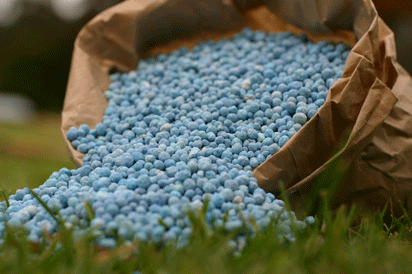
Fertilizer
By Gabriel Ewepu
ABUJA – OVER 100 organic fertilizer producers under the auspices of the Organic Fertilizer Producers and Suppliers Association of Nigeria, OFPSAN, yesterday, called for inclusion in the Federal Government’s Presidential Fertilizer Initiative, PFI, to boost healthy food production and consumption.
The call was made at a press briefing held in Abuja,which was organized by OFPSAN, where the National President, OFPSAN, Adams Musa along with a Board of Trustees, BoT, members – Prof Ebenezer Okonkwo; and Lady Olufunke Oderinde; Vice President, OFPSAN, Muazu Idris; General Secretary, OFPSAN, Dr Enemali Shuaibu; Public Relations Officer, OFPSAN, Chimezie Maluze; and National Treasurer, OFPSAN, Bashir Muhammad, called the attention of President Bola Tinubu to prioritize healthy food production and consumption instead of focusing on quantity alone,which organic fertilizers can do for the farmers and safeguard the health of Nigerians.
According to the leadership of OFPSAN, organic farm produce will stand Nigeria out in the international market and make her farm produce more accepted, competitive, and rejections become a thing of the past.
The National President, OFPSAN, Adams Musa, in his address pointed out that degradation and degeneration has hit soils due to climate variability, which also had negatively affected yields due to decline in soil fertility is declining, therefore, farmers across the country are worried and also demanding more environmentally friendly and cost-effective solutions.
He said: “As an association, we deeply appreciate the Federal Government’s continued investment in strengthening local fertilizer production, particularly through the Presidential Fertilizer Initiative (PFI), which has become a central pillar of Nigeria’s agricultural development agenda.
“The PFI has, without doubt, delivered significant value — from reviving dormant blending plants across the nation, stabilizing input prices for farmers, stimulating job creation, and substantially reducing dependence on imported finished fertilizer.
“In light of these achievements, we respectfully call on the Federal Government to sustain, deepen, and further consolidate the Presidential Fertilizer Initiative.
“This programme remains crucial to Nigeria’s agricultural transformation and long-term food systems resilience.
“We commend the Federal Government for the recent nationwide inspection of fertilizer blending plants. This demonstrates strong commitment to accountability, efficiency, and capacity enhancement within the industry.
“We also recognise and appreciate the pivotal role of the Ministry of Finance Incorporated (MOFI), whose strategic oversight, investment stewardship, and coordination are reinforcing the sustainability and overall success of the PFI.
“However, as global agricultural standards evolve and best practices shift toward sustainability, Nigeria must proactively align its policy direction with emerging realities.
“Our soils are increasingly degraded; climate variability continues to affect yields; soil fertility is declining; and farmers across the country are demanding more environmentally friendly and cost-effective solutions.
“In response to these challenges, OFPSAN is calling for the formal, structured, and deliberate inclusion of organic fertilizer production, distribution, and support within the Presidential Fertilizer Initiative.
“We cannot overlook human health, especially as many of the foods we consume today are no longer truly natural. When our soil, environment, water, and all living organisms are healthy, people become healthier too.
“By protecting and restoring these essential systems, we create a safer, more sustainable nation for both current and future generations—one where well-being is not compromised but strengthened for all.
“Integrating organic fertilizer into the PFI will create a balanced national fertilizer framework that addresses both immediate productivity and future ecological stability. It will also support millions of smallholder farmers who increasingly prefer natural and safer soil-enhancing options.
“Furthermore, OFPSAN strongly urges the Federal Government to maintain and enforce the current policy that places the importation of fertilizer raw materials exclusively under the purview of the Federal Government.
“This measure remains indispensable for preventing market abuse, curbing the influx of substandard and adulterated materials, stabilizing market prices, ensuring consistent availability of inputs, and protecting local producers from unfair distortions caused by uncontrolled importation.”
Meanwhile, the OFPSAN boss also expressed readiness to “collaborate fully with the Federal Ministry of Agriculture and Food Security, relevant regulatory bodies, and the private sector to advance the objectives of the Presidential Fertilizer Initiative and ensure that farmers across Nigeria have access to affordable, high-quality, and sustainable fertilizer inputs.”
“We also encourage the government to continue engaging stakeholders, uphold policy consistency, expand access to financing, and strengthen regulatory enforcement. These steps will significantly reinforce Nigeria’s fertilizer sector and enhance national agricultural productivity.
The OFPSAN boss also expressed readiness to “collaborate fully with the Federal Ministry of Agriculture and Food Security, relevant regulatory bodies, and the private sector to advance the objectives of the Presidential Fertilizer Initiative and ensure that farmers across Nigeria have access to affordable, high-quality, and sustainable fertilizer inputs.”
Other executives of the association asserted that organic fertilizer is the quality assurance of food produce and the reliable farm input that would guarantee what Nigerians consume, and also the confidence that other countries can have in the food systems and importation of agricultural produce from Nigeria, whereby, they know there is no toxins and chemical residues in them, therefore, would boost foreign exchange for the Nigerian farmers, agribusinesses, and the economy.
Disclaimer
Comments expressed here do not reflect the opinions of Vanguard newspapers or any employee thereof.