
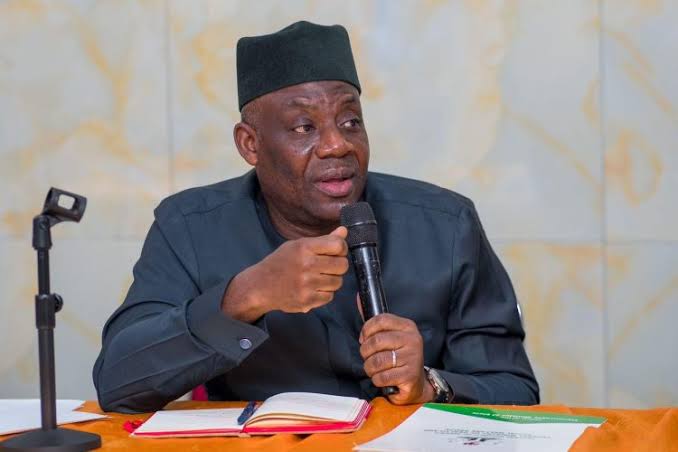
Minister of Education, Dr Tunji Alausa
By Dr Bibi Bakare-Yusuf
Ení bá sÍ ilé nù so àpò ìyà kÍì. Whoever loses their home (language, ancestry, and identity) burdens themselves with unending suffering.
Dear Minister,
I write as the publishing director of Cassava Republic Press, a global African publisher not only based in Abuja but deeply rooted in the cultural and intellectual life of this country. Your recent decision to scrap the 2022 National Language Policy, which had rightly established indigenous languages as the medium of instruction from early childhood through Primary Six, is a devastating moral and intellectual error. It re-opens the colonial wound in our education system and reaffirms the supremacy of English over the tongues that hold our being and thought in ancestry.
It is not a coincidence that the announcement of such magnitude was made at the 2025 “Language in Education International Conference”, organised by the British Council. With a mandate, established by its Royal Charter in 1940, to promote a wider knowledge of the UK and the English language abroad, the British Council is at the epicenter of the Neo-imperial project of propagating and maintaining the empire’s cultural dominance long after independence. This declaration symbolically handed back the hard-won sovereignty of Nigerian culture and knowledge systems to the very powers our ancestors struggled to free themselves from.
Even your own name, Minister, Alausa, a Yoruba word meaning walnut, and is layered with echoes that travel across Yoruba and Hausa histories, embodies the intertwined linguistic heritage your policy seeks to undo. To erase our languages is to erase the very texture of such rich meanings, and severe the threads that connect names, histories, and origins.
To argue then, a mere three years into an experiment of teaching our children in their mother tongues is the reason for their poor performance in examinations is not only false, but also a dangerous diagnosis. No pupil taught under it could yet have reached WAEC, NECO, or JAMB level, any connection is therefore chronologically untenable. It mistakes the symptoms for the cause, and ignores decades of under-investment, corruption, poor teacher training, and historical and systemic neglect of the very languages that root our children in meaning and confidence.
To declare that teaching in the mother tongue has “destroyed” the education system is to deny centuries of empirical and philosophical evidence across the world. The renowned Kenyan writer and intellectual Ngig) wa Thiong’o reminds us that “language exists as culture; it is the collective memory bank of a people’s experience in history.” To strip this away is to assert the supremacy of what his son, Mukoma Ngugi would later call, “the English metaphysical empire” in a wilful refusal to decolonise our minds. This new policy subjects our children once more to that empire, alienating them from their linguistic homes before they can even name the world around them, letting them know that they and their language will always be lesser.
Our position as a publisher
At Cassava Republic Press, we publish primarily in English. This is our reality within a global market logic shaped by colonial histories and current economics. Yet we do not mistake our medium for our mission. In our use of English, we are compelled to always ask: whose voices are being silenced? Which imaginations and world-sense are being lost and erased? We have seen the glee on children’s faces when they open the two books we’ve published in Yoruba and Igbo and recognise themselves, not as translation, but as origin. We have also witnessed the gratitude that fills the comment sections of short social media videos made by a younger generation eager to rediscover and relearn the sounds of home, the tongues of their being. These responses remind us that language is not only communication; it is what the novelist Alice Walker called, “the temple of my familiar”, where identity exhales and the imagination begins to believe itself possible. It is this belonging, memory, and pride made audible, that your policy denies.
We stand for the plurality of Nigerian expressions. We know that translation, not assimilation, is the future. The work of building an inclusive, creative, and prosperous Nigeria must begin with respect and cultivation of the languages in which Nigerians first know and encounter the world, and for many, it is simply not English.
Language, violence and the making of a child
Every child deserves to begin education in the language they dream in. To force a six-year-old whose first language is Tiv, Ibibio, or Kanuri to learn arithmetic and science through English, a language they have not yet mastered, is to build their intellectual life on confusion, and more irreparably, to teach them that their own language holds no place in the empires of knowledge and meaning. Studies across Africa and supported by UNESCO have shown that children who learn foundational literacy and numeracy in their first language outperform their peers in later years when English or French is introduced gradually.
Your declaration deepens our already high inequalities. It privileges urban, middle-class children with proficiency in English at home and penalises millions of rural and indigenous-language speakers. In a country of over 500 indigenous languages, where at least 29 are already extinct and more are endangered, this policy is not simply an error—it is an act of erasure, an epistemic violence, a clarion call for recolonisation. Each lost language takes with it a universe of knowledge, aesthetics and ethics. It is not too late to reverse your decision and continue the practice of decoloniality your predecessor envisioned in 2022, only this time, commit to proper investment and consultation.
Cultural confidence as economic strength
We are told this shift is necessary for “global competitiveness.” Yet history shows that no nation has achieved economic prosperity by first abandoning its linguistic identity. Countries such as Japan, Korea, Finland, China, each built scientific and technological prowess on education in its mother tongue before acquiring English as a second tool, not as master. Economic prosperity grows out of cultural confidence, not linguistic self-negation and immolation.
A child confident in their language is confident in thought and action. A nation secure in its languages speaks to the world from a position of authority and agency, not mimicry and plea. To equate English with intelligence and competitiveness is to continue measuring ourselves with our colonial masters. Prosperity will only come when Nigerian children can think, dream, and innovate first in the tongues that can pronounce their name with precision and affirmation.
The moral and global framework
I invite the Minister to look at Nigeria’s obligations under the UN Sustainable Development Goals.
SDG 4 calls for inclusive and equitable quality education. That means meeting learners where they are, in the languages they understand.
SDG 10 demands the reduction of inequalities, yet this policy widens the gap between privileged English-speaking households and the majority whose first languages are indigenous.
SDG 16 seeks inclusive societies, but inclusion cannot exist when a child’s first language is banished from the classroom.
Linguistic diversity is not a problem to be solved but a resource to be harnessed. Nigeria’s earlier education policy understood this truth: that early instruction in the language of the mother and community strengthens comprehension, confidence, and cognitive development. To abandon that vision while still in its infancy is to renounce progress in favour of expedience, and tacitly court invasion.
Disclaimer
Comments expressed here do not reflect the opinions of Vanguard newspapers or any employee thereof.