
…As CoOTA President Pushes for Reposition of Transport Sector for Competitiveness
The Kaduna State Government has reaffirmed its commitment to building a modern, efficient, and sustainable transportation network that will serve as a model for Northern Nigeria.
Speaking at the National Transport Institute’s Conference on Tuesday, Governor Uba Sani outlined his administration’s Strategic Vision for Sustainable Kaduna’s Mobility, a comprehensive plan that combines infrastructure renewal, environmental sustainability, and inclusive mobility.
Governor Sani noted that transportation has remained central to his administration’s urban renewal agenda since assuming office two and a half years ago.
“Transportation remains the lifeblood of every society. It connects people and places, drives economic growth, and shapes the rhythm of daily life,” the Governor stated.
Governor Sani highlighted that Kaduna State has launched 85 urban and rural road projects covering 785 kilometres, with nearly half already completed. These projects have opened new corridors of commerce, connected farmers to markets, and improved access across the state’s 23 local government areas.
A major component of the plan is the Kaduna Bus Rapid Transit (KBRT) scheme — the first of its kind in Northern Nigeria and second nationwide after Lagos.
Developed in partnership with the Agence Française de Développement (AFD), the 24-kilometre KBRT corridor from Rigachikun to Sabon Tasha is backed by over ₦30 billion in counterpart funding.
The KBRT will deploy 120 Compressed Natural Gas (CNG)-powered buses, projected to cut CO₂ emissions by 38 percent, save ₦1.8 billion annually in fuel costs, and create over 14,000 jobs.
The Governor further disclosed that the Kakuri Interstate Bus Terminal is now 75 percent complete, while a new Sobawa Motor Park is being constructed to replace the congested Kawo Park as part of efforts to decongest Kaduna metropolis and enhance road safety.
In June 2025, under President Bola Ahmed Tinubu’s leadership, Kaduna State introduced 100 brand-new CNG and hybrid buses as part of a subsidised transport scheme aimed at cushioning the impact of fuel subsidy removal. Free rides have since been extended to students, workers, retirees, and vulnerable groups — saving commuters over ₦500 million to date.
To complement these efforts, more than 200 modern bus stops are being constructed in the first phase of a state-wide public transport improvement programme.
Governor Sani also confirmed steady progress on the Kaduna Light Rail Project, which will be rolled out in phases to revive the Rigachikun–Sabon Tasha corridor and connect Millennium City to the Abuja–Kaduna railway line.
Trailer parks at Tafa and Maraban Jos are being upgraded and digitised in collaboration with private investors, each designed to accommodate 500 trucks to enhance logistics efficiency.
The Governor announced that the state-owned Kaduna Line Transport Company has been successfully restructured, with debts exceeding ₦70 million cleared, e-ticketing introduced, operations digitised, and staff retrained to ensure efficiency and investor confidence.
“The wheels of this transformation are turning, and they will not stop until every village, every valley, every vista of our beloved state is connected to the promise of a greater tomorrow,” Governor Sani declared.
“When the story of Northern Nigeria’s renaissance is written, Kaduna will stand as the beacon of modern, efficient, and inclusive transportation.”
Governor Sani expressed his appreciation to the people of Kaduna for their support and partnership, pledging sustained investment in infrastructure, innovation, and sustainability to consolidate the progress made so far.
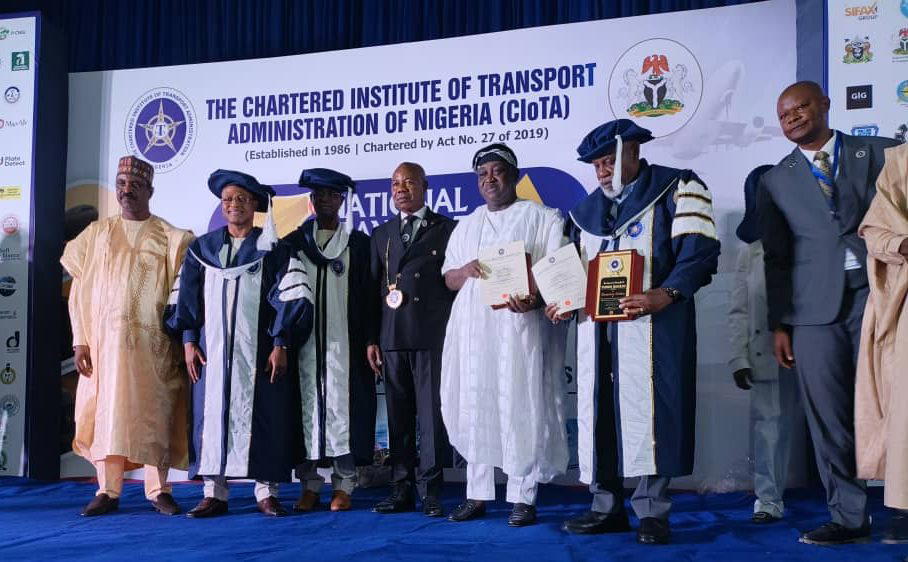
At the same conference, the Minister of Transportation, Senator Said Ahmed Alkali, announced the Federal Executive Council’s approval of Nigeria’s first National Land Transport Policy, developed with contributions from key stakeholders including the Chartered Institute of Transport Administration of Nigeria (CIOTA).
He also highlighted indigenous innovation efforts such as the successful test flight of logistics drones developed by engineers at the Nigerian Institute of Transport Technology (NITT), Zaria, reaffirming the Federal Government’s commitment to smart mobility, intelligent transport systems (ITS), and blockchain-enabled logistics.
In his remarks, CIOTA President, Prince (Dr.) Segun Obayendo, called for comprehensive reforms in Nigeria’s transport governance and urged more states to adopt transport policies similar to Kaduna and Lagos.
He identified four core priorities for Nigeria’s transport transformation: infrastructure optimisation, governance innovation, human capital development, and financial sustainability.
Disclaimer
Comments expressed here do not reflect the opinions of Vanguard newspapers or any employee thereof.