
Valentine Obienyem
Before we turn to Fr. Chigozie Jidere (Fr. Nwayo), let us pause to reflect on the story of the two thieves crucified with Christ, as recounted in today’s Gospel. Tradition, which often preserves details beyond the biblical text, gives them the names Dismas and Gestas.
But what kind of “thieves” were they? They were not thieves in the modern sense, picking pockets or breaking into homes. Rather, they were likely revolutionary bandits, insurgents common in Palestine under Roman occupation. Roman law reserved crucifixion for rebels, brigands, and slaves, which suggests that these men were involved in violent resistance, similar to Barabbas. This historical context helps us appreciate the severity of their punishment.
I am reminded of a humorous yet profound reflection from my former parish priest at St. Paul Catholic Church, Oyingbo, Lagos, Msgr. Michael Omisessan. He once described Dismas as the most successful thief: after having stolen everything in life, he ultimately stole the kingdom of God at the point of death. In that moment of repentance, the mercy of God transformed a condemned criminal into a model of faith.
How can we describe Gestas? The state in which he died exemplifies what the Church calls the sin against the Holy Spirit, or final impenitence. Even in his final moments, he remained hardened in sin, refusing the mercy that could have saved him.
This story leads us beautifully into the message of today’s solemnity, the Feast of Christ the King. Just as Dismas recognized Christ’s kingship and found salvation at the very end, we are called to acknowledge that Christ reigns not through force or domination, but through love, truth, and justice. His kingdom is not of this world, yet it touches every heart, transforms every life, and offers hope to all, even those society deems lost. Today, as we celebrate Christ the King, let us open our hearts to His reign, allowing His mercy and love to govern our lives, just as it did for Dismas.
Fr. Jidere’s sermon for the day was divided into two parts. In the first, he traced the historical and theological origins of the Feast of Christ the King, instituted by Pope Pius XI in 1925 in response to rising secularism and to affirm Christ’s universal reign. Citing John 18:36, he noted that Christ’s kingdom is spiritual, not political, reigning in the hearts of men. Using Luke 1:32‑33, he highlighted that Christ’s kingship is eternal and divinely ordained, fulfilling God’s promise to Israel. He also alluded to Revelation, showing Christ’s victory over evil, and Acts 17, which reminds us that God’s providence invites all people to seek Him. Fr. Jidere emphasized that to embrace this kingship, we must offer Christ total surrender, worship, obedience, and trust – a theme reinforced when the choir sang “Trust and Obey.”
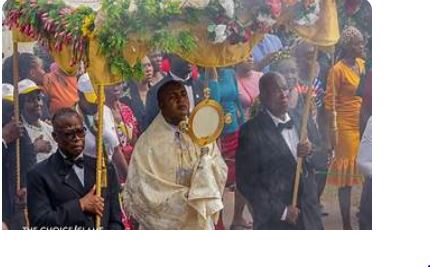
The second part focused on the Corpus Christi procession, celebrated today in Nigeria. Although the feast itself falls earlier in the liturgical calendar, the procession is held on Christ the King Sunday due to local considerations such as weather. In Nigeria, the procession is both a liturgical and cultural expression of faith, uniting the celebration of the Real Presence of Christ in the Eucharist with the proclamation of His universal kingship. It is a public witness, showing that Christ reigns not only in the Church but over society and daily life, calling the faithful to spiritual renewal, repentance, and adherence to Gospel values. Rooted in local custom and enriched with music, hymns, and communal participation, the procession embodies the joy, devotion, and hope of Nigerian Catholics, reminding all that the true King walks among His people, offering guidance, mercy, and transformation.
Finally, today’s Gospel highlights the inscription above Jesus’ head, known as the Titulus Crucis. This was a Roman practice to indicate the crime of the crucified, and in Jesus’ case, it read in Latin: “Iesus Nazarenus, Rex Iudaeorum” (INRI)- “Jesus of Nazareth, King of the Jews.” Pilate ordered it in three languages – Hebrew, Greek, and Latin – so all could read it. In Latin, the letter J did not exist, so Jesus is written Iesus. While meant to mock Him as a political offender, the inscription paradoxically proclaims the truth: Jesus is the true King, not of an earthly realm, but of God’s eternal Kingdom, a kingship even one of the thieves recognized when he said, “Jesus, remember me when you come into your kingdom.”
I am off to join my Chaplaincy in the procession- proclaiming Christ to the whole world as the universal King.
Disclaimer
Comments expressed here do not reflect the opinions of Vanguard newspapers or any employee thereof.