
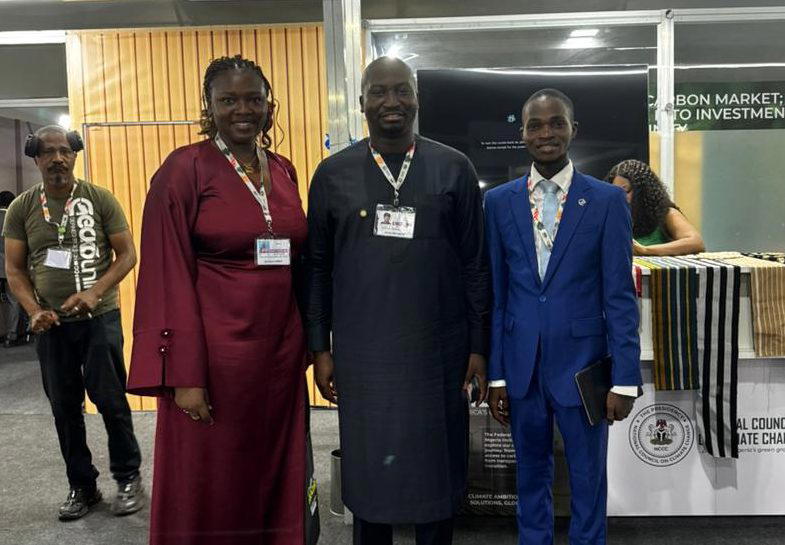
…says Nigeria brings solutions, not problems
By Gabriel Ewepu
ABUJA – IN a bid to showcase Nigeria’s climate change solutions in food production and profitability, the Executive Secretary, National Agricultural Land Development Authority, NALDA, Engr Cornelius Adebayo, Wednesday, spotlighted the NALDA Plantation Carbon Roadmap and others on the COP30 Side Event organised by NALDA in Belém, Brazil.
Adebayo explained that the essence of the side event was to provide a vital platform for Nigeria to share our practical contributions to global climate solutions, exchange knowledge with partners, and strengthen collaboration on nature-based approaches that support mitigation, adaptation, and sustainable land use.
He also said that it is to demonstrate the progress Nigeria is making through landscape restoration, agricultural transformation, and plantation rehabilitation under the auspices of NALDA.
He said: “Our presence here today is to spotlight these transformational efforts and outline the ambitious NALDA Plantation Carbon Roadmap.
“This roadmap provides a clear pathway for placing over 20,000 hectares of plantations under effective monitoring, reporting and verification, rehabilitating ageing stock, integrating pledged lands, and ensuring that communities receive tangible benefits from every hectare restored.
“The roadmap also highlights Nigeria’s readiness to participate in high-quality voluntary carbon markets as integrity standards continue to evolve globally.”
He further stated that, “One of the flagship projects under the Renewed Hope Agenda of President Bola Ahmed Tinubu is the Renewed Hope Mega Farm Estate, where NALDA is developing large-scale agricultural settlements ranging between 5,000 and 25,000 hectares.
“Our pioneer estates have begun in Ekiti and Kwara with over 1200, and 1,050 hectares under cultivation. These estates are fully mechanized, equipped with complete infrastructure such as roads, irrigation systems, processing hubs, housing, and energy systems to function as full agricultural settlements.
“As part of their sustainability framework, each estate will receive comprehensive perimeter fencing, along which NALDA will plant thousands of climate-resilient trees capable of generating significant carbon credits over time. This ensures that beyond food production and job creation, farmers within these estates can earn additional income from carbon markets, allowing them to transition from low-income status into the middle-income economy. This Project will, no doubt, create no fewer than 12,000 direct jobs, 30,000 indirect jobs, and lift over 100,000 thousand lives out of poverty.
Meanwhile, speaking on it connects and compliments the Renewed Hope Restoration Projects, which are smaller but equally impactful models designed on a scale of 500 to 2,000 hectares, he said, “These projects specifically target internally displaced persons, migrants, and refugees, giving them access to land, livelihood opportunities, and a restored sense of stability.
“Here too, NALDA integrates structured tree planting, land rehabilitation, and climate smart Agriculture that allow beneficiaries to generate carbon revenue while rebuilding their lives. These restoration farms are designed to deliver hope -tangible hope- to over 15,000 IDPs which is rooted in economic empowerment, environmental recovery, and social inclusion.”
According to him (Adebayo), NALDA is also developing other Special Plantation Projects dedicated to earning high-integrity carbon credits under its Biodiversity Enhancement Programme.
“Our flagship projects have begun in Ilero, Oyo state, Omotosho, Ondo state, Ila-Orangun, Osun state where over 2,000, 1,500 and 3,000 hectare plantation are being developed respectively. This is in addition to over 6,000 hectares existing plantation across various part of the country spanning cocoa, rubber, cashew and oil palm plantation.
“These plantations are strategically located in ecologically sensitive areas where reforestation, enrichment planting, and species protection can deliver dual outcomes: increased carbon sequestration and the preservation of Nigeria’s biological diversity.”
He also disclosed that, “NALDA will be formalizing a partnership through the signing of a cooperation agreement during this event which serves as an additional step that supports our greater vision.
“We are here to share Nigeria’s commitment to scaling nature-based climate solutions and strengthening the credibility and transparency of its carbon programmes. The cooperation arrangement simply reinforces our technical preparedness, enhances registry alignment, and deepens collaboration with institutions that can help accelerate verification, community participation, and long-term sustainability.
Some of the benefits about the interventions according to him translate into; improved rural infrastructure; enhanced soil fertility; water systems for agricultural production; economic opportunities for youth; and stronger food systems.
“Every credit generated from our restored landscapes is tied to real socio-economic impact on the ground.
This is the ethical backbone of NALDA’s work: climate action that uplifts people, not displaces them; climate finance that strengthens communities, not weakens them; and sustainability that is rooted in dignity, equity, and accountability.
However, he made it clear that Nigeria is bringing on board solutions and not problems As demonstrated by NALDA.
“As global conversations continue on the integrity of carbon markets, finance flows, and climate justice, Nigeria is positioning itself as a country that brings solutions, not problems-collaboration, not complexity. We are ready to engage partners in transparent, credible, and community-centred programmes that meet international best practices.
“Through NALDA, we extend a hand of partnership to organizations committed to genuine, measurable, and verifiable climate action.”
Disclaimer
Comments expressed here do not reflect the opinions of Vanguard newspapers or any employee thereof.