
By Ebunoluwa Sessou
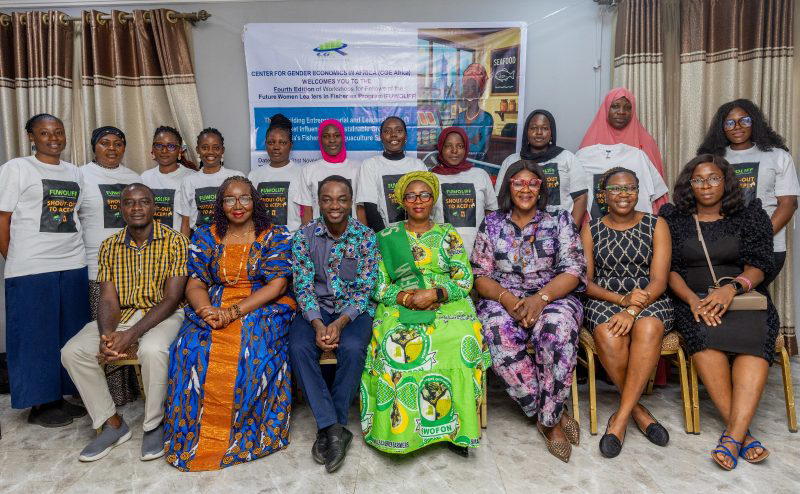
As part of efforts to strengthen women’s participation and leadership in Nigeria’s blue economy, the Centre for Gender Economics in Africa, CGE Africa, has trained postgraduate female students in Fisheries and Aquaculture from four South-Western universities under the fourth edition of the Future Women Leaders in Fisheries Programme, FUWOLIFP.
The FUWOLIFP initiative is part of CGE Africa’s broader mission to prepare young African women as innovators, policy influencers and enterprise leaders in fisheries, aquaculture and the wider blue economy.
The one-day workshop, funded by the Africa Centre for Energy Policy, ACEP,, focused on the theme: “Building Entrepreneurial and Leadership Skills for Market Influence and Sustainable Growth in Nigeria’s Fisheries and Aquaculture Sector.”
Speaking at the event, Executive Director of CGE Africa, Uchenna Idoko, said the programme was designed to deepen the entrepreneurial capacity, market literacy and leadership competence of young women preparing for careers in the fisheries and aquaculture value chain.
According to her, “Women play a vital role in Nigeria’s fisheries and aquaculture value chains, yet they continue to face limitations in accessing markets, finance, leadership roles and visibility. Strengthening their entrepreneurial capacity is key to enhancing their resilience and contribution to climate-smart development.”
She explained that the fellows were trained to gain improved market literacy and entrepreneurial competencies; develop mini business action plans; acquire strategies for accessing value-chain opportunities; strengthen leadership posture and visibility; and understand how to build, structure and scale sustainable enterprises.
One of the facilitators, National PRO of the Connection of Stakeholders in Agricultural Mechanization, CONESAM, Dr. Aisha Ime-James, stressed the need for women in aquaculture to formalise their businesses, build capacity and adopt proper corporate governance practices.
She said many women struggle to scale because “they want to do everything themselves, they do not pay consultants, they don’t keep proper books, and their businesses are not registered. Agro is risky, and banks will not support you if you are not structured.”
Ime-James urged the participants to specialise within the value chain, embrace record-keeping, work with experts, insure their businesses, and explore less capital-intensive entry points such as feed processing, packaging or by-product utilisation.
Another facilitator, the President of Dew Empowerment Foundation, Dr. Funmilayo Arowoogun, emphasised the need for female researchers to convert their knowledge into income-generating ventures. She noted that “without structures, businesses cannot grow or attract funding,” adding that leadership capacity, business modelling and proper planning were essential for their success.
Sharing her experience, the President of Obonge Women Multipurpose Cooperative, Mrs. Chinasa Asonye, advised the participants to form cooperatives to enhance access to mentorship, markets, and funding. “Networking is paramount. Together you can grow, learn from each other, and build sustainable enterprises,” she said.
A fellow of the programme and PhD student at the University of Ibadan, Josephine Adebayo, described her experience as transformative. She highlighted the extensive training across four workshops including gender and visibility in the blue economy, climate change adaptation, legal frameworks, academic writing and grant applications, and finally, entrepreneurship and leadership.
According to her, the fellowship has improved her leadership competence, digital visibility, academic development, and understanding of opportunities within Nigeria’s aquatic ecosystems.
She however pledged to apply the skills gained to her research, teaching career and future ventures.
Disclaimer
Comments expressed here do not reflect the opinions of Vanguard newspapers or any employee thereof.