
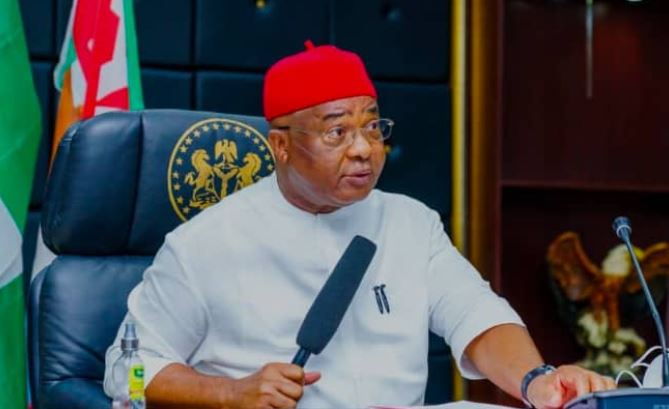
Governor Hope Uzodimma
By Juliet Umeh
Imo State Governor, Senator Hope Uzodinma, has called for the constitutional recognition of traditional rulers in Nigeria’s governance system, saying their exclusion from the political framework has created a vacuum in community administration and grassroots development.
Uzodinma made the call in his keynote address at the opening of the National Council of Traditional Rulers of Nigeria, NCTRN, meeting held in Lagos.
The event, themed “The Traditional Institution: The Imperative of Its Inclusion in Effective and Efficient Governance in Nigeria,” brought together prominent monarchs, governors, and policymakers from across the federation.
The Governor, who served as Special Guest of Honour and keynote speaker, said the time had come for Nigeria to correct a “historic omission” by legally acknowledging the indispensable role traditional institutions play in promoting peace, justice, and social order.
He said: “Across the country, traditional rulers continue to carry out responsibilities essential to the stability and cohesion of our communities. Yet these responsibilities remain informal, acknowledged in principle but not secured by law.”
Uzodinma recalled that before Nigeria’s transition to the presidential system, traditional rulers were part of the governance structure under the 1963 Republican Constitution, noting that “the Oba of Lagos was listed as an ex-officio member of the Senate, while the Northern, Western, Mid-Western, and Eastern Regions had Houses of Chiefs where royal fathers played legislative and advisory roles.”
He blamed subsequent constitutions for erasing that recognition, saying the 1979 and 1999 Constitutions “excluded the traditional institution from governance,” leaving a vacuum in community leadership despite their continued contributions to peace and justice.
According to him, “This is not about nostalgia; it is about institutional memory and legal continuity. Our royal fathers are still performing vital functions daily, settling disputes, preserving heritage, and mediating between government and the people, even without constitutional backing.”
Citing examples from other African democracies, the governor urged Nigeria to learn from Ghana, South Africa, and Namibia, where traditional rulers are constitutionally recognised.
He said: “Ghana’s 1992 Constitution guarantees the chieftaincy institution, while South Africa’s and Namibia’s constitutions explicitly recognise traditional leadership and provide for national councils of chiefs to advise government. If they can give constitutional expression to their traditional systems without compromising democracy, why not Nigeria?”
The Imo governor also appealed to royal fathers to remain neutral and non-partisan, noting that their moral authority depends on their impartiality.
He said: “Our traditional rulers must continue to stand as beacons of peace and unity, not political actors. Their influence and moral weight are strongest when they rise above partisan considerations.”
Other speakers at the event, including the Sultan of Sokoto and Co-Chairman of the Council, His Eminence, Sa’ad Abubakar III, and Lagos State Governor, Mr. Babajide Sanwo-Olu, commended the traditional institution’s contributions to peace and stability.
The Sultan urged Nigerians to rise above ethnic and political divisions, saying: “Whatever challenges we face as a nation are not insurmountable. We must confront them together with honesty and love for one another.”
Sanwo-Olu, on his part, reaffirmed his administration’s partnership with royal fathers, describing them as “true custodians of Nigeria’s moral and cultural fabric.”
The meeting, attended by top monarchs including the Ooni of Ife, Oba Adeyeye Ogunwusi, and the Obi of Onitsha, Igwe Alfred Achebe, ended with a unified call for constitutional reforms to strengthen collaboration between government and traditional institutions.
Disclaimer
Comments expressed here do not reflect the opinions of Vanguard newspapers or any employee thereof.