
…as smallholder farmers to access finance, upscale food production
By Gabriel Ewepu
ABUJA – IN a quest to drive agricultural inclusivity, the National Agriculture Development Fund, NADF, and Jigawa State Government have partnered to develop the nation’s first-ever agricultural lending de-risking framework in the country.
Nigeria’s efforts to achieve food self-sufficiency and inclusive agricultural growth is receiving a major boost as the National Agriculture Development Fund (NADF) and Jigawa State Government, jointly launched an initiative to develop the first-ever sub-national agricultural lending de-risking framework in the country.
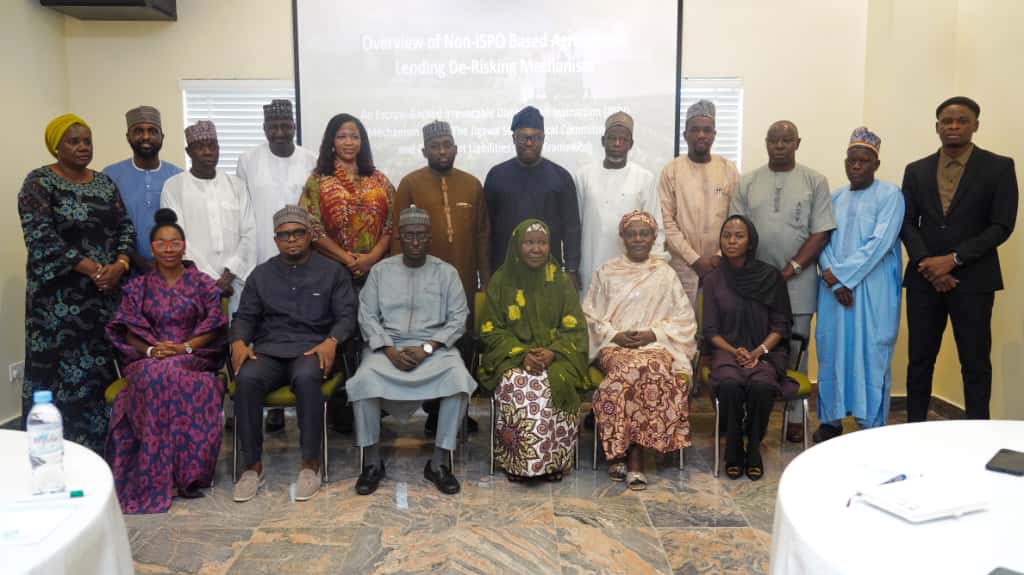
Meanwhile, a two-day co-design workshop with the theme ‘Jigawa State Agricultural Lending De-Risking Model’, became the catalyst to make financial lending accessible for smallholder farmers and agribusinesses as it would add value to their operations, through innovative and state-led financial risk management mechanisms.
In ha remark, the Executive Secretary, NADF, Mohammed Ibrahim, explained that the initiative represents a bold and practical approach to take out persistent barriers farmers have been limited with as far as agricultural lending is concerned.
Ibrahim said: “Persistent barriers to access to finance for smallholder farmers and agribusinesses cannot be overemphasized.
“If state-led mechanisms like this are put in place, those barriers can be easily surmounted.
“National-level financing bodies like ours have done well, but a bottom-up approach led by state governments, tailored to their peculiarities, will have greater impact.”
He further stated that the NADF, established by an Act of Parliament in 2022, plays a statutory role in bridging the national and sub-national agricultural finance ecosystems and that also has remained a major focus in order to create that synergy between the national and sub-national instead of placing farmers under pressure and frustration.
Therefore, the NADF boss assured that the Fund will provide technical guidance to ensure the success of the Jigawa pilot model while it facilitates partnerships at every level of governance to boost food production, strengthening farmers’ resilience, boosting profitability, and providing financial accessibility.
“Our role is to bridge finance ecosystems and facilitate engagements for the entire agriculture sector.
“This is a bold initiative, and with the technical assistance of Propcom+, (A UKAid-Funded programme), we will do our very best to ensure it succeeds”, he added.
Meanwhile, the representative of the Jigawa State Government, the Director General, Jigawa Agricultural Transformation Agency, JATA, Dr Saifullahi Umar, reassured Jigawa State’s readiness, resolve and commitment to driving agricultural transformation through innovation, private sector inclusion, and strategic partnerships in the. State.
Umar also disclosed that Jigawa State has invested nearly $30 million in agriculture over the past two and a half years on mechanization, input financing, and rural infrastructure.
However, he pointed out that the financing needs of the state’s vast agricultural sector, valued at N3.4 trillion, remain enormous and daunting.
“Our mechanization programme cost about $17 million, and input financing, especially for rice, was around $7 million”, he said.
He further stated that “But government alone cannot meet the capital requirements of agriculture. We need to attract private investors and financial institutions into every link of the value chain, from input supply and production to processing, marketing, and distribution.”
Interestingly, Jigawa’s agricultural potential is vast – 2.4 million hectares of arable land, 3.6 million cattle, and over 6 million sheep and goats, the state is already one of Nigeria’s top producers of rice, wheat, and sesame. It currently produces 2 million metric tonnes of rice annually and aims to reach 4 million metric tonnes by 2030.
“That would not happen without the right financing. We must create an enabling environment and mechanisms that attract private sector investment and ensure sustainable financing for farmers”, he said.
Meanwhile, according to the Head of International Partnerships, NADF, Naona Usoroh, in a remark explained that the framework is being co-designed with technical support from Propcom+, with NADF, leading the initiative to ensure, amongst others, that the Framework aligns with national agricultural plans and policies, global best practices, and climate-smart principles.
“Our mission is to be Nigeria’s leading catalytic institution driving inclusive, resilient, and commercially viable agriculture.
“Through this initiative, NADF will help states like Jigawa develop de-risking models that ensure not only affordable but also sustainable financing for smallholder farmers”, Usoroh said.
She also explained that the model will focus on four key pillars, framework development including; financial innovation, policy alignment, and institutional capacity building.
The framework is expected to enhance transparency and attract private capital by ensuring that every N1 of state commitment generates multiple inflows from development partners and financiers.
“We want to move away from one-off project financing to systems that sustain themselves. The idea is to create a catalytic effect that multiplies investment and ensures continuous access to affordable finance”, she added.
The workshop also highlighted Jigawa’s strategic readiness to lead the pilot, anchored on strong policy reforms under Governor Umar Namadi’s administration.
Recent legislation, such as the Ministry of Livestock Development Law and the Jigawa Agricultural Transformation Service (JATS) Law, has established institutional frameworks to industrialize agriculture, formalize livestock value chains, and promote climate-resilient practices.
Jigawa’s 2024–2030 Agricultural Policy further envisions transforming the state into West Africa’s leading hub for agricultural production and processing, emphasizing food security, youth and women empowerment, and private sector collaboration.Under these reforms, the state has already constructed over 800 kilometers of rural access roads, empowered 300,000 women and youth, and attracted national recognition for leadership in agricultural innovation and productivity.
Also speaking was the Strategy Director, Propcom+, Dr Olumide Ojo described the initiative as a crucial step in promoting inclusive finance and climate resilience.
The programme’s access-to-finance strategy focuses on business readiness, capacity building, and innovative product design for underserved farmers.
If successful, the framework could serve as a national template for other states, accelerating Nigeria’s agricultural transformation agenda and contributing significantly to food security and rural development.
Disclaimer
Comments expressed here do not reflect the opinions of Vanguard newspapers or any employee thereof.