
By James Ogunnaike, Abeokuta
Education stakeholders in Egbaland have called for collective action and renewed commitment to reposition the sector as the bedrock of development, stressing that the task of reviving education cannot be left to government alone.
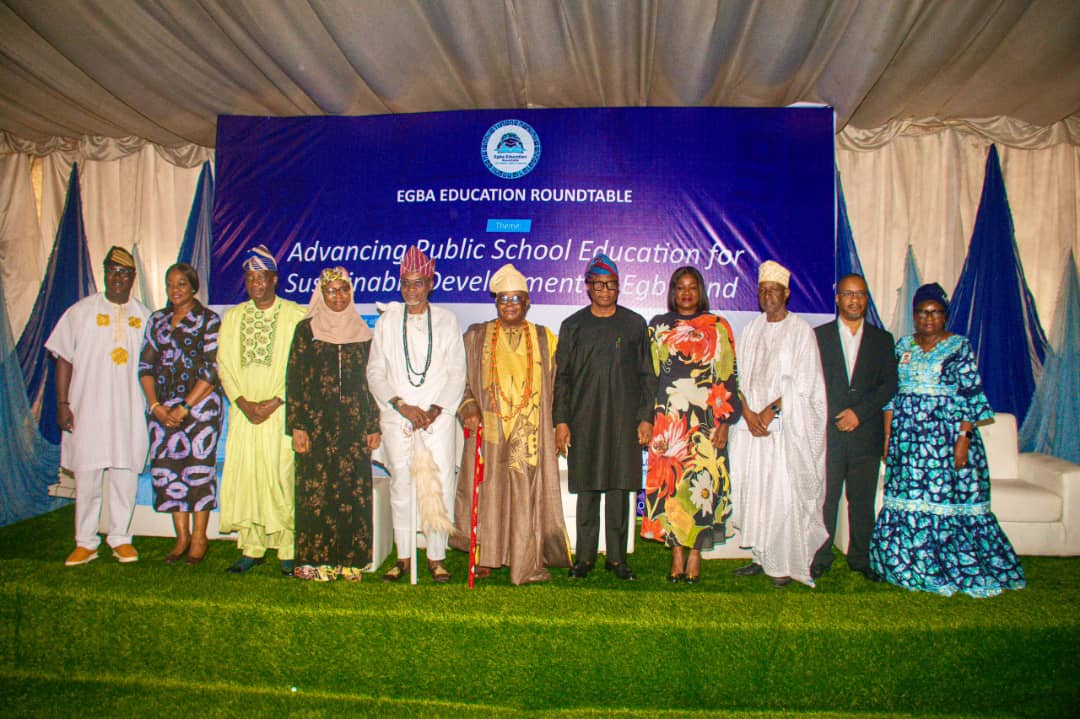
The call was made at the Egba Education Roundtable held at the Olusegun Obasanjo Presidential Library (OOPL), Abeokuta, where eminent personalities, traditional rulers, and policymakers gathered to chart a new course for educational advancement in Egbaland and Ogun State at large.
The Egba Education Roundtable was jointly put together by six non-governmental organisations, including; J.A. Akintobi Science Education Foundation, Femi and Mope Coker Foundation, Chief Dr. Moses Adekoyejo Majekodunmi Foundation, Oba Matemilola Oluyalo Otileta VII Foundation (OMOOF), AG Leventis (Egba) Scholarship Scheme and the Egba Heritage Foundation to examining their various areas of focus in providing educational support to public school students in Egbaland.
Speaking at the programme, the Alake and Paramount ruler of Egbaland, Oba Adedotun Gbadebo, emphasized the importance of continuous engagement among stakeholders to address the multifaceted challenges confronting education, noting that government alone cannot tackle these issues within a short time, describing the roundtable as “timely and visionary.”
Also speaking, the Olowu of Owu Kingdom, Oba (Prof.) Saka Adelola Matemilola, highlighted four crucial pillars for effective learning, which include the learner, the teacher, the content, and the environment, advocating that learners must be shielded from distractions, while teachers must remain current and well-supported to deliver knowledge effectively.
He further stressed that parents must instill sound values at home, while the learning environment must be conducive for intellectual growth.
On her part, the State Commissioner for Health, Dr. Tomi Coker, noted that Egbaland has a rich legacy of producing highly educated individuals who have excelled globally, lamenting that recent developments however demand innovative and collaborative approaches to sustain the legacy.
“Egbaland has a foundation of education, but presently, there aren’t many Egba people in prominent positions. This roundtable is to explore new ways to ensure that future generations continue to uphold our proud tradition of excellence,” she said.
Delivering the keynote address titled “Repositioning Education as the Bedrock of Egba Development,” the State Commissioner for Education, Science and Technology, Prof. Abayomi Arigbabu, underscored the centrality of teacher quality in educational outcomes, saying the quality of education cannot rise beyond the quality of its teachers.
He added that training, retraining, and digital literacy must be prioritised, while also advocating entrepreneurship and vocational education as integral to modern learning, noting that institutions such as TASUED have already begun integrating such courses into their curriculum.
Prof. Arigbabu further urged increased investment in libraries, laboratories, and infrastructure to enhance learning, reiterating that education must remain a right, not a privilege.
In the communique issued at the end of the programme, the stakeholders emphasized the need to reposition public schools as reputable citadels of learning as in the past, where every child can access quality education that captures the current global trends.
“It is important to ensure that learners can compete internationally, that is, using global trends to address local challenges.
There is need for non-governmental organizations, such as this forum, to collaborate in exploring other areas to address existing gaps in existing interventions”.
The communique jointly signed by Prof. Ajao Adelekan, Dr. Adebayo Akintobi and Mr. Richard Uwayzor noted that there is need for the establishment of an Egba Education Advancement Fund, towards the provision of infrastructure, bridge gaps in public schools in the area.
“There is need for proper mentorship of learners to assist them in succeeding in their various fields of learning. Standardization of intervention process to ensure uniformity across different schools; provision of a central database that will capture all existing interventions to reduce duplication of efforts.
They added that “teachers should be encouraged to desist from preferential treatment of students.
Creation of an endowment fund specifically to periodically reward outstanding teachers and encourage performance”.
Disclaimer
Comments expressed here do not reflect the opinions of Vanguard newspapers or any employee thereof.