
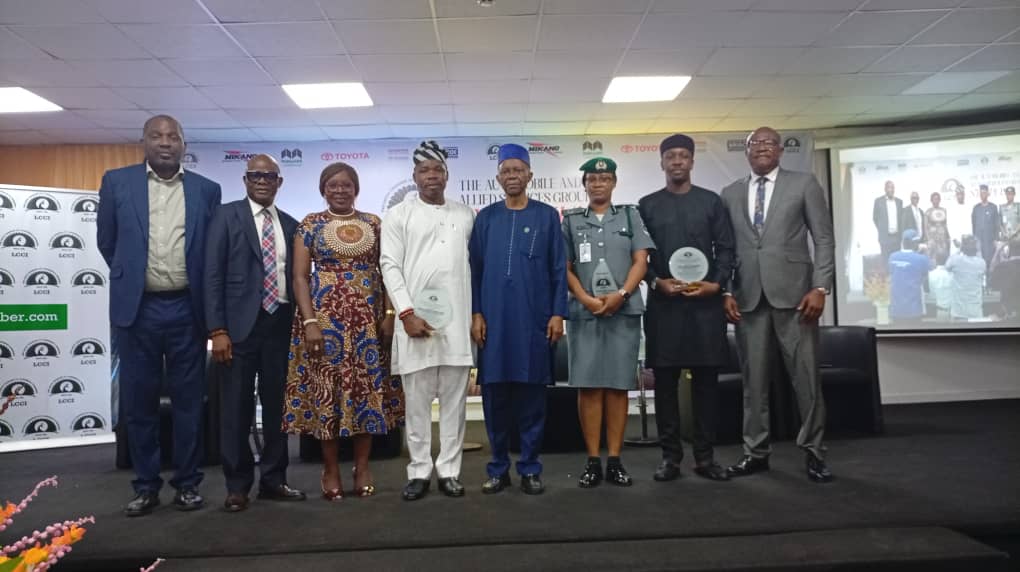
From left:Ufuoma Umukoro, Director of Sales, Coscharis Motors, Dr Femi Eguakhide, Chairman, LCCI Auto Sub-Sectoral Group, Dr Chinyere Almona, DG LCCI, Otunba Chief Joseph Oluwemimo Osanipin, DG NADDC, Gabriel Idahosa, President/Chairman of Council LCCI, Assistant Comptroller of Customs, Limai Okuwakemi, representing the CG of NCS, Syam Abdulkadir, National Operations Manager of Mikano Motors and Otunba Kunle Jaiyesimi, Deputy Managing Director of CFAO Mobility during the Auto Summit held on Wednesday, October 8th, 2025 in Lagos.
*Non-Passage Stalling Industry Growth, says Osanipin
By Theodore Opara
The Director-General of the National Automotive Design and Development Council (NADDC), Mr. Joseph Oluwemimo Osanipin, has expressed concern over the continued delay in the passage of the Nigeria Automotive Industry Development Plan (NAIDP) Bill, warning that the situation is stalling vital investments and slowing growth in the automotive sector.
Speaking at the 2025 Automobile Symposium organized by the Lagos Chamber of Commerce and Industry (LCCI) and its Automobile and Allied Services Group, Osanipin noted that the policy, once signed into law, has the potential to unlock the industry’s full potential.
“The NAIDP has been our roadmap for developing Nigeria’s automotive industry. But the inability of lawmakers to pass this comprehensive policy into law remains a major hindrance,” he said.
Osanipin explained that the NAIDP is anchored on five key pillars: investment promotion, market expansion, local content development, skills acquisition, and financing. While progress has been made—especially in market expansion and capacity building—he stressed that a solid legislative framework is essential to sustain momentum.
According to him, NADDC has already established 18 training centres across Nigeria, equipping over 30,000 technicians with relevant skills to support the local industry. In collaboration with the Association of Local Content Manufacturers of Nigeria (ALCMAN), the Council has also identified several vehicle components that can now be produced locally.
The DG further highlighted efforts to transition towards cleaner energy in the sector, revealing that solar panel installations have been completed to support the deployment of new energy vehicles, while CNG (Compressed Natural Gas) vehicle adoption is being promoted through technician training and financing support.
However, Osanipin emphasized that these achievements will have limited impact without legislative backing.
“Nobody wants to commit serious capital to the auto industry without adequate laws to protect their investments,” he noted.
He added that NADDC is actively engaging with key agencies—including the Standards Organisation of Nigeria (SON), Nigeria Customs Service, and the National Assembly—to resolve contentious issues in the draft bill and ensure its prompt passage.
President and Chairman of Council at LCCI, Mr. Gabriel Idahosa, applauded NADDC’s efforts and called for urgent policy refinement. He emphasized the need for a balanced and competitive tariff structure, warning that continued delays could worsen unemployment and weaken local manufacturing.
Chairman of the Automobile and Allied Services Group, Mr. Femi Eguaikhide, said with the right legislative support and investment incentives, Nigeria’s automotive industry could become a significant foreign exchange earner.
“This symposium is about tackling the real challenges caused by the NAIDP bill’s delay and exploring strategies to strengthen local manufacturing,” Eguaikhide said.
During the interactive session, Mr. Syam Abdulkadir, National Operations Manager at Mikano Motors, described the absence of legislation as the sector’s biggest obstacle.
“Once the legal framework is in place, everything else—investment, growth, innovation—will follow,” he said.
Deputy Managing Director of CFAO Mobility Nigeria Ltd, Mr. Adekunle Jaiyesimi, pointed to currency instability as another critical barrier to growth. He contrasted Nigeria’s situation with Benin Republic, where consumers have better access to auto loan schemes, making vehicle ownership more affordable.
He urged NADDC to deepen engagement with local representatives of global auto brands to drive industry-specific policy actions.
Chairman of ALCMAN, Mr. Anselm Ilekuba, described Nigeria’s automotive industry as a strategic pillar of economic growth, lamenting that the absence of enabling legislation continues to erode investor confidence.
“The prolonged delay in passing the NAIDP bill is discouraging investment and stifling growth. If passed, we will see significant progress in local production and value chain development,” he said.
Ilekuba also condemned the current policy inconsistencies, calling for a legal framework that protects local component manufacturers and ensures long-term investor security.
The symposium closed with a unified call from stakeholders for the urgent passage of the NAIDP Bill. Consensus among participants was clear: the bill is not just necessary—it is critical to the survival and future of Nigeria’s automotive industry.
With the right legislation, stakeholders believe Nigeria can become a regional automotive powerhouse, attracting OEMs, creating jobs, and boosting industrialisation.
Disclaimer
Comments expressed here do not reflect the opinions of Vanguard newspapers or any employee thereof.