
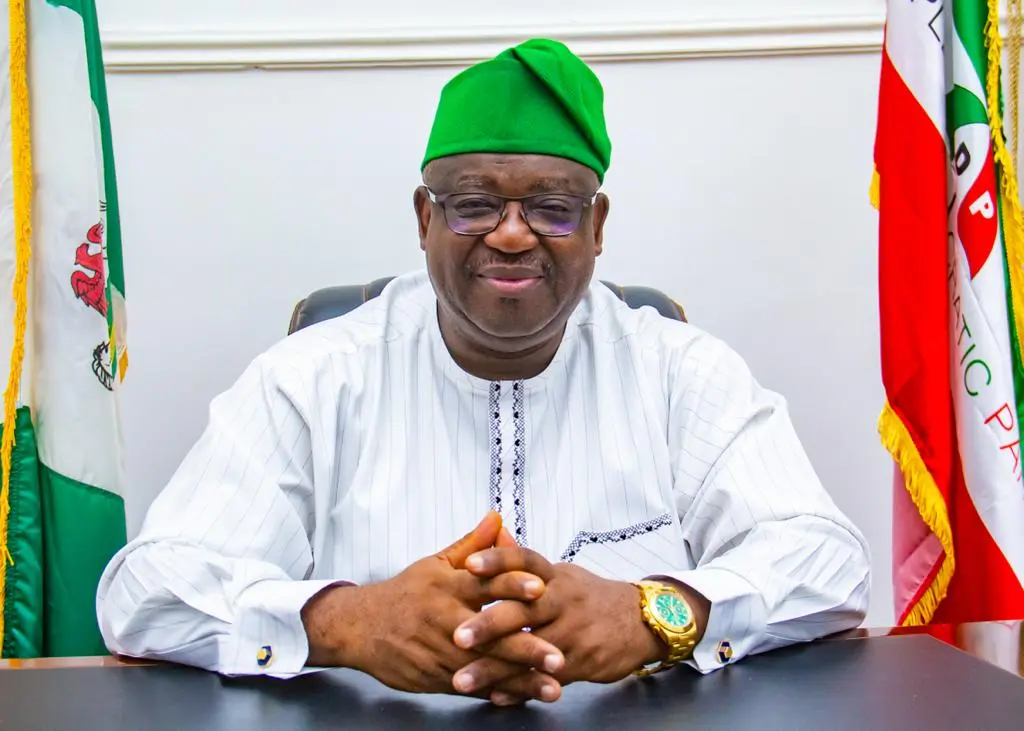
Gov. Caleb Mutfwang
By Marie-Therese Nanlong
Governor Caleb Mutfwang in this concluding part of an interview with Nigerian Guild of Editors, NGE, first published on Sunday September 21, 2025 speaks on challenges before the Peoples Democratic Party, PDP, 2027 polls and governance in Plateau among others.
Read Also: Only Kwankwaso, Kwankwasiya Movement planning APC defection – NNPP
When you came into office, what were your plans, and how are you executing them?
If anybody tells you that he has a complete picture before coming into government it’s a lie. No, it’s not possible. You know, when you are outside and campaigning, you are like a man sitting on top of a hill or mountain and looking at people meandering below the mountain, you’ll be wondering, why is this man cornering like this? Why is he not going straight? Until you come down, then you will know that the jungle is different.
Certainly, we had many ideas, but when we came in, we had to know the reality of the situation, even now, I can tell you that nobody knows all, because the dynamics keep changing. You know, the dramatis personae at all levels of government sometimes determine what happens. So, sometimes you are like a football coach. You play according to the strength of your players, not according to the philosophy of your game.
What are the efforts in tourism that Plateau State has a natural advantage?
Tourism investment is something we are working on very strenuously. We have an agreement with the UNDP to develop a tourism master plan. You know, all that you’ll be hearing in tourism is haphazard. Now we are trying to be more methodical, so that we can lay some basic rules on ground.
We know what the spaces for tourism are, but we are doing it alongside the tourism infrastructure. You can’t do tourism without hospitality. They go hand-in-hand. We’re trying to make sure that we do the best we can do before those plans come in.
Plateau has been identified as one of the most expensive states to live in the country. What are you doing about the cost of living in the Plateau?
I’m made to understand that houses in Jos are quite expensive. And honestly, we’re still cracking our heads on how to intervene, but it’s a function of demand and supply. So, we are going to be doing our best to see how we can throw more houses into the basket. Last week, I laid the foundation for a housing estate for civil servants.
My Commissioner of Housing told me we have other lands that have been cleared so that we can begin developing housing estates. We hope that we will add more houses to the basket, within the next two years. But in the meantime, we’re still thinking of how to appeal to landlords and homeowners, even Lagos that passed a law, it’s not working. It’s going to be very difficult, but we’ll continue to explore ways and means of reducing the burden on people.
What’s being done to reduce post-harvest losses?
Our farmers on the Plateau have been receiving the short end of the stick for decades, and that’s why, when we came in, we set up the Plateau commodities marketing company. Last year when we had eggs glut, we mopped up the excess eggs, paid, and shared the eggs to schools so that farmers won’t be short-changed.
This year, the prices of crops have also dropped, especially maize, because there was a massive importation. We are in the process of seeing how we can help farmers to reduce their losses. We haven’t concluded yet, but we are thinking very seriously that we should be able to add some value to farmers and then mop up the excess and see how we can process it into other products that will be better consumed. And so for us, Plateau Commodities Marketing Company is an older brother to what the Lagos government did about the Lagos produce market. We started before them, but, you know, we don’t have the money Lagos has, but we are hoping that David will kill Goliath. We will get there.
What are you doing to ensure a free media space for professionals to do their jobs without any fear of sanctions?
It will interest you to know that we are passionate about the freedom of the media. I don’t think there’s any media house on the Plateau that will say we have been hostile, or we have attempted to gag them or to determine the way they operate. We have always believed in the freedom of the press. We deliberately chose not to have skeletons in our cupboards. But because government is a continuum, there are some things that come out today with which you can use to accuse the government, but you go and find out, the roots of that problem were before we even came on the scene.
We believe that constructive criticism is not bad, and when you deal with facts, not where you invent lies. You know the Plateau version of APC is made up of many liars, and they will invent a lie, package it, then they ask you to defend. That is their modus operandi. And we don’t come down to such levels. We don’t want to do that. But when you bring out facts, if we are wrong, we’ll own up. There’s no big deal about owning up that you did wrong. There’s honour in it. When we had some issues about employment and we tried to correct it, there were lots of what I call mistakes. They were deliberate mischief in employment before the last government left, and we came in and found the situation. We suspended all the employment in our bid to correct it. Some mistakes were made, and when the mistakes were pointed to us, we owned up and we corrected them. So there’s no big deal about it.
We will always encourage the media to do their job. But let me say this, the media has to sometimes weigh the reportage, the consequences of what you report. And for many years, we felt Plateau was being targeted by some sections of the media, because I’ve seen ridiculous headlines where something happened 84 kilometers from Jos yet the headline is ‘Jos boils again.’
We don’t believe in suppressing all the tragedies that have happened, but sometimes the reportage, if you go to the European embassies today, many of them would warn their citizens against coming to Plateau, for example, because of the reportage, and we sometimes plead with the reporters, please weigh the consequences before you put it out there. And some have listened to us, which we are grateful for and we appeal to the media to do your best to de-escalate the situation. If you had that at the back of your mind, you are going to report in such a way that tensions will be de-escalated, I think it will help the society generally.
What are the steps to mitigate land grabbing?
Like I said, it’s a dynamic thing you cannot proffer one solution, even if you make laws, implementing them is another ball game. There’s a lot but what I can tell you is that the plans we have put in place have worked, Plateau State today does not have one single local government that is a no-go-area. That is the difference between us and the North-West or North-East or Niger. There are local governments in Niger, Sokoto, Zamfara, today, you can’t say you are going there and expect to come back freely. But for us on the Plateau, by and large, I told you, what they do is they come in attack and flee. Our most vulnerable areas are the border villages. And because of the nature of our terrain, sometimes before securities personnel react, the damage has been done. That’s why we’re trying to open up more access roads into the villages to see how our response time can be reduced greatly. We’re doing a lot, looking at other options, legislative options, judicial options, administrative options to be able to slow down or even arrest land-grabbing entirely.
The Rogers committee report, I can assure you, will not gather dust. We are planning to even serialise some of the findings by God’s grace. One thing certainly that will happen is that I will forward the report to Mr. President. I’ll forward it to the heads of security agencies, so that at least we can begin to talk the same language and be on the same page.
What are the efforts to liaise with the federal government to repair the inter-state roads in the State especially, the Akwanga-Jos road, and others?
This is one road that I have personally pursued with interest, and I’m glad to inform you that Mr. President ordered that it be included among his legacy projects. So the design has been completed. As a matter of fact, the contract for the road was awarded in 2018 by President Buhari to CGC, a Chinese company. But we came in and we had to review some of the designs. Initially, at some point in time, the Ministry of Works was talking about expanding it into six lanes and doing a concrete road project, but I think things have settled now. We’re talking about four lanes and usual asphalt.
That is what I’m pursuing, and I hope it will succeed, and get the federal government, at least, to commit some money for the contractor to go to the site. So, the next battle has shifted to budget at the federal level, and I would also appeal to you to use your good offices to help us appeal that this is a critical Road, like you said, it’s a gateway to the North-East. This is something we can get done with before the elections are set in proper.
In 2026, where will you be?
I have said that my politics has been dictated by God and the people, and I believe there’s an alignment between God and the people of Plateau State, and they spoke well in 2023 and what they said in 2023 has not changed, to the best of my knowledge. And so I will always go with where God and
the people want me to be. We’re in a season of anomie. Each political season comes with its own dynamics, and so you have to measure your steps.
You have to look before you leap. I believe things will become clearer as the days go by. For now, all said and done, the worst fear people had about the Peoples Democratic Party, PDP, is gone. We got stuck at a point, but I think that PDP is back on its road, where it will get to only God knows. But for now, we’re in good place, let me leave it at that.
Disclaimer
Comments expressed here do not reflect the opinions of Vanguard newspapers or any employee thereof.