
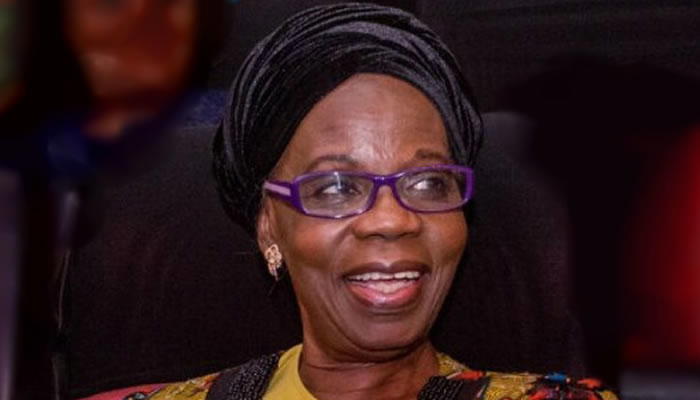
Doyin Abiola
By LANRE IDOWU
The passage of Dr. Doyin Abiola (nee Aboaba) on August 5 has rightly elicited an outpouring of tributes on her place in history. It is not an exaggeration to say no woman has matched her influence in Nigerian journalism history, and few men have surpassed it.
Throughout her lifetime, she was a record breaker. In 1979, when she earned a PhD in Journalism, she was the first Nigerian female to earn such a distinction. In 1980, as Editor of the National Concord, she became Nigeria’s first woman editor of a national daily. Six years later, she became the first Nigerian woman to head a national newspaper as managing director and editor-in-chief. In 1986, when she participated in the Eisenhower Fellowship, she was the first Nigerian woman to do so. In 1998, she and Bilikisu Yusuf were the first set of women named fellows of the Nigerian Guild of Editors. In 2010, she was the first woman to receive the Lifetime Award of the Wole Soyinka Centre for Investigative Journalism. In 2015, she was the second woman to receive the Lifetime Award of the Diamond Awards for Media Excellence for her lifelong devotion to advancing the frontiers of knowledge and strengthening the media as a pillar of democracy. Within five years, she became the first woman to win both major media awards.
Educated at the University of Ibadan where she earned a degree in English and Drama in 1969, she started her journalism career as a reporter with the Daily Sketch. There, she also kept a weekly column, “Tiro,” which addressed sundry issues of public concern, including gender matters, before she left for the United States in 1970 to pursue her Master’s programme in Journalism at the University of Wisconsin, Madison, USA.
From 1972 to 1975, she worked at the Daily Times as a Features Writer and rose to become the Features Editor. The Daily Times crisis of 1975/76 and the fouled atmosphere at the workplace offered her opportunity to embark on her doctoral programme in Journalism; so she travelled to the United States on study leave. In 1979, armed with her PhD, she returned to the Daily Times and was deployed to the Editorial Board where, in her words, “meetings were tutorials with informed arguments” in the company of such “cerebral people like Stanley Macebuh, Dele Giwa, and Amma Ogan.” It was, however, to be a short stay as the newly formed Concord Group of Newspapers soon invited her to be its pioneer daily editor.
Dr. Abiola’s Concord odyssey spanned three decades of a mixture of unbridled joy and agonising pain. Her privileged position allowed her to shape public opinion on issues and guide Concord Group into public reckoning and respect. Aside from the National Concord, the daily, and the weekly Sunday Concord, the group grew under her to introduce a revolutionary Saturday paper, called the Weekend Concord and three Indigenous language newspapers, Isokan, Amana, and Udoka. This was a daring effort at community reporting, which provided breadth for the Concord brand of journalism. The company also published state versions of its Community Concord, which oiled the political ambition of the publisher, Chief Moshood Abiola, whom Dr. Abiola had wedded after she joined the paper.
Being married to the Concord publisher, the late Chief Moshood Abiola, also meant that she was in the thick of the political crisis which engulfed the country after the June 12, 1993, presidential crisis. The frequent clashes with the political authorities and the attendant family feud affected the fortunes of the publishing group, which finally closed shop in 2001. “It was,” by her own admission, “a very intricate problem,” which she tried to resolve, but could not. “I really wish I’d been part of building an institution that will endure, that will outlive me as part of that institution” (see Femi Babatunde’s 2007 interview, “Journalism: Not for Wealth Aspirers” in Idowu, Lanre (2011) Watching the Watchdogs: Media Review at 20, pages 268-277.)
After her Concord days, she continued to lend her talents and time to the continued effort to mould the Nigerian media into a respectable institution through column writing, training, and mentoring. She kept a column with the Punch, served as the chairperson of both the Awards Nominating panel of the Nigerian Media Merit Award, and of CNN African Journalist of the Year Awards. Over the years, Dr. Doyin Abiola’s protégés have worked in public and private positions acquitting themselves admirably, which, in part, is a tribute to her.
I did not work with the late Dr. Abiola at the Daily Times or National Concord. She had left the Times before I joined, and while she was at Concord, I was at the Guardian. We interacted when I was at ThisWeek between 1986 and 1989, including events such as the 1987 African Concord Food Crisis conference in London, her husband’s installation as Are Ona kakanfo on January 23, 1988, in Oyo, and Chief Olusegun Osoba’s installation as Akinrogun Egba a week later in Abeokuta. On these occasions, Dr. Abiola conducted herself with the grace of a media CEO and publisher’s wife.
One interesting thing happened in Abeokuta. As the editor of ThisWeek, I was having an engaging conversation with Chief Abiola until I asked him to clarify what appeared like a discrepancy in his account of his infamous clash of January 25, 1988, with some Air Force officers in Lagos (dubbed in the press as the Mad Dogs’ episode). It was a question that he took on the wrong side, and he lashed out at me for spoiling his party mood. Dr. Abiola was within earshot and heard our conversation, and she urged me with pleading eyes to end the conversation. The following Monday, she phoned me to apologise on her husband’s behalf.
Later, when I published Media Review, Concord Press was one dependable subscriber. I was her guest at her father’s funeral in 1991, and she sent me a pretty picture frame when our first son arrived shortly after. We also met at various professional fora to discuss issues germane to the development of journalism. Until she became ill, and reduced her public outings, we had been discussing organising a series of seminars to address professional inadequacies in the industry. Her last recorded views on some developments in Nigeria are worth sharing.
On Government-Media interactions, she was not impressed with the role of various journalists as spokespersons. She told Richard Ikiebe in Nigerian Media Leaders: Voices Beyond the Newsroom Volume One, 2015, p7: “The executive arm of government, rather than engage the media directly as one of the stakeholders in national development, has chosen a dubious co-option alternative—employing a media adviser who is misused as a megaphone rather than a vital link between the executive and other arms of government and media….Official briefings should not be limited to crisis management but must be an ongoing dialogue with mutual respect for the truth which can make us all whole.”
The last word is for the media: “Journalism, contrary to popular belief, is not a profession for all-comers. Journalists should aim to be the brightest and best to play the functional role of informed watchdogs. They must have professional rules of operation and abide by a code of conduct. We must keep striving for professional excellence to regain trust and respectability. We need a transformational makeover to regain the moral authority of being the Fourth Estate of the Realm.”
May her soul rest well.•Idowu, FNGE, is Chair, BOT of the Diamond Awards for Media Excellence.
Disclaimer
Comments expressed here do not reflect the opinions of Vanguard newspapers or any employee thereof.