
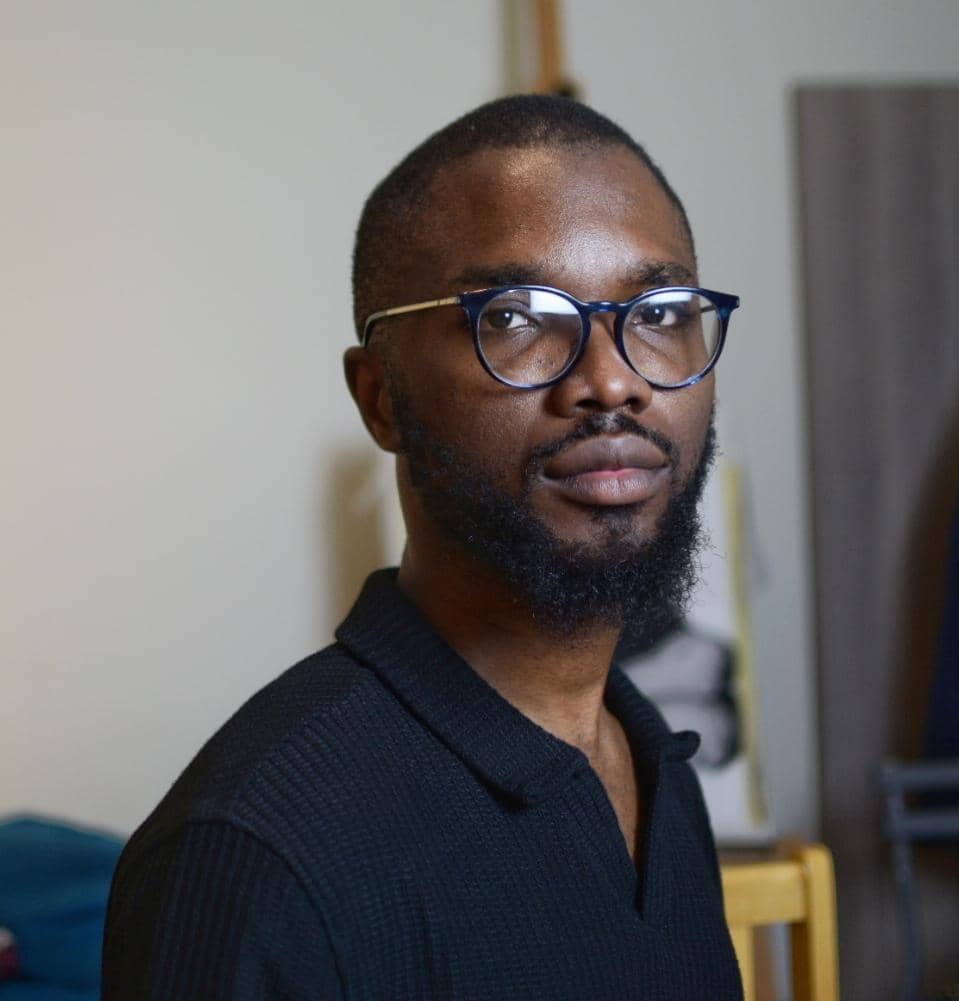
By Osa Mbonu-Amadi, Arts Editor
Hillary Emetuche’s artwork is a powerful testament to his mastery of complex formal textures and tonal nuances.
Over a decade of committed practice has enabled him to create evocative works that explore profound themes reflecting the human condition and his personal experiences.
His portraiture features familiar faces—from family and friends to public figures and models—rendered predominantly in graphite on paper, a medium through which he achieves rich, photographic effects with remarkable dexterity.
By skillfully manipulating tonal variations, Emetuche’s black-and-white figurative portraits achieve strikingly realistic and emotional results.
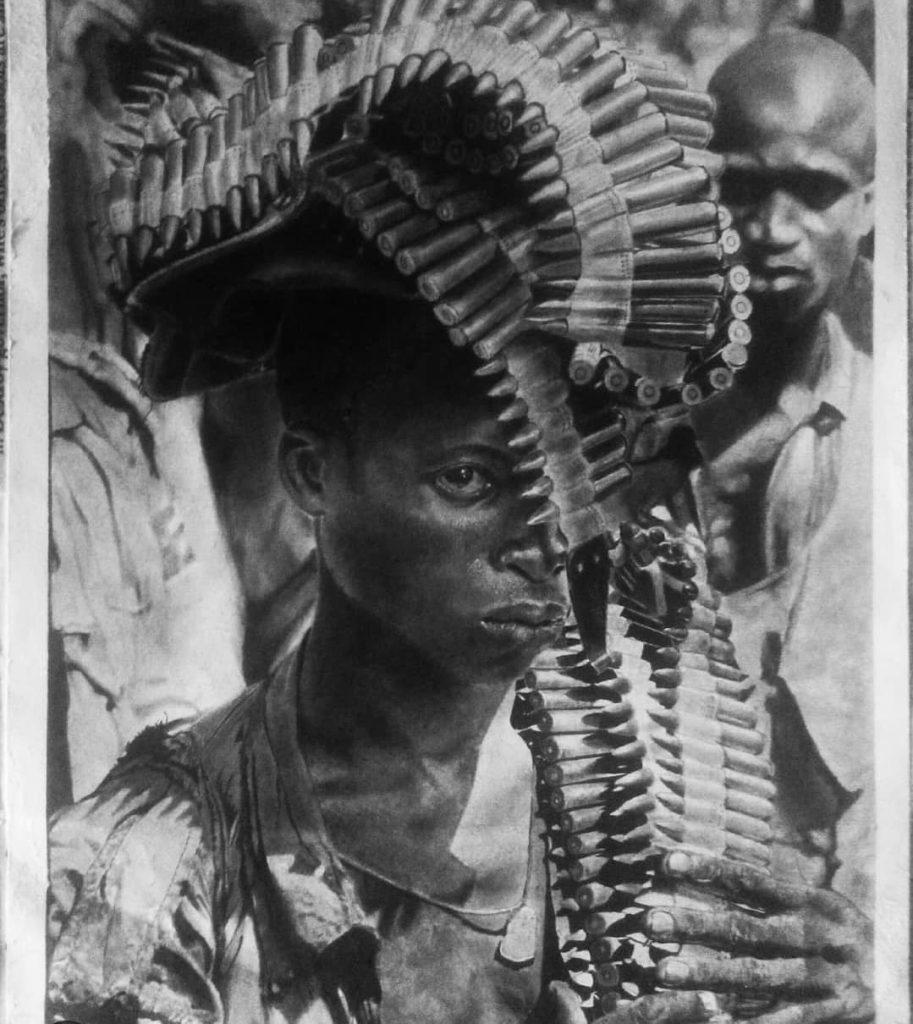
The central themes in Emetuche’s oeuvre are identity, society, and beauty. His works engage with socio-cultural issues rooted in Nigeria, where he lived prior to relocating to the United Kingdom for further studies. A poignant example is his graphite drawing titled Fusillade, dedicated to the French photographer, Gilles Caron, who took the picture. Fusillade depicts a young man clad in quasi-military attire, bearing folded machine gun bullets that encircle his head like a heavy scarf. The young man’s and a second figure’s faces convey a deep weariness and mourning. This piece draws inspiration from the heroic yet tragic narratives of the Nigerian Civil War (1967–1970), a brutal conflict between Nigerian federal troops and the breakaway Republic of Biafra that resulted in over two million casualties.
The scars of that war remain fresh in Nigeria’s collective memory and continue to inspire artistic expression. Similar themes are explored in Chimamanda Adichie’s novel Half of a Yellow Sun and the extensive body of work by artist Uche Okeke. Emetuche’s Fusillade and other Biafra-themed works affirm that the tragedy of war, though decades past, can inspire deeply reflective and moving artworks. Furthermore, these works resonate with contemporary insecurities in West Africa, subtly alluding to ongoing issues such as banditry and the Boko Haram insurgency afflicting Nigeria, Emetuche’s homeland. These crises have driven many disillusioned citizens to take up arms, resulting in widespread violence and suffering.

In another notable drawing, Emetuche portrays a young Igbo man wearing a traditional cap alongside a Western bow tie obscuring his mouth. This juxtaposition of contrasting cultural symbols poignantly reflects the liminal, often conflicted postcolonial identity many African societies grapple with today.
Emetuche deftly depicts a man caught between tradition and foreign influence. Despite the crown of the traditional cap, the wearer’s eyes are encircled with nzu (white chalk), symbolizing indigenous wisdom and seership. Yet, his voice is metaphorically muffled by the bow tie, representing colonial language and religion, which have overshadowed many native cultures. Among the Igbo people of southern Nigeria, English and its dialects have largely supplanted indigenous languages, a cultural erosion to which Emetuche responds with hope that his art will help rekindle pride and awareness in indigenous tongues.
Emetuche’s reflections on Nigeria’s social challenges also inspired his work titled Kalashnitoy, dedicated to victims of the 2020 EndSARS protests. These protests aimed to end the brutality of Nigeria’s Special Anti-Robbery Squad (SARS). The excessive force and violence used by police during mass protests galvanised many young artists, including Emetuche, who captured the turbulent spirit and resilience of the crowds. In Kalashnitoy, a drawing of a gun with a tap on its barrel and a baby’s hand on the trigger offers a striking metaphor: the juvenile recklessness with which some police officers wield guns. Despite the calm appearance of the piece, it carries a powerful critique of systemic violence.
Though Emetuche discovered his artistic talent early, he initially faced skepticism from family members who urged him to pursue other career paths. His skills matured during his studies at Michael Okpara University of Agriculture, Umudike, Nigeria. His artistic trajectory shifted notably in 2018 when the BBC’s Igbo Language service featured him for his use of art to promote Igbo culture. To advance his career, Emetuche now aims to innovate further and develop a more distinctive personal style.
Social media platforms like Instagram, alongside features in international magazines and local media, have helped Emetuche connect deeply with audiences, including family and friends, enhancing appreciation of his work. These engagements have expanded his recognition and resulted in more commissions. Since moving to the United Kingdom about two years ago, Emetuche has produced a significant body of work and actively participates in various artistic activities within his community and beyond.
Disclaimer
Comments expressed here do not reflect the opinions of Vanguard newspapers or any employee thereof.