
By Isaac N. Obasi
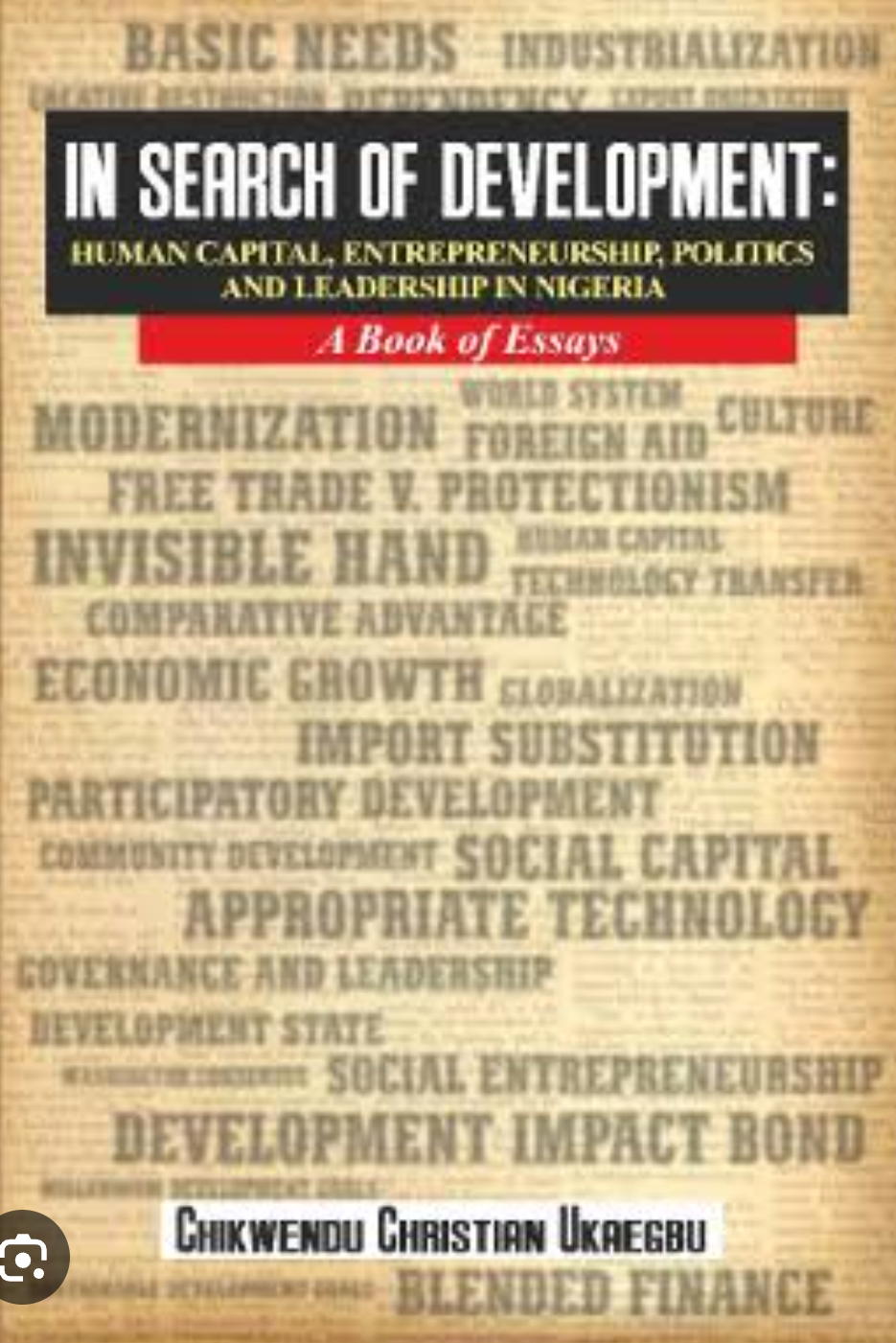
In Search of Development: Human Capital, Entrepreneurship, Politics and Leadership in Nigeria (A Book of Essays) is the title of a book written by Prof. C. C. Ukaegbu. Formerly of the University of Nigeria, Nsukka (UNN), Prof. Ukaegbu subsequently lectured in a couple of American universities, with visiting appointments in three other universities in Russia, Taiwan, and China. He retired as a Professor of Sociology, National and Global Development.
In this thought-provoking book, Prof. Ukaegbu discussed critically the complex relationships existing between and among four major variables in the title — namely human capital, entrepreneurship, politics, and leadership — in an intertwining manner that presents an interesting reading. One powerful central message we can draw from the interplay of the dynamics of these four parameters is that bad politics and leadership in Nigeria have, over the years, led to the gross under-utilization and/or mismanagement of her human capital and entrepreneurial resources. The book is, in various ways, an amplification of this central message.
Essentially, the essays in this book use ‘empirical research accompanied by theoretical insights to examine the nature and process of the political economy of development in Nigeria in four areas of human action historically strategic to the development of nations… The book observes that while human and natural resources abound in Nigeria, the search for national development which started at independence in 1960 continues without a clear path to a development destination.’
In Search of Development… is a 642-page book (excluding preliminary section numbering 22 pages). It is composed of 29 chapters organized in seven major parts. Given the constraints of space, it will not be possible to go into the details of these seven major themes and 29 chapters. The review will, however, provide a glimpse by drawing attention to the central theses of the book.
The book begins with an elaborate elucidation of the theories and concepts of development. It sees national development as the ability of citizens who, under the leadership of a developmental state, apply their mental and physical energies to transform their natural resources and social and economic institutions for individual and national self-actualization.
Put another way, national development is about growth and diversification of the economy, modernization of physical infrastructure, advancing education, science and technology, enhancing socio-political participation, building and maintaining an efficient bureaucracy, and using the dividends of changes in the economy and other social institutions to increase opportunities for citizens to improve their life chances and quality of life on a continuing basis. It is important to note that improvement of citizens’ ‘life chances and quality of life on a continuing basis’ is central to this conceptualization. By putting the citizens at the center of development, the author’s idea resonates perfectly well with those of foremost scholars in the field of development globally.
Can any nation develop without the effective utilization of her scientific and technological human capital? This question falls into one of the thematic issues addressed in the book. The verdict of the author is that the present high level of technological dependence by Nigeria is clear evidence that there is no effective utilization of her abundant scientific and technological human capital. As a professor of national and global development, the author is greatly pained that Nigeria is still technologically dependent because she would have advanced rapidly if she had utilized the benefits of her indigenous technological innovations and advancements recorded 65 years ago during her war with Biafra.
The author gave first-hand evidence of the ‘strategic role of indigenous human resource in general and science and technology manpower in particular in national development’, based on the experience during that period. According to him, on the Biafran side of the war, for example, armoured cars were built (though in crude form), bombs and bullets were produced (recall the mass killer bomb locally called ogbunigwe), there was significant inroad into building a rocket launcher, crude oil was refined and petroleum products were produced, an airport was built, and above all, there was effective and efficient management of research laboratories and workshops in an unprecedented manner.
The powerful argument of the author is that Nigeria’s technological progress would have taken a different trajectory away from dependency if these skills were harnessed.
Consequently, the author became passionate about how Nigeria can best use her human capital and entrepreneurial resources for her rapid progress.
With respect to the utilization of entrepreneurial resources, the author offered many policy options for the flourishing of entrepreneurship if there is good political and transformative leadership. One option offered is the use of imaginative policymaking as a tool for national development. The author gave an example of how to stimulate great economic activities across the country. According to him, if the National or State Assemblies propose a bill (anchored on the philosophy of environmental aesthetics) requiring all homeowners and landlords to paint their houses every five years (and with the right policy incentives to encourage the manufacturing of paints in Nigeria), then entrepreneurial activities would blossom through a fire of multiplier effects ignited in the paint manufacturing industry, i.e., employment of painters and carpenters, sellers of paints and brushes, ladders, etc.
This particular idea, which the author first espoused in The Guardian newspaper of Thursday, October 28, 2010, is being implemented in a few states in Nigeria today. Anambra State, for example, is leading in this under the government of Governor Charles Soludo. However, the nitty-gritty of its implementation has not been studied before this review.
Furthermore, for entrepreneurship to blossom, the author feels that the government has no business allowing the importation of products that can be produced in Nigeria. It should rather provide an enabling environment and give the right policy support. Fortunately, in this reviewer’s view, there is now a Nigeria First Policy adopted by the Bola Ahmed Tinubu administration which, if properly implemented, will stimulate the growth of local entrepreneurship. But as the author recalled, there was a period in this country when the federal government imported 60,000 waste bins worth one billion Naira (N1 billion) rather than encouraging their local production. An imaginative policy altering this, for example, can also generate similar multiplier effects in the plastic industry as in the paint manufacturing industry cited above. The examples of what imaginative policies can do to generate multiplier effects in many sectors of the economy are limitless.
Finally, for these things to happen, the author envisions ‘a political leadership that embodies courage and knowledge of the trajectories of development,’ and ‘a society in which political expression is not encumbered by debilitating parochialism,’ and where ‘the constraints posed by the geo-ethno-political structure of the country’ are resolved.
From the little said so far, In Search of Development… is an invaluable resource for policymakers and entrepreneurs, academics and students of public policy who want to move from theory to practice. Above all, it is a wake-up call to our scientists, engineers, and allied professionals to put on their thinking caps and confront the challenge of innovation necessary for the rapid development of Nigeria.
In conclusion, this book challenges us to rethink the way we do things that perpetuate dependency and underdevelopment rather than promote development. Nigeria should act now to change this mindset.
*Isaac N. Obasi is a professor of public administration at the University of Abuja.
Disclaimer
Comments expressed here do not reflect the opinions of Vanguard newspapers or any employee thereof.