
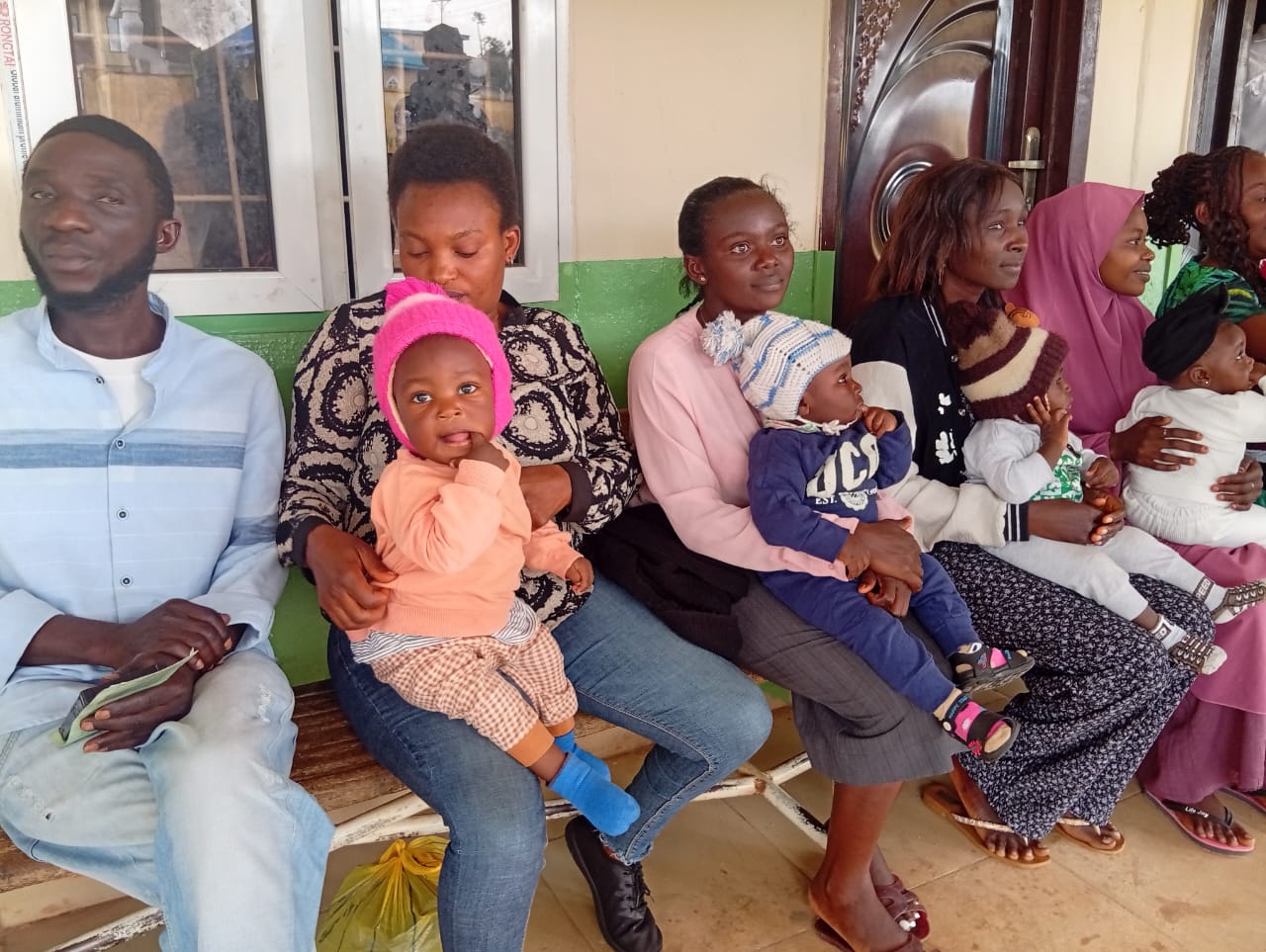
From left: Eric, his wife, and other mothers, and children at the PHC Bukuru Expressway
By Marie-Therese Nanlong
Jos – Despite economic hardship, and lean resources, at the diverse primary healthcare centres across Plateau State, families and health workers are uniting to confront the challenge of child malnutrition, especially among children.
Through exclusive breastfeeding from birth to six months of age, complementary feeding with local foods, between six and 23 months of age, testimonies reveal a growing movement transforming child health in the State.
In the past, the issue of child nutrition was largely left for caregivers, and mothers alone. Still, recently, fathers too are increasingly taking part to ensure an improved well-being of the children.
At the Primary Healthcare Centre, Bukuru Expressway, Eric Jimwan, a first-time father, shared how he supports his wife saying, “My wife and I have been coming here together since pregnancy. I make sure she follows the advice given, and I buy the recommended foods for the supplementary feeding,” he said.
Their baby, exclusively breastfed for six months, has stayed healthy with no illness apart from routine vaccinations, he confirmed, encouraging other men to do the same, because, “The outcome has been tremendous.”
Health workers emphasize that this level of involvement is crucial. Yerima Jacob, the Chief Nursing Officer in charge of the Bukuru Expressway PHC, explained, “During antenatal care, we emphasize exclusive breastfeeding for the first six months, then proper introduction of complementary feeding. We encourage husbands to participate and support their wives, and many comply.”
He discouraged dependence on imported baby food, stressing that “local grains and natural foods are healthier and more affordable.”
Mothers echoed similar confidence. Elizabeth David, who practiced exclusive breastfeeding, said complementary foods later eased the night burden of nursing. She enriches her one year, three months old child’s diet with millet, guinea corn, crayfish soybeans, and dates as natural sweeteners but lamented rising food prices.
At the Township Primary Health Centre in the Jos North LGA, other mothers shared their approaches. Dim Bridget fed her child exclusively for six months before introducing pap enriched with vegetables and fish. “He is active and healthy. I make sure his meals are rich, even if I don’t have much,” she said. Her husband also helps care for their child.
For Tabitha Solomon, personal experience inspired enterprise. She now produces and packages homemade complementary food for sale. “It’s cheaper and safer than artificial options. I know exactly what goes in,” she explained.
Similarly, Cynthia Raymond, whose child is three months old testified, “I practice exclusive breastfeeding, my baby hasn’t fallen sick even once. When he turns six months, I’ll start with local grains and vegetables.”
Health officials credit consistent health education, proper hygiene, and partnerships with agencies like UNICEF for the progress.
Paula Hata, the Nutrition Focal Person of the Jos South LGA noted, “We now see fewer cases of severe malnutrition. Local foods are healthier, and mothers are increasingly aware, and making use of them.”
While families embrace homemade methods, Plateau State is also scaling up modern nutrition interventions.
At a recent media dialogue in Jos, the UNICEF Nigeria, Bauchi Field Office Nutrition Specialist, Philomena Irene, underlined the urgency. “No child should die of malnutrition. Prevention is cheaper, it costs ₦21,000 to prevent malnutrition in one child, but ₦198,000 to treat a severely malnourished child,” she said.
Irene explained the need for the introduction of Small Quantity Lipid-Based Nutrient Supplements (SQ-LNS), made from groundnut paste blended with milk, oils, vitamins, and minerals.
The supplement, given between six and 23 months, fills essential nutrient gaps without replacing family meals. Research has shown it reduces child mortality by 27%, severe wasting by 31%, stunting by 17%, and iron-deficiency anemia by 64%.
“… The first 1,000 days of life, is scientifically proven window critical to lifelong development.
In Plateau State, according to the 2021 Multiple Indicator Cluster Survey, two out of every three children suffer from food poverty, meaning they lack access to the minimum dietary diversity needed for proper growth. Our goal is to mobilize awareness and foster government and community action to improve child nutrition outcomes,” she stated.
Irene revealed that Plateau State had committed $200,000 to procure the supplement, which UNICEF matched, providing over 5,900 cartons of SQ-LNS. A mother can receive about 30 sachets per month for each child while visiting the clinic for child welfare and immunization services.
“With the government commitment, father involvement, and community mobilization, we can reverse the trend of stunting and anemia in Plateau,” she emphasized.
Adding perspective, Silas Nansel, Plateau’s Deputy State Nutrition Officer, described SQ-LNS as “a step forward,” noting that when introduced during complementary feeding at six months, it could drastically cut malnutrition.
“Malnutrition remains a challenge, but with the government intervention, the numbers are reducing. If SQ-LNS is used properly, it will go a long way to ease the burden in Plateau State,” he affirmed.
From the testimonies of fathers, mothers, and health workers, Plateau families are proving that child survival does not depend on expensive solutions. Whether through exclusive breastfeeding, complementary feeding with local foods, or supplementation with SQ-LNS, a foundation for healthier children is being laid to rewrite the story of malnutrition in the State.
Disclaimer
Comments expressed here do not reflect the opinions of Vanguard newspapers or any employee thereof.