
By Chukwuma Ajakah
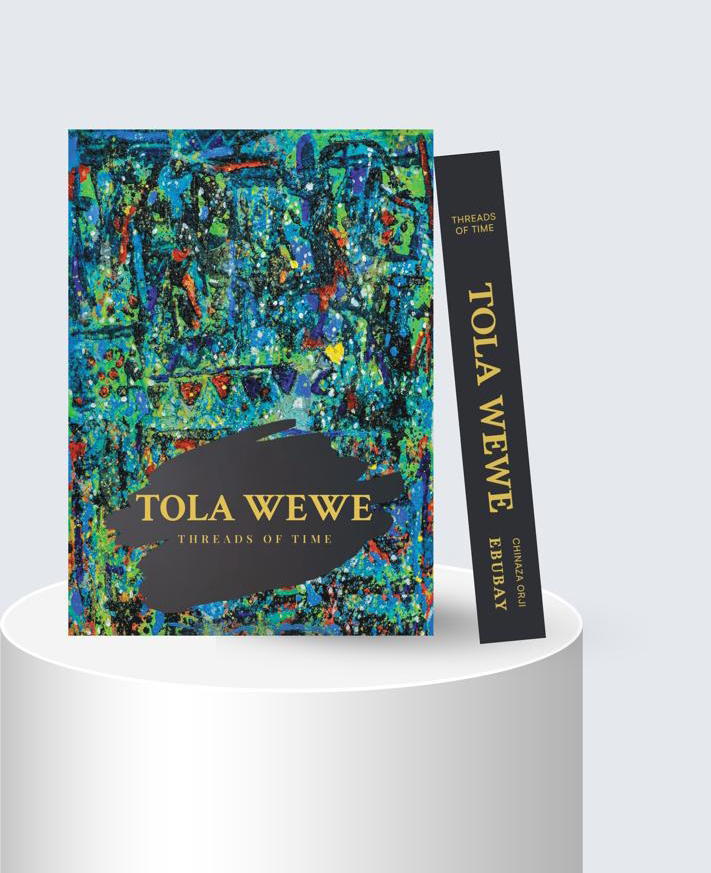
“Time by itself means nothing, no matter how fast it moves, unless we give it something to carry for us; something we value.” These words by the late Ghanaian writer Ama Ata Aidoo open Threads of Time, a new art book that does just that—gives time something of deep value to carry: the extraordinary life and work of Nigerian master artist, Chief Tola Wewe.
Curated and authored by Chinaza Orji, Threads of Time is a richly layered visual autobiography—a sweeping, soulful journey through the creative mind of one of Nigeria’s most revered artists. With 137 carefully selected works spanning decades, the book maps not only the evolution of Wewe’s style but also the shifting spiritual, political, and intellectual landscape of Nigeria. Each piece is anchored in a timeline, inviting readers to experience art not just as static expression, but as living witness.
The book will be officially launched on Sunday, August 17, at 1 pm, at the Nike Art Gallery in Lekki, Lagos, one of the country’s most celebrated art spaces. Hosted by Ebubay, Orji’s Houston-based platform and art consultancy, the event promises to be more than a mere unveiling—it is envisioned as a ceremony, a tribute, a handing over of memory from one generation to the next.
Born in 1959 in Okitipupa, Ondo State, Chief Tola Wewe is a towering figure in Nigerian contemporary art. A graduate of the University of Ife and the University of Ibadan, Wewe began as a cartoonist, educator, and gallery collaborator before committing fully to his studio practice in the early 1990s. Over the decades, he has become synonymous with bold, symbolic works that merge Yoruba cosmology, folklore, and philosophy with contemporary visual language.
Wewe was a founding member of the Ona art movement, an influential collective that sought to root modern artistic expression in indigenous Yoruba aesthetics. His paintings are instantly recognisable: vibrant colours, intricate patterns, and a mystical depth that reflects what many have described as a trance-like creative process. These spiritual undercurrents, combined with his nocturnal habits and sacred rituals of creation, earned him the moniker “iwin”—the spirit.
But Threads of Time is not just about mystique. It is a book of clarity, a document of legacy. Orji’s curation doesn’t simply celebrate—weaving together the personal and the political, the sacred and the sensual, the historical and the deeply human. Wewe’s art dances across themes of femininity, identity, generational memory, politics, and spirituality. His body of work is not only massive in quantity—spanning thousands of pieces—but monumental in its influence, with exhibitions held across Europe, the United States, and throughout Africa.
Behind this ambitious project is Chinaza Orji, a name steadily rising in the art world. A graduate of the Sotheby’s Institute of Art, Orji was once the founder of Watersworth Art Gallery in Lagos. She now leads Ebubay, a dynamic online gallery, curated shop, and consultancy devoted to amplifying African art with intelligence, care, and intention. For Orji, Threads of Time is both personal and professional—a continuation of her mission to give African art its rightful platform.
“I didn’t write this book to reflect my own faith or background,” Orji notes, herself a Christian. “I wrote it to honour the integrity of the artist and the traditions he draws from. This is about cultural accuracy, about respecting a story enough to let it speak for itself.”
She adds, “It is about who we are, what we have inherited, and what we choose to pass on. Art helps us remember that.”
For Orji and many others, Threads of Time is also a response to the structural challenges African artists face—underrepresentation in global markets, limited access to international platforms, and the chronic undervaluation of their work. This book, published by Ebubay, is not just a collector’s item—it is a curatorial blueprint, a teaching tool, and a celebration of legacy.
And as the launch date draws near, the anticipation grows—not just for the event itself, but for the broader conversation it ignites.
“These works transcend tribe and time,” Orji writes in her introduction. “They draw from a collective consciousness that honours the traditions while dreaming forward. Reflect, if you will, on the passage of time—not as something that merely happens to you, but as something you are intricately a part of.”
For those who wish to witness the unveiling of this landmark publication, Nike Art Gallery will open its doors on August 17 to artists, collectors, scholars, and all who believe that art—when rooted in truth—can outlive even time itself.
Disclaimer
Comments expressed here do not reflect the opinions of Vanguard newspapers or any employee thereof.