
By James Ogunnaike, Abeokuta
Stakeholders advocating against gender-based violence (GBV) have blamed poverty, poor justice system, nonchalant attitude on the parts of religious and traditional leaders, social media influence, as well as breakdown of societal structures, as some factors that encourage rising in the gender bases violence in Nigeria.
They reinforced the need for proactive measures to combat the menace and promote gender equity in their respective communities.
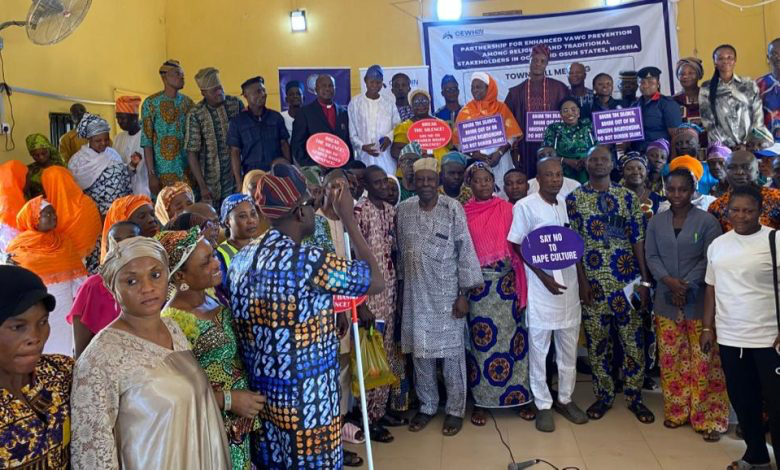
The stakeholders, spoke at a town hall meeting held in Ilaro, Yewa South local government area of Ogun State, organized by Centre for Women’s Health and Information (CEWHIN).
The programme, put together under the banner of United to Prevent Violence Against Women and Girls, with the support of Ford Foundation, served as a call for collective action, education and implementation of necessary laws.
The stakeholders at the programme with the theme: “Our community, our responsibility working together to prevent Sexual Gender Based Violence”, included; representatives of Youth Council of Nigeria, Christian Association of Nigeria members, Community leaders traditional leaders, Federation of Muslims Women Association of Nigeria, artisans, transport unions and other.
Speaking at the town hall meeting, the Project Associate at CEWHIN, Mrs. Funmi Abdullahi said findings from a survey conducted by the non-governmental organization revealed that the negligence by both traditional and religious leaders has contributed greatly to rising of gender-based violence in the country.
She emphasized the critical role of religious and traditional leaders in addressing the menace.
“The main problem we’ve identified through our data is that religious and traditional leaders often cover up incidences of violence”.
“When there’s a case of sexual or gender-based violence in the community, these leaders sometimes intervene to ‘settle’ matters internally, allowing perpetrators to escape consequences and they may likely commit the offence again.”
The CEWHIN Abdulahi further highlighted concerns about confidentiality breaches: “Many pastors and imams don’t maintain confidentiality when women report domestic problems to them. Some even mock these situations from the pulpit, which discourages victims from speaking up. We want prevention, not just intervention after harm has occurred.”
On her part, Alhaja Adegbite, from the Federation of Muslim Women Associations in Nigeria (FOMWAN) highlighted different efforts by the association in fighting gender-based violence through advocacy.
She said, “our organization has always advocated for a society built on equality and equity, where abuse and maltreatment have no place. We organization programmes at local, state and national levels to address these problems.”
She identified poverty as a major contributing factor to violence, explaining, “If you don’t empower your child, your wife, or your husband, many problems will arise. When a woman is confined at home all day with no resources, it creates conditions for abuse.”
Also speaking, the Chairman of the Coalition of NGOs on Ogun State, Mr. Adesgun Adesina, corroborated Mrs. Abdullahi’s position on the role played by both religious and traditional leaders on the matter.
He posited that major problems is more or less the societal and religion, stressing that in most of the GBV cases, religious and traditional leaders usually silence it to prevent society from shame and name calling of people, instead of allowing law to take it full responsibility of the culprits.
He called on the religious and traditional leaders to stop intervening in GBV cases, by trying to take it out of court in order to allow perpetrators go free without, saying that their actions encouraged rise in GBV cases in communities.
Pastor A.A. Alade, who represented the Christian Association of Nigeria (CAN) highlighted the transformative power of education.
“Ending violence against women and girls begins with knowledge. Our churches must become centers of enlightenment, not just worship,” he said.
Dr. Adeyemi, a community leader in Ilaro, emphasized the importance of moral education. She said, “families must commit to teaching their children morals, not just academics, but values that foster respect and empathy.”
Comrade Adenike Kafilat, a youth leader and the Vice Chairman of National Youth Council of Nigeria (NYCN) Ogun State Council, stressed the importance of awareness and advocacy creation.
“We must not wait until violence erupts. Our communities should be alarm systems, alerting us early to social vices and intervening before they escalate,” she said
On his part, Chief Babatunde Yinusa, urged the citizens to report abuse and act within the bounds of the law.
“Silence is complicity. We must empower victims to speak out and ensure that justice is not just promised but delivered.”
Disclaimer
Comments expressed here do not reflect the opinions of Vanguard newspapers or any employee thereof.