
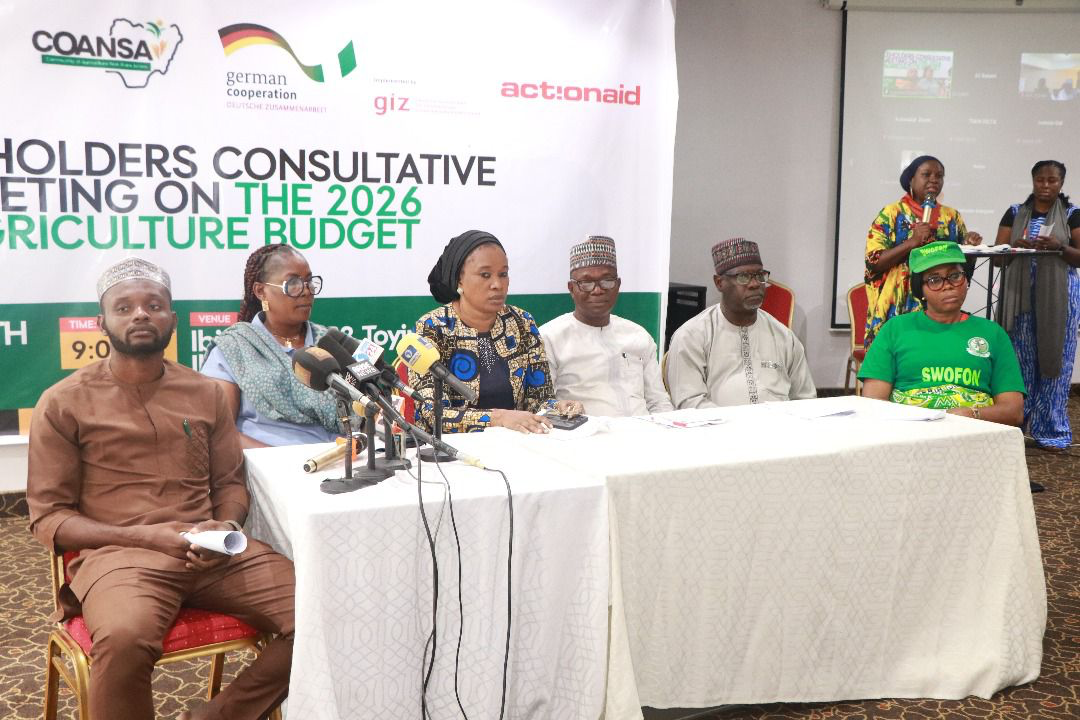
Government officials, civil society groups, and development partners have renewed calls for the Federal Government to increase agriculture sector funding to at least 10 percent of the national budget, as a 3 day national agriculture budget consultative forum ended with a press conference in Lagos on Wednesday.
The press briefing marked the close of the consultative meeting on the 2026 agriculture budget, which held from July 15 to 17 and focused on key priorities such as food security, climate change, market access, youth engagement, and the inclusion of women and persons with disabilities.
Participants raised concerns over the consistent underfunding of the sector, noting that agriculture received only 1.2 percent of the 2025 national budget, down from 4.2 percent in 2024. They warned that Nigeria has never met the 10 percent target set by the Maputo and Malabo Declarations, despite the sector’s central role in national food production and employment.
A representative of the Federal Ministry of Agriculture and Food Security said the allocation has slightly improved to about three percent in internal planning discussions but acknowledged that more work needs to be done to meet expectations.
Stakeholders also highlighted the widening food crisis, with more than 30 million Nigerians projected to face food and nutrition insecurity between June and August 2025. They stressed the need for early release of agriculture funds, stronger extension service delivery, improved access to quality inputs, and security support for farmers affected by conflict and climate-related disruptions.
The press conference featured a strong push for inclusion, with youth leaders referencing an upcoming relaunch of the Youth Manifesto in Agriculture. The document, which has been under review since May, is expected to consolidate young farmers’ demands and align with the African Union’s youth-in-agribusiness framework. Representatives also noted the ongoing zonal consultations for the review of the National Gender Policy in Agriculture.
Civil society organisations at the event welcomed the government’s decision to digitally track 2,000 tractors procured for distribution. They called for transparency in disbursement, urging that trackers be publicly accessible and monitored by independent groups to ensure the tractors reach the right beneficiaries.
Speakers also identified the need for better post harvest infrastructure, structured commodity markets, and rural feeder roads to reduce the 45 to 50 percent food loss currently experienced by smallholder farmers. The shortage of agricultural extension agents was another concern, with participants urging urgent recruitment and deployment of officers across underserved communities.
The event closed with a collective commitment to continue engaging government ministries and legislators on agricultural funding priorities, and to advocate for a 2026 budget that reflects the urgency of the food crisis, supports vulnerable groups, and builds a more resilient and inclusive food system.
The final press conference was addressed by sector leaders including Andrew Mamedu, Country Director of ActionAid Nigeria Bello Mohammed, Director of Land Use and Conservation at the Federal Ministry of Agriculture and Food Security Chinasa Asonye, National Secretary of SWOFON Rosemary Efemena, Chairperson of COANSA; Foluke Olaniwun Taiwo Daramola Permanent Secretary of the Ministry of Agriculture, Ondo State and Solihu Abduwasii, National Coordinator of TOFIN. They collectively called on the Federal Government to prioritise agriculture as a national emergency and ensure that the 2026 budget delivers timely, inclusive, and accountable interventions.
Disclaimer
Comments expressed here do not reflect the opinions of Vanguard newspapers or any employee thereof.