
By Esther Onyegbula
The Federal Government of Nigeria has reaffirmed its commitment to deepening the industrialisation of the nation’s solid minerals sector through strategic investment and value addition, as part of its broader economic diversification agenda.
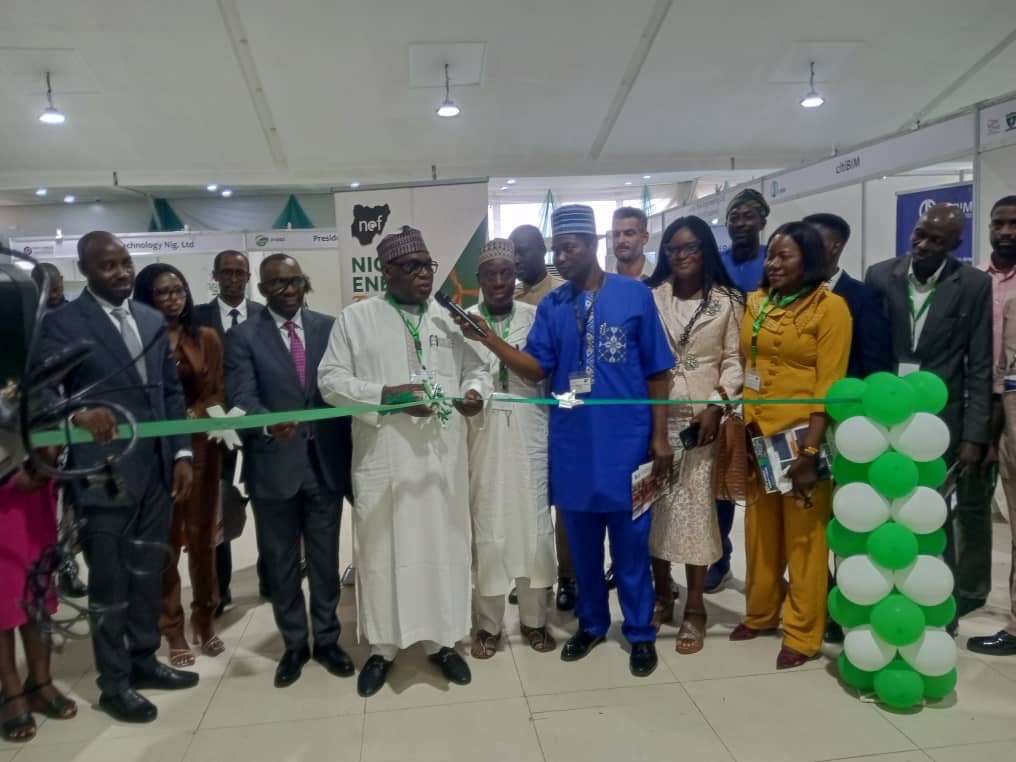
This assurance was given on Wednesday by the Minister of Solid Minerals Development, Dr. Dele Alake, during the opening session of the 10th Nigeria Energy Forum (NEF) Conference and Exhibition, held in Lagos. Speaking through Dr. Obadiah Nkom, Director General of the Nigeria Mining Cadastre Office, Alake emphasized that while Nigeria is richly endowed with solid minerals, the sector’s contribution to the national economy remains limited.
“The Ministry is prioritising policies that will attract investment into mineral processing plants, refinery projects, and production of finished mineral-based goods within the country,” Alake said. “This is aligned with the Renewed Hope Agenda of President Bola Ahmed Tinubu’s administration, aimed at creating jobs for millions, building local capacity, and positioning Nigeria as Africa’s hub for critical minerals and value-added products.”
The NEF2025, themed “Decade of Energy Transition for Economic Prosperity”, drew participation from global development agencies, investors, researchers, and private sector stakeholders. Key discussions centred around mobilising investment for green mineral development, advancing energy access, and local manufacturing.
Engr. Omatsola Ogbe, Executive Secretary of the Nigerian Content Development and Monitoring Board (NCDMB), represented by Barr. Naboth Onyesoh, stressed the importance of building indigenous capabilities across the energy sector. “We must drive local content by encouraging technology transfer, human capital development, and domestic production,” he stated.
On the need for coordination, Mr. Seye Bassir, Investment Director at All On, called for better consolidation of Nigeria’s multiple energy and climate policies. “The government must harmonise its frameworks into actionable instruments to attract the right kind of investment,” he said.
Similarly, Ms. Marit Kitaw of the United Nations Economic Commission for Africa (UNECA) identified infrastructure and limited energy access as major barriers to green mineral processing and industrialisation in Africa.
Highlighting Nigeria’s energy transition efforts, Engr. Michael Oluwagbemi, Programme Director of the Presidential Compressed Natural Gas Initiative (PCNGi), said the initiative is targeting the conversion of 250,000 vehicles annually through the establishment of 1,000 auto-gas workshops nationwide. “This will not only reduce emissions but also create 250,000 jobs and train 25,000 technicians by 2027,” he explained.
In his remarks, NEF Chairman Dr. Daniel Adeuyi said the forum had facilitated over $70 million in financing for clean energy projects over the past decade, benefiting more than 8,000 stakeholders globally. “NEF2025 will go beyond talk — it will mobilise multimillion-dollar investments to support green mineral industrialisation in partnership with UNECA,” he said.
Co-chair Engr. Adekunle Makinde highlighted NEF’s impact in tackling energy poverty and job creation, particularly among youth and academic institutions.
The conference also showcased impactful grassroots environmental projects supported by the UNDP’s Global Environment Facility Small Grants Programme (GEF-SGP), including biofuel production in Oyo State, water purification in Lagos’ Makoko community, and shea butter processing using LPG in Nasarawa State.
Ibrironke Olubamise, National Coordinator of GEF-SGP, said the programme’s collaboration with NGOs and community-based organisations has empowered remote communities to combat environmental challenges.
A major highlight of the forum was the Tertiary Institution Energy Challenge (TIEC 3.0), supported by All On, which celebrated student-led innovation in clean energy. Out of 93 pitch submissions from over 400 students across 35 institutions, top innovators were awarded grants to scale their ideas.
First prize of ₦2 million went to Green Preserve, led by 100-level Mechanical Engineering student Febechi Desmond Uzomadike of the University of Cross River State. The team also won the Public Vote Award of ₦500,000, drawing over 50,000 votes in just 10 days.
Second prize of ₦1.5 million was awarded to AI Hybrid Agri Dryer from the University of Lagos.
Third prize of ₦1 million went to Keytric, an energy-tech project from the University of Port Harcourt.
The most promising teams will be invited to showcase their scaled projects at the NEF2025 Virtual Day 2 event on November 20.
As Nigeria continues to pivot from fossil dependency to sustainable economic models, this year’s NEF underscores a growing synergy between government policy, private investment, innovation, and youth-driven action, all pointing toward a greener and industrially vibrant future.
Disclaimer
Comments expressed here do not reflect the opinions of Vanguard newspapers or any employee thereof.