
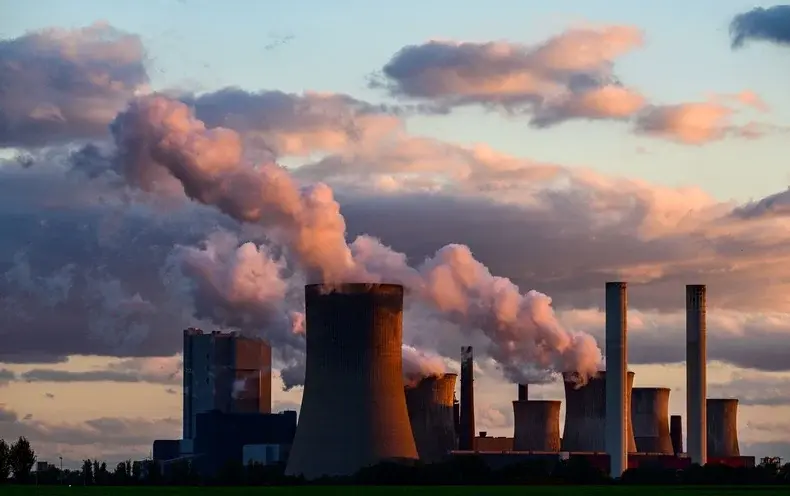
Stock image.
By Nkiruka Nnorom
A report by Climate Action Tracker, CAT, has rated Nigeria’s climate targets and policies as “almost sufficient,” noting that the country needs to decarbonize its economy and will require international support to achieve its net-zero target by 2060.
CAT, an independent scientific project that tracks government climate action and measures it against the globally agreed Paris Agreement, argued that Nigeria’s continued reliance on fossil gas on the domestic front could jeopardise the set target.
It also argued that the reliance on fossil gas could lead to increased national emission, delaying the country’s energy transition plan.
The federal government has set an updated Nationally Determined Contribution (NDC) plan, committing to an unconditional reduction of 20 percent and a conditional reduction of 47 percent below business-as-usual levels by 2030, with a long-term net-zero goal by 2060.
Consequently, the government has adopted new measures and announced plans to reduce emissions.
For instance, the FG has re-strategised to utilise more and different low-carbon and cleaner energy sources in its energy mix and had put in place the Energy Transition Plan (ETP) in 2022 to achieve this target. The updated Nigerian Energy Transition Plan (ETP 2.0) aims to achieve a total installed power capacity of 277GW by 2060 with much emphasis on clean energy, modern energy storage, and emerging technologies. The ETP requires significant emissions reductions in five major sectors: power, oil and gas, transport, cooking and industry.
Also, there’s the FG’s Electricity Act of 2023, which aims to address challenges plaguing the power sector by decentralising and privatising the sector and removing barriers to the deployment of minigrids.
In January 2023, the government adopted new Methane Guidelines that include mandatory measures for oil and gas companies, such as leak detection to reduce methane emissions from the oil and gas sector.
Methane emissions from oil and gas production accounted for about 13 percent of emissions in 2023 and have traditionally been a significant source of emissions.
However, the CAT report stated that while Nigeria’s policies and action are 1.5°C compatible when compared to its fair share contribution, “they are not on track when compared to the level of climate action needed within the country to meet that warming limit.”
It, therefore, argued that Nigeria needs additional support to implement additional policies to strengthen and meet its conditional target.
The Report said: “While these policies are positive developments, the government’s continued reliance on oil and gas risks locking Nigeria into emissions-intensive infrastructure. This will likely lead to the major stranding of assets and misallocation of investment resources and continue to drive up national emissions.”
To meet its net zero ambitions, CAT said Nigeria could support the uptake of renewables, such as solar home systems and mini-grids, as people move away from expensive diesel and petrol back-up generators and expand access to unserved areas.
“It also needs to move ahead with implementing the 2021 Climate Change Act and clarify key elements of the net zero target, such as emissions coverage and the role of carbon removals.
“Avoid locking in high-emission fossil gas infrastructure projects, such as the Nigeria-Morocco gas pipeline and additional liquified natural gas (LNG) export capacity. “With uncertainty in long-term fossil gas demand, these investments are at risk of becoming stranded assets,” it added.
In her expert commentary, Dr. Chinyere Nriezedi-Anejionu, an International Energy Investment Law lecturer at Nottingham University, said that despite the ambitious climate goals Nigeria has set for itself, there are certain stumbling blocks in the form of legal, regulatory, institutional and infrastructural challenges that could limit it from achieving the goals.
“Although, some existing laws and regulations such as the Climate Change Act 2021 have made provisions that cover aspects of carbon reduction and briefly mention energy transition, there are still other extant laws whose provisions run contrary to the long term 2060 net-zero goal, such as the Petroleum Industry Act 2021 with its provisions for continuous grant of petroleum exploration and prospecting licences,” she said.
To meet its 2060 net-zero target, Nriezedi-Anejionu said that Nigeria would need to enact an energy transition law that would serve as an all-inclusive statute combining many relevant provisions scattered across multiple national laws.
She cited instances of Colombia and Brazil that have successfully enacted energy transition laws that demonstrated their zeal for achieving zero targets.
Disclaimer
Comments expressed here do not reflect the opinions of Vanguard newspapers or any employee thereof.