
By Oluwaseun Abimbola
In 1994, after the genocide in Rwanda, a small group of women gathered under a tree in a rural village outside Kigali. There were no therapists, no counsellors. Instead, the women began to sing. One woman started a slow, mournful melody; others joined, harmonising grief. Gradually, the tempo quickened. Drums appeared. Someone began to dance. First, alone and then in a circle. They called it kwibuka, which means to remember. But the ritual was also about living.

They sang their dead back into memory but also sang themselves into motion. This was not a performance for spectators. It was not curated for an audience. It was grief turned into rhythm; mourning turned into movement as a communal reclaiming of life through African expressive traditions. I think about this story often when reflecting on how African performance is not merely aesthetic, but ontological. It is a way of knowing, remembering, healing and rebuilding community from rupture. Whether in post-conflict Rwanda or post-migration Cardiff, African performance becomes a vessel of diasporic world making, as a choreography of survival and re-rooting.
I conceptualise Nganga Performing Arts within this evolving global performance ecology as a performance collective and equally as a living archive and a cultural strategy. Nganga Performing Arts is a UK-based cultural performance group that uses traditional African drumming, dance, and storytelling as tools not just for entertainment, but for healing, education, and community building. It has a strong presence in Wales and across the UK, but they have become a key voice in multicultural arts, driven by a mission to bridge cultures and unify communities through performance. The group was founded in April, 2022, by Chinyere Chukwudi-Okeh, an acclaimed writer and cultural curator, with its first drumming, poetry and storytelling performances delivered at the Psychology Department of the University of Wales Trinity St Davids. Nganga has grown to be the cultural subsidiary of the C3 Centre for Creativity and Culture (CIC). In many ways, Nganga is the embodiment of her larger vision through the C3 Centre: one where African arts, literature and embodied heritage serve not just as symbols, but as active instruments of inclusion, healing and creative expression.
The name Nganga carries layered meaning across African cultures. In Igbo, it expresses pride, particularly cultural pride, and speaks directly to the ethos of Nganga Performing Arts. In several Bantu languages, including those spoken in Central Africa, Nganga refers to a traditional healer or spiritual practitioner—one who mediates between the physical and spiritual realms. The term can describe a diviner, herbalist, or ritual specialist whose work often includes healing, guidance and social responsibility. Taken together, these meanings converge beautifully in the vision of the group. Nganga Performing Arts and Mobile Theatre embraces cultural pride and spiritual restoration, presenting performance not only as artistic expression but as a form of healing and reclamation.
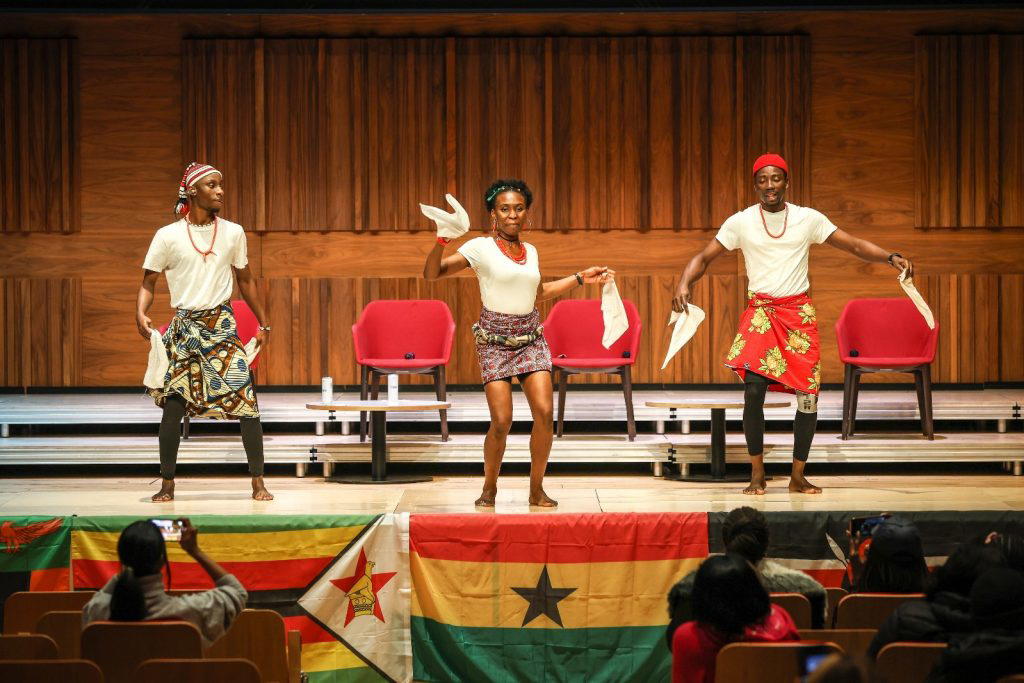
This is not a name chosen lightly. It speaks to the groups mission to carry African culture with dignity, to facilitate healing through rhythm and movement, and to promote unity through the expressive power of dance, flute, poetry, drumming and storytelling. Their work across schools, community centres, care homes, festivals and theatres in Wales is a living affirmation that African performance is not a relic of the past but a dynamic and contemporary mode of cultural engagement. Their performances are not folkloric re-enactments, but vibrant, living dialogues between the ancestral and the present.
Nganga’s ensemble is made up of deeply committed and talented artists, each contributing to the collectives vision with skill and passion. Chigozie Valentine Oguejiofor, the group’s Lead Drummer and Dancer, a recent graduate of Swansea University, provides the rhythmic backbone of each performance. His drumming does not simply accompany movement, it leads it. He channels sonic memory and spiritual resonance into each beat, evoking African cosmologies where rhythm is both language and life force. Ogochukwu Sandra Nwaizugbo, the Lead Choreographer and Dancer, translates stories of migration, identity and resilience into movement. Her choreography is fluid and grounded, at once ancestral and experimental, affirming African dance as a language of both continuity and transformation. Chimodo Emmanuel Chinedu, who is the group’s first pioneer member, is a dancer, drummer and Lead Flutist. Chinedu adds a melodic layer that bridges time and space. His flute carries ancestral echoes and contemporary grace, reminding us that African sonic traditions are ever evolving, never static.
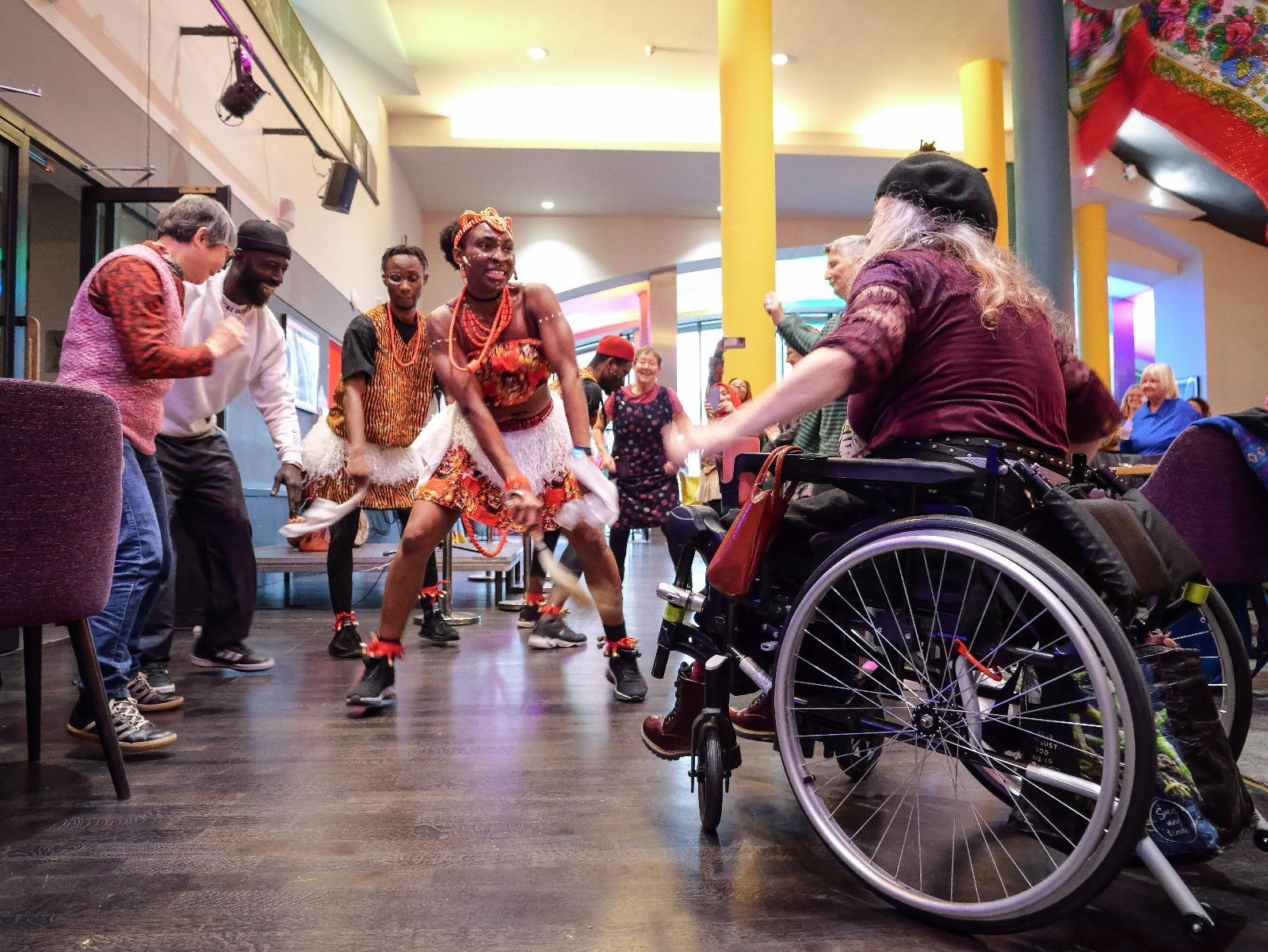
Together, these artists do more than perform. They embody a pedagogy of presence. They bring African knowledge systems into direct conversation with contemporary Britain. Their community workshops, held in schools, care homes and neighbourhood halls, are not just interactive sessions but spaces of healing, learning and cultural affirmation. Participants of all ages are invited to express, explore and connect through rhythm and movement. In these moments, Nganga becomes more than a performance group. It becomes a facilitator of memory, emotion and communal well being.
One particularly moving example occurred during a performance at the Little Theatre in Dylan Thomas House. The audience included members of the deaf community. Though unable to hear the music, they felt the vibrations of the drums through the floor and followed the performers’ movements with rapt attention. Their response was emotional, embodied, and joyous. This moment distilled what Nganga stands for, a practice that transcends barriers of language, ability, and background. Through rhythm and movement, they communicate on a deeply human level.
Nganga’s impact is evident across the UKs cultural landscape. They have performed at many powerful events, for example at: The C3 Centre Annual Welsh Multicultural Christmas 2024; Festival of Communities 2025 in collaboration with EMWWAA at the Brangwyn Hall ; Refugee Week 2025 at the Collaboration Centre at the St Davids Square in collaboration with the Swansea; City of Sanctuary Group, where The Nganga Team delivered 3 workshops; (1) Storytelling with drum and flute accompaniments, (2) Spoken Poetry, (3) Electrifying Dance and Audience Participation Dance Circle ; Black History Month, in collaboration with the African Community Centre Swansea, where they celebrated African heritage through storytelling and movement;
Cultural Diversity Fashion Show in Newport with the Cynefin Pamoja and the West African Exhibition and Parade team; Swansea Talent Fashion Exhibition, where their performance added emotional resonance and narrative texture to the occasion and other performances at the Dylan Thomas Theatre, Sherman Theatre, Riverfront Theatre Newport, Grand Theatre, Volcano Theatre, Schools, Colleges, Universities and event centres.
Through each of these appearances, Nganga turns performance into a form of community dialogue and cultural reflection. Their work reaches beyond the stage, becoming a site where memory is revived through rhythm, where identity is reaffirmed through movement, and where healing is enacted through shared experience. The artistry is evident, but more striking is the sense of purpose. Performance becomes a way of teaching, connecting and affirming African presence in contemporary Britain.
Nganga’s practice can be read within a wider theoretical framework that brings together diaspora, memory and decolonial thought.
Embodied expression, as some scholars have observed, carries knowledge that resists inscription in official archives. Movement and storytelling, in this view, are forms of remembering. Each performance is not only a cultural display but a method of transmitting experience, particularly in contexts where written history is fragmented or absent. The cultural flows that shape their work resonate with those Atlantic crossings that gave rise to hybrid, diasporic forms. In these transits, creative expression became both refuge and resistance. Nganga’s performances are part of that lineage, where tradition is not fixed but carried, reworked and made responsive to new conditions. Their work does not replicate the past, but speaks from it with clarity and innovation.
There is also an insistence in their practice on working outside prescribed aesthetic frameworks. Their rhythms, movements and stories do not seek alignment with European theatrical expectations. Rather, they assert the value of other ways of knowing, rooted in rituals, community gatherings and oral traditions. This is not simply about difference, but about sovereignty, making space for forms of expression that carry their own systems of meaning. Such thinking has long guided scholars and artists who see performance not only as entertainment, but as a vital part of communal life.
Dance, music and masquerade have always held social and spiritual weight in African contexts, where the line between the sacred and the everyday is often fluid. Nganga moves within this understanding. Their performances are not framed as exotic or symbolic. They are living acts that draw on a rich continuum of knowledge. This capacity to engage the present without abandoning the ancestral is at the heart of Nganga’s innovation. Tradition, in their hands, becomes a resource that is flexible, enduring and generative. They respond to the complexities of British society, with its exclusions and cultural negotiations, by offering a form of performance that is pedagogical, therapeutic and economically valuable. Their work enters
civic spaces not as intervention, but as continuation of practices that have always taught, healed and gathered people together.
As a scholar of African performance, I am particularly drawn to how Nganga’s work parallels older traditions such as the Alárìnjó Theatre of the Yoruba in Nigeria. The Alárìnjó, often mobile troupes performing in markets and public squares, used music, movement and masquerade to entertain, critique and transmit knowledge. Nganga stands in this lineage, not as replication but reinvention. The spirit of Alárìnjó is present in Nganga’s mobility, their community ethos, their rootedness in narrative and rhythm.
In a time where cultural migration continues to shape the diasporic experience, Nganga’s work is vital. It offers a model for how African performance can be a tool of transnational identity, a source of healing and a mechanism for public scholarship. Their approach reminds us that African traditions do not need to be justified by Western frameworks. They exist on their own terms and continue to evolve, influence and enrich global spaces. Nganga is not only preserving culture; they are reengineering it to meet contemporary needs. They are building bridges between generations, between continents, between wounds and healing. In doing so, they reaffirm the continuing relevance of African performance as a mode of cultural transmission, resistance and joy.
Oluwaseun Abimbola is a Doctoral Fellow, African Performance, Arts and Culture, Institute of African Studies, University of Ibadan.
Disclaimer
Comments expressed here do not reflect the opinions of Vanguard newspapers or any employee thereof.