
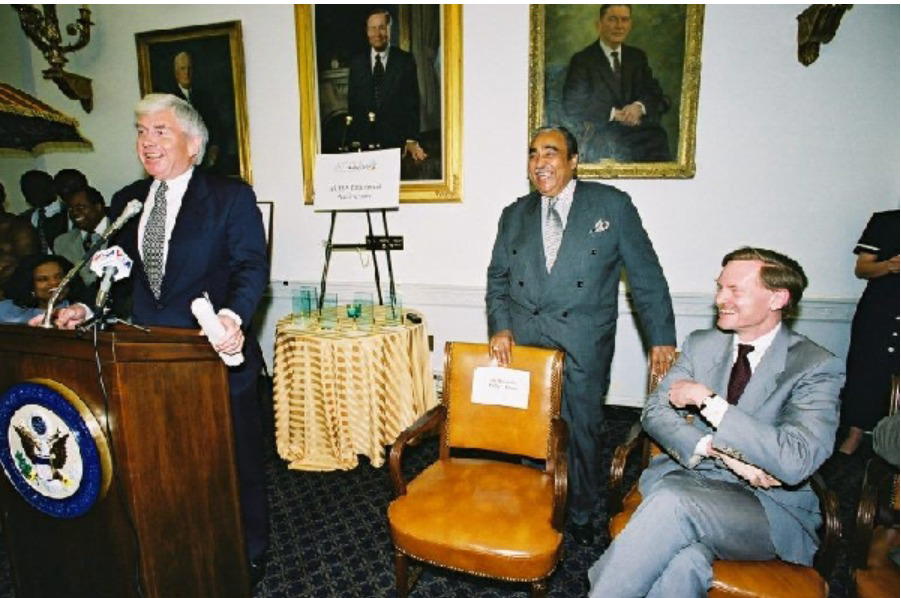
Congressman Rangel with Rosa Whitaker, Hon. Jack Kemp and then U.S Trade Representative Ambassador Robert Zoellick – Advancing AGOA’s extension in the U.S Congress
In a world where politics often forgets the powerless, Congressman Charles B. Rangel stood tall—as tall as any iroko tree in the African forest. As the world mourns his passing, Nigeria joins the rest of the continent in paying tribute to a towering figure whose unwavering devotion to justice, equity, and African upliftment etched his name indelibly into the continent’s story.
For over 45 years in the U.S. Congress, Rangel was more than a legislator—he was a bridge across the Atlantic, connecting Black America’s political might with Africa’s aspirations. And nowhere was that connection more potent than in Nigeria.
AGOA: The Economic Bridge Rangel Built
In 2000, the African Growth and Opportunity Act (AGOA) rewrote the rules of trade between the United States and Africa. And at the heart of that transformation was Rangel—a principal architect and unrelenting guardian of the legislation.
AGOA’s impact and untapped opportunities for Nigeria are consequential. With over $280 billion in Nigerian exports facilitated through AGOA, the initiative became a catalyst for job creation, industrial development, and economic diversification. It breathed hope into sectors like textiles, leather, and petrochemicals, offering Nigerian entrepreneurs access to American markets and visibility on the global stage.
But AGOA did not happen by chance. Behind the scenes, Rangel fought tenaciously for its passage and successive reauthorizations, understanding that trade—not just aid—was the path to lasting prosperity. He worked hand-in-hand with Nigerian diplomats, including Ambassador Jibril Muhammad Aminu, and built trust with African leaders like President Olusegun Obasanjo, who was instrumental in securing pan-African support for the initiative.
Champion of Democracy and Justice
Rangel’s solidarity with Africa went far beyond trade. He was a moral compass in American politics—fearless in confronting injustice wherever it reared its head.
In the twilight of apartheid, Rangel wielded legislative tools to undermine the regime’s economic lifelines. His amendment to eliminate tax credits for American firms operating in South Africa turned the screws on the apartheid economy—and won him respect from global freedom fighters.
In Nigeria, his voice resonated powerfully in the fight for democracy during some of the country’s darkest hours. Following the annulment of the 1993 presidential elections and the incarceration of Chief MKO Abiola, Rangel spoke with rare clarity and conviction. From the floor of Congress, he demanded Abiola’s release and challenged the Abacha regime, earning admiration from pro-democracy advocates across Nigeria.
Giving Africa a Seat at the Table
Rangel believed that Africa belonged not in the periphery of U.S. policy, but at its center. As Chairman of the influential House Ways and Means Committee, he worked to institutionalise Africa’s presence in the corridors of American power.
One of his boldest moves was convening U.S. congressional hearings that placed African business leaders front and center—among them, a young Nigerian businessman named Aliko Dangote. By spotlighting African enterprise, Rangel helped dismantle outdated narratives and cast a new vision of the continent as a dynamic engine of innovation and growth.
He also co-founded the Congressional African Caucus, cultivating bipartisan support for Africa-focused legislation and amplifying the continent’s voice in Washington.
Mentorship, Legacy, and a Living Impact
Rangel’s influence lives on in the leaders he mentored. Among them is Rosa Whitaker, the first-ever Assistant U.S. Trade Representative for Africa. That historic post, established during the Clinton Administration, was a direct result of Rangel’s advocacy to embed Africa in America’s trade architecture.
Whitaker’s firm has since become the partner of choice for global investors in Africa—proof that Rangel’s legacy did not end with policy but multiplied through people.
A Statesman in Every Sense
Rangel was no stranger to African soil. He led numerous congressional delegations to the continent, forging bonds with heads of state, civil society leaders, and everyday citizens. His rapport with icons like Nelson Mandela, Ghana’s Jerry Rawlings, and Nigeria Olusegun Obasanjo was built on mutual respect and a shared commitment to justice, sovereignty, and dignity.
Time and again, he rallied U.S. support for African-led initiatives, from debt forgiveness and HIV/AIDS funding to educational exchanges and democratic reforms.
Farewell to a Friend of Nigeria
Charlie Rangel may have represented Harlem, but his heart also beat for Africa. He saw in Nigeria not just a partner, but a promise—a nation capable of leading a continental renaissance.
As we bid farewell to this statesman, Nigeria remembers him not only as an ally, but as family. His was a life spent in service to justice, equity, and the audacity of hope.
The iroko has indeed fallen, but the shade it cast, the seeds it scattered, and the bridges it built will endure for generations.
Disclaimer
Comments expressed here do not reflect the opinions of Vanguard newspapers or any employee thereof.