
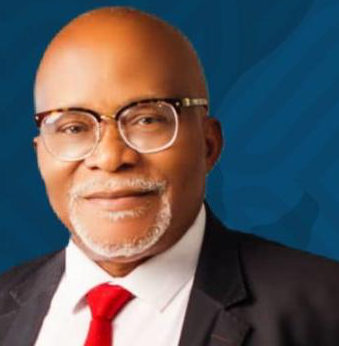
Prof. Mbachu
By Chris Onuoha
Former Head of Department of Defence and Security Studies, Nigeria Defence Academy (NDA), Prof Isaac Mbachu has advocated that using pragmatic approach including kinetic and non kinetic method would help solve the country’s security challenges.
He said this during a virtual conference held on Thursday by the Africa Leadership Group (ALG) themed: “Reviewing the state of National Security: way forward.”
This was as the ALG forum, founded by Pastor Ituah Ighodaloh of the Trinity House, Lagos has not relented in pushing out narratives to sensitize and change the course of human orientation towards a better society.
Much as the organisation’s weekly conversational series called Nigeria Leadership Series, (NLS) continued to dissect topical issues bedeviling Nigeria in particular, Prof Mbachu who aided the discussion with a detailed lecture slide, enumerated some of the challenges the country is grappling with, that include insecurity, banditry, kidnapping for ransom and region unrest under the guise of unknown gunmen among others.
He illustrated his points with the efforts of two remarkable nation, Rwanda and Singapore who were able to strengthen their country from challenges and had remained strong, establishing strong institutions and frameworks for growth.
He said Paul Kagame of Rwanda and Lee Kuan Yew of Singapore demonstrated resilience and commitment that Nigeria should adopt as a model for national development.
While Nigeria should copy such model, he said the country should embark on selecting quality leadership. “We need sincere leadership; leaders with genuine integrity. Until we have such thing like sincerity of purpose and adapting the ‘let the best rule’ approach to our leadership selection, then will we move the country forward,” he said.
Sharing some thoughts on national security in Nigeria, Prof Mbachu said Nigeria is currently laced with violent crimes from many extremists under the cover of insurgency, kidnap, banditry and unknown gunmen. He mentioned that Boko Haram and bandits are the most potent threats characterised by attacks.
He also highlighted the state of the national security with conceptual clarification saying; “National security should be a state of trust on the part of citizens,” noting that issues like institutional and structural challenges should be looked into.
In addition, Prof Mbachu noted that some of the challenges included security personnel welfare management.
“Police is under funded, under trained and over stretched. There is also a failure in intelligence gathering coupled with corruption in the system. Other things include youth unemployment that is the major cause of criminality and unrest, regional and international collaborations that will strengthen communal understanding, control of arm proliferation by the insurgents and unknown gunmen, acquisition of surveillance and intelligent technology to deal with the situation, cybersecurity, national unity and dialogue to address regional grievances,” he added.
While he summed it up, he mentioned that to address the challenges, it requires comprehensive and prolonged approach.
He said: “With electoral reforms, there will be hope. It can come through transformation. When the system is reformed, there will be a turn around. Secondly, if we can believe that the best can rule, without minding where he comes from, then we can adopt “let the best candidate rule” approach and avoid bigotry and sensationalism that have beclouded Nigeria election system,” said Prof Mbachu.
Stressing further and narrowing down the security challenges, Prof Mbachu mentioned that National Assembly should look into it and come up with bill that will make it work. He noted that the effects of security challenges can be deradicalized through theoretical and practical approaches, mentioning that the North can be deradicalised by using non kinetic approach on the government side and kinetic by the armed forces.
“The country’s economy is not doing well. This however, affects funding most of these challenges. I believe in regional autonomy under restructuring. Restructuring is a viable means of letting States grow and manage their resources well. It would be easier to hold leadership accountable under regional structure.
“The most form of democracy is stomach infrastructure. China does not practise democracy but uses the model to lift 14 million people in her country out of poverty every year, while Nigeria would pull the same number down every year. Nigeria does not lift poverty, instead it pulls it down,” he said.
Prof Mbachu noted that State police is good and that it should recommended; “State police and local security formation such as Amotekun in the Southwest, Neighborhood Watch in Lagos, Hisba and others should be encouraged to back the federal police. It is not good that Nigeria has only one police at the federal level when some developed countries operate State and city police.”
On his final take, he advocated that leaders should allow their children to school at home, and at the same time, receive medical attention locally, other than going abroad on medical tourism. He said using pragmatic approach and adapting to Rwanda and Singapore model will help to achieve quick results, also noting that fixing human beings through education and attitudinal formation should be applied, while electoral reforms still remain the basics for healthy democracy in Nigeria.
Disclaimer
Comments expressed here do not reflect the opinions of Vanguard newspapers or any employee thereof.