
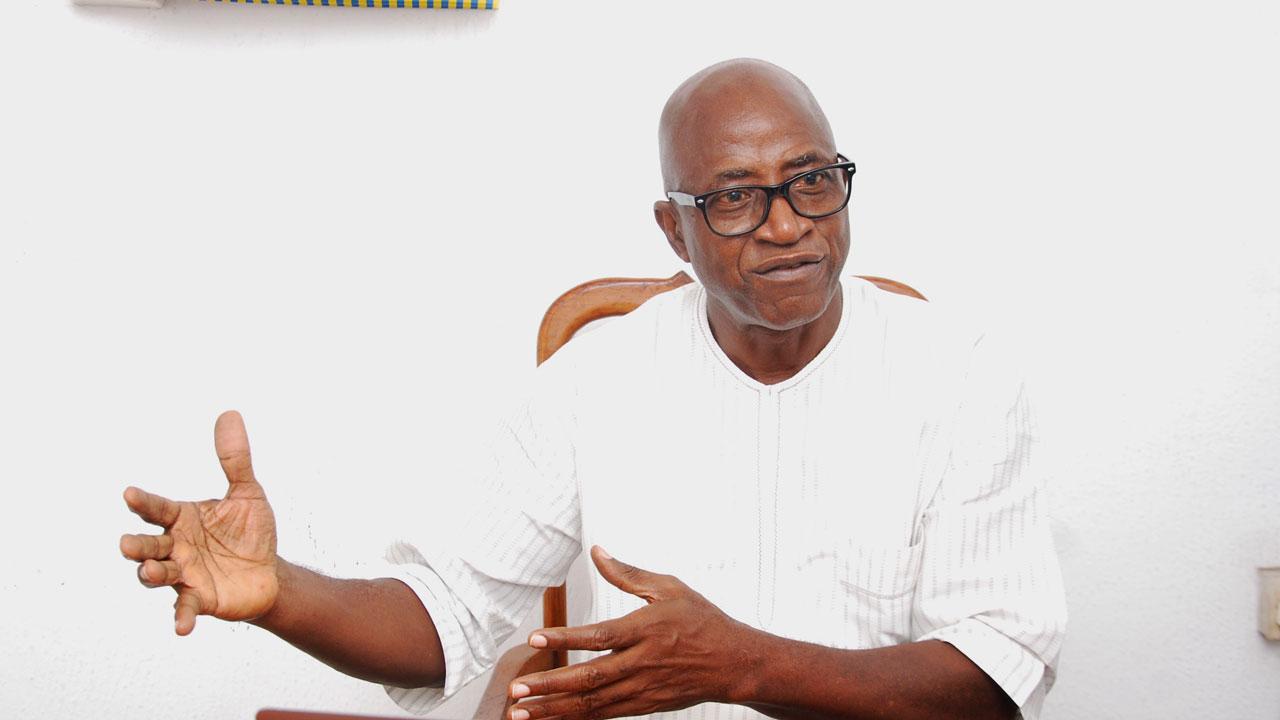
By Dickson Omobola
Legendary Segun Odegbami is not new to conjuring magical moments. He is a man of many parts. He is knowledgeable politics, brilliant in humanities and legendary in sports, his main constituency.
A shinning star in football which he played to the delight of all, administered reasonably well and now promoting and developing astonishingly through his football college in Wasimi and his Eagle 7, FM, a sports radio of excellence.
As a professional footballer, there were days his speed, passing precision and ball striking skills threw spectators off their feet.
Like those breathtaking moments, Odegbami, in this uncommon interview with the presidential candidate of the African Action Congress, AAC, in the 2023 polls, Omoyele Sowore, induced a sense of disbelief in his audience.
From politics to sports and the politics of sports, Odegbami asked hard-hitting questions, which date back to the activist’s student union days. And, in his characteristic manner, Sowore answered and, in fact, revealed how Odegbami was in the rearguard of the struggle for June 12. Eagle 7 Radio engaged Sowore and Odegbami himself anchored the engaging interview. Excerpts:
Let us start from your university days, the things you fought for and against…
(Cuts in) Well, I actually met you (Odegbami) one day when we were playing soccer. It was a soccer game and you came to open it. It was the student union week. On the sports side, you came and kick-started the opening game using the back of your heel, which is your signature tune. Till tomorrow, I still try that skill. You were our favourite on the sports side. That same week, we were also expecting Fela Anikulapo Kuti to play on the social side.
It was not long after that the June 12 election came about. Even though I knew that you didn’t play an open, engaging role in fighting for June 12, you were involved. You had an office somewhere in Jibowu (Yaba, Lagos) where we would sneak in, see you and hold some conversations. Before now, I had never said this publicly, so I hope I don’t get in trouble. That was 1993. My university days were remarkably marked by the struggle for democracy. The struggle to fight against economic policies or Structural Adjustment Programmes, SAP, in our days. Also notably, the struggle against cultism on campus. Each of them, as you can imagine, cost me a lot. The struggle for democracy led the military to get us expelled from the university in 1992 for the first time.
Eventually, I got expelled twice. The struggle against cultism almost cost me my life. I was attacked on campus, stripped naked, starved and injected at some point with an unknown substance. And the general struggle for the students’ welfare also put us against the school authority. The good news is that we did pass through the university and we allowed the university to pass through us.
(Burst into laughter) That was a solid foundation. Did it prepare you for going to jail without even thinking about it?
When I got to the United States, I was not looking for a job as such, but I was bored doing the work of Sahara Reporters. So, I wanted to kickstart the regeneration of my brain cells. And it took me to a job as a university professor. That is what they call it there, professor. Everybody who is a teacher is called a professor. I wanted a job as an adjunct professor, which is what they call a temporary lecturer here.
When I met the Dean of the School of Humanities at the School of Visual Arts in New York, a private but very elite school, he asked: ‘what have you done with your life before now?’ I said: ‘I went to the University of Lagos, UNILAG, and got a certificate.’ He said: ‘No, I am not interested in the certificate.
What did you do?’ I told him I was a student union leader. He said: ‘where?’ I said: ‘Nigeria’. He said: ‘Well, you can start teaching tonight.’ That is how I got the job. They never asked me or tried to verify if my certificates were real or fake.
You mentioned Sahara Reporters, which I did not hear very well. What is your relationship with Sahara Reporters?
I founded Sahara Reporters in 2006 in New York. Actually, it was my response to using technology to tell stories. When I arrived in the US and I was doing my master’s degree at Columbia University in New York, it was the advent of what is now popularly known as citizen journalism. And I just found the internet to be amazing because every night when we went to work and came back (I was doing all kinds of jobs to survive), I would go and look for Nigerian news. There was only one website known as NigeriaWorld in those days.
I had a laptop, which was my biggest investment and I would log on.
It was the days of dial-up internet when you waite for the inter-dial-up on AOL (online service provider) in those days. And when it came on, I would just rush and read what was on. So, I started thinking, well, I left Nigeria under military rule and the media was more vibrant. This is civilian rule. I am talking about the year 2000 now, and the news was not as punchy and pungent as I wanted it to be.
So, I started thinking about publishing. 2005 was when I bought the domain name because I had been helping others to set up their own platforms and do reports in those days. And it was to focus on citizen journalism, which was basically to tell citizens, come and tell your stories through me. I will be the curator. And that was how Sahara Reporters started in 2006 officially. It has been 19 years now since Sahara Reporters was founded. At that point, I actually had Sahara Reporters Sports, which is still online, which was basically to focus on reporting sports from a more political angle. Because contrary to what people think about sports, I do not know of any human endeavour that is more political than sports.
That is an interesting dimension…
(Cuts in) Yes. If you want to know about the politics of sports, go and look at what goes into hosting World Cups. The countries that want to hold it deploy their best diplomats to be at work and get consultants. They also deploy propaganda because they have to vote. In those days, there was some sort of democracy. You had to get all kinds of agreements, international agreements.
And whenever there was international sports, nothing else was happening globally. Whenever the World Cup is going on, that one month period does not coincide with the United Nations General Assembly. It does not coincide with any election anywhere in the world. Everything stops just so that sports can take the centre stage. And nothing unites like sports; nothing divides like it, too.
Before we go into sports, just so that we can put a cap on your Sahara Reporters days. When Sahara Reporters came up, you had news that we in Nigeria did not even have. You were forced to reveal so many things about Nigeria, and you were not in the country. How were you able to do that?
Well, I tapped into the credibility that I had over the years in getting information that nobody had. And you would be surprised that some of the best information or some of the most powerful information revealed on the website were given by regular people. When I say regular people, I will give you an example, but not too deep, of when there was a crisis in the country of a sick president. They were hiding his location and his condition. I would get information from people as simple as people working at the airport, helping them to pull the plane from the tarmac.
They would say: ‘this man is going again. They just dragged him to the plane now on a wheelchair’. There is nothing done involving more than two people that can not be revealed. The moment people knew that it (Sahara Reporters) was a credible platform and that they were safe to provide information, information flowed. They also knew that I was not going to take information from them and use it to extort people or sell the story. Also, there was no information that was available to the public that we didn’t know.
For instance, one of the areas where we made a lot of progress was collecting information about houses, luxury items bought by Nigerian leaders abroad. And those things were staring you in the face on the internet. In the United Kingdom, they have a land registry where, if you know the address, you buy, including the house plan. In the US, every local government has a land registry. If I search Olusegun Odegbami in the US, it will tell me potential areas where you have houses or where you have stayed.
Even places where you stayed and just collected mail while you were in the US are on the Internet. If you want to get deeper, of course, you have to do some paid service for it. So I used to buy a lot of land registry information from the UK. Around that time, it was like three to five pounds. I would just stick my debit card on it, and when I knew the name of the person, I knew the location. In an hour, I was already doing a story about houses that were bought and hidden in the UK, who they bought it from, when the house was built, who transferred it from which person to which person. During that period, I was able to find a lot of properties owned by Nigerians abroad and publish it, and it was novel in those days.
I remember I was trying to get a property owned by one governor. He did not buy it himself. He used a front to buy it. We stayed in front of the house, just trying to look and get, and eventually, a lot of citizen reporters, when they dropped their mails one day, found his gym membership. That was a problem. Interestingly, this guy doesn’t look like somebody who enters a gym.
Disclaimer
Comments expressed here do not reflect the opinions of Vanguard newspapers or any employee thereof.