
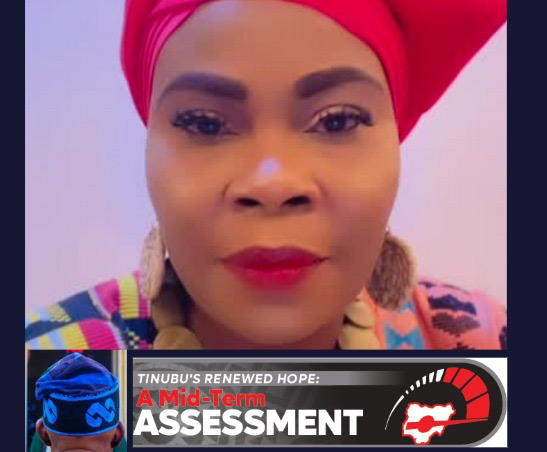
“Health is wealth,” the World Health Organization (WHO) once declared—a timeless truth that resonates deeply with Dr. Maymunah Kadiri, a Consultant Neuropsychiatrist.
Speaking during the Vanguard Conference Hall session, Dr. Maymunah Kadiri underscored the critical role of good health in driving productivity and improving quality of life, as she reviewed President Tinubu’s two years in office.
Kadiri:
I’m going to say we are not doing well in the health sector. But, of course, I speak a lot of times based on scientific basis, and also doing deep research into not just taking one side and leaving the other side.
I’ve had to be in the Ministry of Health, talking with a lot of people, colleagues that are also in different parastatals, the MDAs, and asking what is really going on. And this is where I want to also quickly chip in. The government is not doing enough to give us information on the things, the reforms they are doing behind the scenes.
If we are doing reforms and we are not seeing it, we are not feeling it, we are not experiencing it, it’s as good as we are not doing anything. That’s just it. It’s pure, it’s basic.
When you look at the number 1,000, 1,000 is one, zero, zero, zero; 1 represents health, the first zero represents family, the second zero represents money, the last zero represents career. Without the number 1, all the other numbers are zero. So, health is that powerful.
What’s been observed in the last two years
This current administration, in the last two years, what have they done? The truth is that I would say we are standing on a very qualified “somewhat”, that is, not yes, not no, somewhat. That means it is neither here nor there.
Concerns about reforms
Because for some people, health is not really there even though they are seeing some improvement, and I’ll give parameters to showcase the reforms that are ongoing that will show us that if these reforms have not been done, we are definitely not going to see the change we want to see in the future.
The Minister for Health and Social Welfare recently said people are not yet seeing those reforms or expressing those reforms, but we need to do what we need to do. But in the next five to six years, we will start seeing the benefit of these reforms.
Health Insurance Act (areas of non-coverage)
And one thing I have to bring to the fore is the National Health Insurance Scheme that has been turned into an Act now, that is the National Health Insurance Agency Act. So what has that done for us? Before now, we had less than 10 percent of Nigerians covered by health insurance, which is significantly very, very poor. Very, very poor.
But between 2023 and 2024, we have had some coverage from 16.8 million to 19.1 million now, which is just about 10 percent. Are we happy with that? No. That means that over 70 percent of Nigerians are still doing out of pocket payment.
Some health management organizations, sometimes you go there, they’ll tell you your package is not covering X-Y-Z. Some, they won’t tell you that this sickness you have is self-induced.
Like for infertility, they won’t even cover it, they’ll tell you that it’s your issue. I’m a mental health physician, and as a psychiatrist, when people come in for drug rehabilitation, that doesn’t even cover it.
There are some mental illnesses that require a minimum of two weeks to one month to be in the hospital. The X-Y-Z is just five days, so that means at the end of the day, you are still going to do it as out of pocket payment.
So we are still reforming with the National Health Insurance Scheme, not for the Act, which is true, covering just 10 percent, and of course the Mental Health Act, which was a good parting gift that President Buhari gave us before leaving, and I was very ecstatic about.
By the way, Nigerians are very good with laws, we have very fantastic laws, but our problems have always been implementation and execution. So, yes, we have the insurance Act, then, of course, the coverage as of now, barely to just 10 percent, which is still very, very low.
There are some HMOs that I don’t even want to mention, because for me, I don’t even deal with it. More than 90 percent of Nigerian HMOs I don’t deal with. They don’t pay well, they don’t pay on time, they will stress you out. They are saying that this hospital will not do this, X, Y, Z. Who is going to pay the salaries at the end of the day? You know, there is no balance. You know what they say? The balance is non-balancing, this is where it is.
So yes, the health insurance, the health Act is there, the coverage has just barely moved a little bit. We have 10 percent coverage, can it be moved to at least 32 percent in the next two years? All these are drivers with Universal Health Coverage, UHC, whereby, if I leave and I go to Port Harcourt today, I can put my card to UHC, I can access it easily and it is affordable, accessible, available and of course, acceptable by all that is what we call Universal health coverage. It really matters.
So let’s see, in the next few years, how do we move? 10percent is good, but is it possible to move to 30percent? Well, I may not say 50 per cent because I know they say health is a continuum, and 50 percent may be unrealistic for now, so, let’s just shift a little bit, it is a good time to move to 30 percent.
Strengthening our primary healthcare system
If our primary healthcare centers are functioning well, not the ones that goats and sheep are sleeping in, you will not need to go to a Gbagada General Hospital or you will not go to LUTH which is tertiary, but any little thing, even as basic as small fever, people run to LUTH.
We have primary healthcare centers in our localities. If you don’t know where your primary healthcare center is, go look for it. There’s one, either it is locked, or it is being abandoned, or we have animals living there, or homeless people are taking over. So, in this administration, we are gradually seeing improvement, strengthening of the primary healthcare centers, which, of course, is a good thing.
Pain of maternal mortality
But in all of this, the challenges are still there, there are still a lot of challenges, and I’ll go to one of the biggest challenges: Maternal mortality; and we have the highest in the world. That means that, that woman that is pregnant and goes to the hospital, they say, is neither here nor there. How can we be the highest in the world? We surpassed India, we surpassed many other countries, what’s the result they said? Deaths.
So, we still have that. So, maternal and child mortality is still high.
Effect of brain drain (Japa syndrome)
Another thing is the fact that you can’t stop people from moving. Japa syndrome has taken over, yes, brain drain.
For some of us, like myself and my team, in mental health, we are not even worried about that anymore. We now have a telemedicine platform that is delivering culturally appropriate therapy to people of colour, blacks, Nigerians, and of course, Africans in general.
Why? Because when you go there, you can’t stop there. But when you are there, please, can you log in online and deliver culturally appropriate therapy to somebody that needs therapy anywhere they are, in the world, whether they are in their bedroom, in their workplace, and all that. So, we have seen that the workforce crisis is really a big issue.
Poverty, ignorance as challenges
We have weaponized poverty so much that the people are deciding whether to eat or take medication, and it shouldn’t be.
We physically see people walk into the hospital, you give them medication and say take this two in the morning, two in the night, and they are coming to tell you after one week, that they still have the medication. But you as the doctor know that those medications should have finished yesterday. And they say it hasn’t finished, that they are shuffling its usage. And I, like, are you a doctor? How will you be reshuffling your medication? There is potency to it, there’s half-life, there’s a use for this medication.
So, a person is hypertensive, he’s supposed to take one medication, or two, one morning, one night, and he’s taking one every other day, and you are wondering why there’s this slump-and-die syndrome?
Strengthening our primary healthcare centres in terms of the physical infrastructure is key. Standardize them, train the trainers; and training the trainers also means that we have a WHO document for mental health and of course we have a document for the regional country.
Yes, the PHCs are not as good as the general hospital or secondary or tertiary hospital, where you can train people, but they are important in that they can pick the early signs and symptoms and refer appropriately to boost, increase training and re-training and all that, and of course, ensure that essential drugs are available. Essential drugs are just regular paracetamol, antibiotics, painkillers, they don’t have to be as good or as expensive as augmentin. Those essential drugs should be available in the region.
And of course, we also cannot but talk about the NHIA, which is an Act. So health insurance coverage, strengthening of our primary health care system, how do we remove the bottlenecks like the cost of production and getting to promote our supply chain window. Then most importantly, when it comes to mental health, we have a Mental Health Act, like I said earlier, it’s beautiful. But one of the core parts of that Act is that they should have a National Council on Mental Health, whereby, the CEO will be overlooking its service delivery and all that. Let us have that National Council, when we have that National Council, and a Chairman as CEO, then as a committee of different aspects of the ecosystem, including an individual who needs the experience.
We need to put money into the health care sector. Yes, in as much as education is important, health is wealth, if health is not there, nobody will go to school, nobody knows the kind of sickness we are going to face later.
The real test we are seeing here is how to ensure that when the average Nigerian, the farmer, the single mother, and unemployed youth can walk into a health facility, he’ll receive timely, dignified, and affordable care, that is when, we’ll know that we are headed in the right direction.
Disclaimer
Comments expressed here do not reflect the opinions of Vanguard newspapers or any employee thereof.