
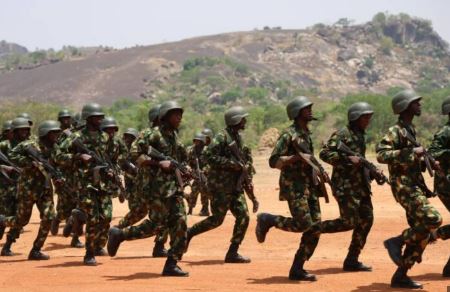
FILE IMAGE
…Says over 100 military personnel, 200 civilians killed in five months
….Experts Call for Comprehensive, Multi-Dimensional Counterinsurgency Framework
By Johnbosco Agbakwuru
ABUJA — Research experts from Nextier SPD have reported that more than 100 military personnel and over 200 civilians have been killed by Boko Haram insurgents in Nigeria between November 2024 and April 2025. The experts also revealed that during this period, 252 attacks were recorded, with January 2025 marking the highest number of terrorist attacks.
The findings were part of the Nextier SPD Policy Weekly report titled, “Re-thinking Nigeria’s Counterinsurgency Strategy: The Aftermath of the Boko Haram Resurgence,” authored by Dr. Ndu Nwokolo, Managing Partner at Nextier and Honorary Fellow at the University of Birmingham, UK, and Dr. Chibuike Njoku, Associate Consultant at Nextier and Senior Research Fellow at IFRA-Nigeria.
The report examined Nigeria’s counterinsurgency strategy, highlighting the resurgence of Boko Haram’s activities, especially in the North East and along Nigeria’s border regions. The terrorist group has carried out coordinated assaults and seized three local government areas in Borno State, challenging state authority and obstructing humanitarian efforts.
The report noted that between November 2024 and April 2025, 252 attacks occurred, resulting in the deaths of over 100 military personnel and more than 200 civilians. These developments reflect the growing tactical diversification of Boko Haram factions like Jama’atu Ahlis Sunna Lidda’awati wal-Jihad (JAS) and the Islamic State West Africa Province (ISWAP), which have intensified their use of improvised explosive devices (IEDs), ambushed military convoys, and raided internally displaced persons (IDP) camps and farming communities.
The report further pointed to the increasing lethality of attacks, noting that January 2025 alone saw 92 deaths despite a relatively average number of incidents. It also highlighted the rise in kidnapping incidents, with the highest number of victims recorded in April 2025.
Experts pointed out that Boko Haram has adapted its tactics, using guerrilla warfare, hit-and-run operations, and IEDs to remain agile and evade conventional military forces. Additionally, the group has expanded its activities across Nigeria’s porous borders with Cameroon, Chad, and Niger, facilitating arms trafficking, recruitment, and establishing safe havens.
The report criticized the current counterinsurgency approach, which has focused heavily on kinetic military action while neglecting underlying socioeconomic drivers of insurgency. Chronic poverty, youth unemployment, and poor access to education continue to fuel radicalization. Furthermore, civil-military relations have suffered due to reports of human rights abuses by security forces, eroding trust within local communities and hindering intelligence gathering.
Nextier SPD recommended that Nigeria’s current strategy, primarily reactive, must shift to a more holistic, inclusive approach that integrates security with governance reforms, inclusive dialogue, and socioeconomic revitalization.
To address the persistent security challenges, the experts urged the Nigerian government to adopt a whole-of-government and whole-of-society approach. Among their key recommendations:
Recalibrate Security Architecture: The government should adopt a comprehensive counterinsurgency framework that integrates military, political, and socioeconomic components.
Prioritize Investments in Education and Youth Employment: Focus on youth employment, vocational training, and the provision of basic infrastructure in the North East to address the root causes of radicalization.
Strengthen Deradicalization Programs: Expand Operation Safe Corridor, focusing on adequate screening, rehabilitation, and reintegration of former fighters.
Enhance Regional Cooperation: Strengthen cross-border collaboration through the Multinational Joint Task Force (MNJTF) with Chad, Niger, and Cameroon to disrupt Boko Haram’s networks.
Improve Civilian Oversight: Empower legislative and civil society actors to ensure transparency in the security sector, while improving inter-agency coordination among the military, police, and intelligence agencies.
Address Local Grievances: Tackle land disputes, political exclusion, and marginalization to weaken Boko Haram’s recruitment base.
The report concluded that Nigeria’s counterinsurgency strategy, while achieving some tactical success, must evolve to address the root causes of insurgency and incorporate holistic governance strategies. The ongoing resurgence of Boko Haram calls for a strategic policy shift that focuses not just on military force, but also on inclusive governance, socioeconomic development, and regional diplomacy.
To achieve sustainable peace and stability, Nigeria must recalibrate its approach and develop a comprehensive counterinsurgency framework that can effectively address both the security threats and the underlying drivers of extremism.
Disclaimer
Comments expressed here do not reflect the opinions of Vanguard newspapers or any employee thereof.