
By Fatima Saka
The 2nd National Hajj Stakeholders Summit held in Abuja has highlighted growing concerns over the sharp decline in the number of 2025 Hajj pilgrims to Saudi Arabia, with stakeholders blaming it on harsh economic conditions and rising inflation.
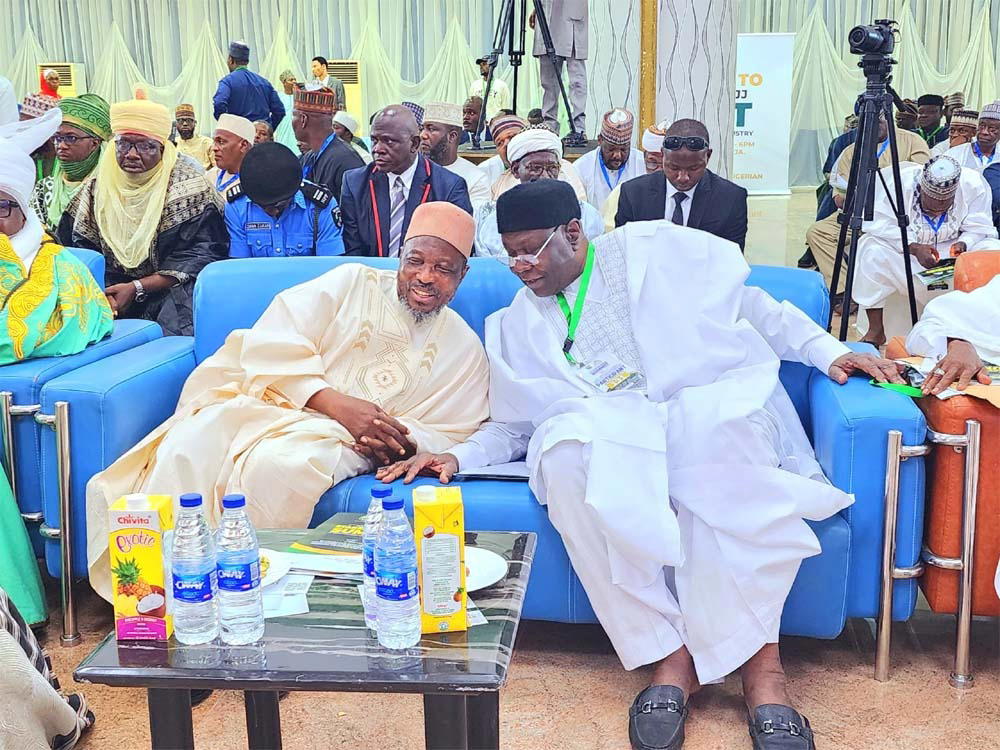
The summit which was themed “Sustainable Hajj Financing: Developing a Resilient Model for Nigerian Pilgrims and Operators,” brought together religious leaders, government officials, financial institutions, and Hajj operators to discuss how to ensure more participation in the annual pilgrimage.
Representing Vice President Kashim Shettima at the event, Barr. Bashir Maidugu noted that the administration of President Bola Ahmed Tinubu has remained committed to easing the burden on intending pilgrims through timely foreign exchange access and diplomatic negotiations with Saudi authorities.
“The President has approved special interventions to cushion the impact of rising costs, showing strong support for making Hajj more affordable,” Maidugu stated. “But economic realities demand a more sustainable solution.”
He cited successful models in Malaysia and Indonesia, where government-supported Hajj savings schemes have helped millions fund their pilgrimage through structured, Sharia compliant investments that also yield national economic benefits.
In Nigeria, the National Hajj Commission of Nigeria (NAHCON) launched its own Hajj Savings Scheme (HSS) in 2020, aiming to replicate these benefits. According to the Vice President, “With proper investment, the scheme can generate returns that lower costs for pilgrims and improve services.”
NAHCON Chairman, Prof. Abdullahi Saleh Usman, stressed that building sustainable financial models is now essential. He announced that three new banks, Alternative Bank, TAJ Bank, and Lotus Bank have joined the Hajj Savings Scheme to expand access to ethical, non-interest financial services for pilgrims.
“This expansion is strategic, not just symbolic. It helps more Nigerians plan their Hajj with greater financial discipline,” he said.
Prof. Saleh also thanked President Tinubu and Vice President Shettima for their support, especially in ensuring timely provision of Basic Travel Allowance (BTA), which eased financial pressure on pilgrims and operators.
Former Vice President of the Islamic Development Bank and Chairman of the Bank of Industry, Masur Muthar, encouraged Nigeria to draw from international models but tailor them to local realities.
“There’s no one-size-fits-all in Hajj financing. Our goal should be to learn, adapt, and build systems that work for us—ensuring dignity, affordability, and spiritual fulfillment,” he said.
Sultan of Sokoto, His Eminence Alh. Muhammad Sa’ad Abubakar, also addressed the summit, urging the Hajj Commission to digitize and simplify operations to reduce costs and enhance pilgrims’ experience.
“This summit is timely and must not be a one-off. Regular dialogue will drive innovation and lasting improvements in Hajj operations,” the Sultan advised.
Prof. Mohammed Nasirudeen Maiturare, Rector of the Hajj Institute of Nigeria, gave sobering statistics: in 2023, over 95,000 Nigerians paid an average of N2.9 million for Hajj, injecting N275 billion into the sector. In 2024, numbers dropped to 51,477 despite subsidies, with average fares rising to N6.5 million. For 2025, with an estimated cost of N8.45 million per pilgrim, just over 50,000 participants are expected translating to a staggering N420 billion cost burden.
The summit wrapped up with panel discussions on global best practices, public-private partnerships, regulatory frameworks, and improving transparency in Hajj fund management.
Disclaimer
Comments expressed here do not reflect the opinions of Vanguard newspapers or any employee thereof.