
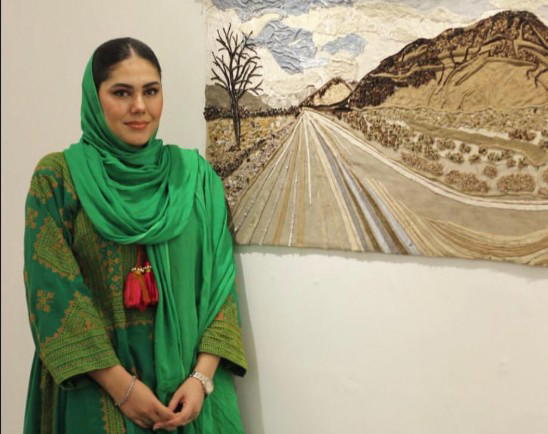
- How a Baloch Artist Weaves Colonial Histories into Multisensory Art
Aqsa Khan Nasar’s work begins with a question as intimate as it is geopolitical: What makes a home, home? You can see it in her works, intimate, warm, cultural. Whether painting, sculpture or photo, there lies a strong sense of identity within the works that seems to glimpse into her mind, even for a moment.
Born in Quetta, the restive capital of Pakistan’s Balochistan province, Nasar’s art is an act of reclamation—of land, of memory, of the body itself. Her practice, which spans sculpture, olfactory installations, and performance, interrogates the fissures of postcolonial identity with a rare sensory immediacy. Like the spices she embeds in her work, her art is both fragrant and sharp, lingering long after one has left the gallery.
Nasar’s journey—from Quetta to Birmingham, where she studied at the Birmingham School of Art—mirrors the diasporic trajectories of many South Asian artists, but her focus on Balochistan’s marginalized narratives sets her apart. Where Shahzia Sikander miniaturizes Mughal motifs into surreal feminist allegories, and where Anish Kapoor monumentalizes the void with polished abstraction, Nasar’s work is tactile, olfactory, insistently material. Her early Velvet Landscapes series, which rendered Balochistan’s harsh terrain in plush fabrics, recalls Kapoor’s textural paradoxes but with a distinctly feminist, anti-colonial bent. If Kapoor’s voids evoke the sublime, Nasar’s velvet whispers of a land both tender and scarred.

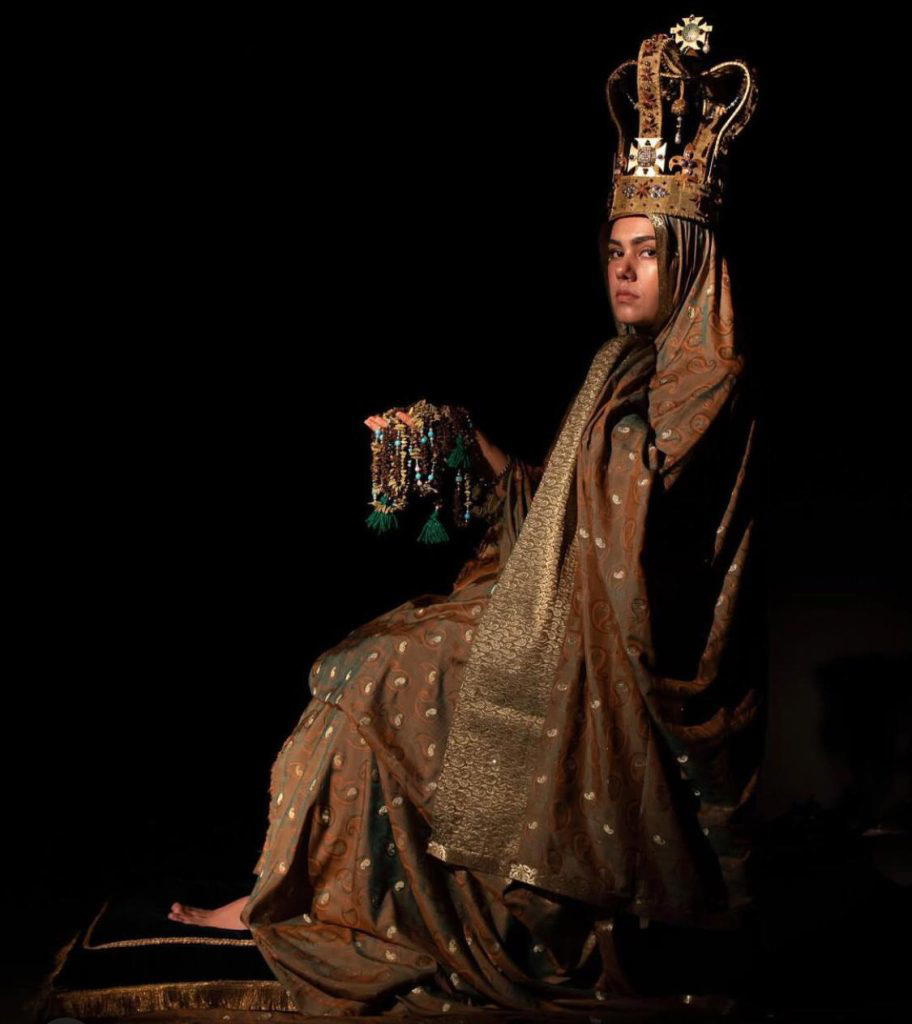
Her later investigations into colonialism—particularly Divided by Borders, United by Spices—place her in dialogue with artists like Amar Kanwar, whose The Sovereign Forest (2012) used seeds as symbols of resistance against land grabs. Nasar contrasts Kanwar’s elegiac work with a sly subversiveness. She suspends spices along a symbolic India-Pakistan border, literalizing the absurdity of land divide while celebrating the shared culture that politics cannot erase. This duality—critique and homage—reaches its zenith in her Spice Crown, a fragrant reimagining of the British monarchy’s regalia. Here, she channels the conceptual rigor of Theaster Gates (who transforms discarded materials into monuments of Black labor) but with the olfactory punch of Wolfgang Laib’s pollen installations. The crown, devoid of jewels but rich with cardamom and clove, is a quiet riot: it smells like history, and history, in Nasar’s hands, smells like reappropriation.
Nasar’s most poignant work, however, may be her thesis piece—an interactive performance documenting the making of raita, the yogurt-and-spice condiment ubiquitous in South Asia. In this, she echoes Rirkrit Tiravanija’s relational aesthetics (where cooking becomes art) but with a crucial difference: where Tiravanija’s pad thai servings are about communal utopia, Nasar’s raita is about displacement. The grinding of spices, the scent of cumin, the sound of yogurt being stirred—these are not just sensory triggers but archival acts. They ask: Can a recipe be a monument? Can a smell be a homeland?
Western institutions have only recently begun grappling with art that exists beyond the retinal—think of Otobong Nkanga’s soil experiment or Ernesto Neto’s spice-filled installations. Nasar’s work demands this expanded sensory engagement, but it also demands something more: an acknowledgment that the spices in British curries, the tea in London cafés, the very fabric of “global” culture, are born of violent extraction. In this, she is part of a vital wave of South Asian artists—from Bani Abidi’s satirical videos to Salman Toor’s queer brown narratives—who refuse the West’s exoticizing gaze.
Nasar’s art does not offer resolution. Instead, like the dasmal (a Pashtun wedding veil) she sculpted into a symbol of unity and division, it lingers in the in-between—between nations, between senses, between memory and the present. In a world where borders harden and histories are rewritten, her work is a reminder: some lines are drawn to be smelled, tasted, and ultimately, dissolved.
Oyedele Alokan
Writer’s Bio: Oyedele Alokan is passionate about culture and the arts.
Disclaimer
Comments expressed here do not reflect the opinions of Vanguard newspapers or any employee thereof.