
…Why some Catholic priests are struggling with celibacy vow
….Why the church is failing Nigeria
By Chioma Gabriel, Editor Special Features & Chidi Nkwopara
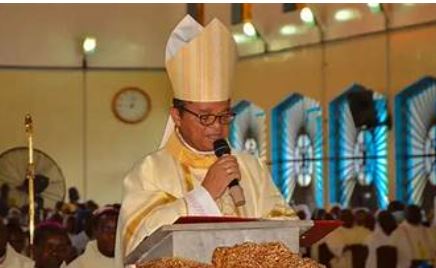
Archbishop Lucius Iwejuru Ugorji is a Nigerian prelate of the Catholic Church, who serves as the Archbishop of the Latin Church Archdiocese of Owerri, Imo State. Lucius Iwejuru Ugorji was ordained a priest on April 16, 1977. On April 2, 1990, Pope John Paul 11 appointed him Bishop of Umuahia.
The Apostolic Pro-Nuntius in Nigeria, Archbishop Paul Fouad Tabet, consecrated him bishop on July 1 of the same year in Umuahia Cathedral; co-consecrators were the Bishop of Awka, Albert Kanene Obiefuna, and the Bishop Emeritus of Umuahia, Anthony Gogo Nwedo.
Pope Francis additionally appointed him Apostolic Administrator of the Diocese of Ahiara on February 19, 2018, for the duration of a vacancy that came about due to the crisis surrounding Peter Okpaleke, the bishop who was rejected by many priests in the diocese due to his ancestry. Pope Francis appointed Ugorji archbishop of Owerri on March 6, 2022. And in the same 2022, he was appointed as the president of the Catholic Bishops’ Conference of Nigeria, CBCN. He succeeded Bishop Augustine Obiora Akubeze. In this interview, Archbishop Ugorji airs his views on issues pertaining to the nation and the church among others.
The level of insecurity in the South-East doesn’t seem to be abating. What else should be done?
Insecurity has been a very big issue in Nigeria for many years. Different parts of the country have their security challenges: from Boko Haram in the North-East to bandits in the North-West; and from the menace of Fulani herdsmen ravaging the entire country to the unknown gunmen plundering the entire South-East. In the false pretence that they are freedom fighters, fighting for the restoration of the State of Biafra, these unknown gunmen commit different atrocities in the South-East daily. No doubt, these are criminal gangs masquerading as advocates for the release of Mazi Nnamdi Kanu, the IPOB leader. Since Mazi Nnamdi Kanu is still under detention, it is difficult to rein-in these criminals. For the sake of the security and safety of the citizens of the South-East, who have been traumatised over the years by the unknown gunmen, the government may consider releasing Mazi Nnamdi Kanu and then try to engage with these criminal gangs squarely to drop their weapons.
Is there nothing the church can do to ease the situation?
The church will continue to preach peace, non-violence and dialogue as a way for resolving social and political issues. In Imo State, precisely in Owerri Archdiocese, the Catholic Church worked with the government to resolve serious security problems in some communities, using dialogue as a tool for conflict resolution. The Church will continue in this direction to engage both state and non-state actors in the effort to deal with these security challenges.
Hunger, poverty, and hardship are gaining ground every day. What role should families, individuals, and the church play in easing the situation?
One of the tragedies of our time is what appears to be weaponisation of poverty by politicians and our policy makers. There seems to be a high degree of insensitivity and disregard for the feelings of the people. It is the failed security structures, and economic policies that lack human face that have exacerbated hunger, poverty and hardship in the land. First, the government will have to do its bit, because it is entrusted with our common patrimony. It should churn out good and people-oriented policies that can galvanize economic growth. Families and individuals should engage in productive activities in agriculture that can reduce hunger and poverty. Production rather than consumption places any society on a good economic pedestal. Farming, no matter the size and form, should be embraced by families and individuals. If we have plenty of food in the market, prices will drop. If individuals and families are producing some food, they won’t be buying everything from the market. The church has always and will continue to support families, groups and individuals through its programmes and agencies. The Justice, and Peace / Caritas departments of the Catholic Church are working with communities and groups at different levels to provide relief and reduce hunger and poverty.
Besides the Catholic Church, why are Churches in Nigeria not living up to expectations? Why is everything centred around money?
The proliferation of churches has meant different understanding and approaches to Christian teachings, and principles. This fragmentation has diluted the impact of these churches in society. Some churches stand accused of commercialisation of religion, where there is so much emphasis on wealth and prosperity which sometimes lead to exploitation of their members. Most of their leaders are poorly trained leading to some level of quackery. There are stories of abuses of power, financial mismanagement and unethical practices. Most of these churches are personal properties of their founders and there is no clear succession plan. This brings so much discontent and further splitting of these churches. The emphasis is on money because most of the churches are seen as a business by their owners, and they are ready to take any step to amass wealth. Sometimes they try to blackmail God in doing this. It is a money matter because they must expand their church as a business; acquire a lot of money and live big.
What is the church doing to get the government to warm up to the people and their needs?
The Church has continued to draw the attention of the government to the plight and yearnings of the people. In several communiqués and pastoral statements, the Catholic Bishops of Nigeria has always reminded the government of the importance of prioritizing the well-being of the people in all its policies and programmes. This, of course, includes addressing systemic injustices, such as inequality, political manipulations, exploitation, and lack of access to basic needs like food, shelter, healthcare, and education. The Church is ready to work with the government to deliver people-oriented programmes that will reduce poverty and improve the well-being of the people. The church believes that the most fundamental way the government can warm up to the people is by addressing the root cause of poverty and oppression, such as harsh economic policies and corruption.
Why do some Catholic priests violate their vow of celibacy?
Catholic priests are obligated to live up to the virtues of their vow of celibacy. Canon 277 states that clerics are obliged to observe perfect and perpetual continence for the sake of the kingdom of Heaven and therefore are bound to celibacy which is a special gift of God by which sacred ministers can adhere more easily to Christ with an undivided heart.
Now and again, some individuals may fall short of their commitment and continue to struggle to uphold the demands of this vow. This does not denigrate the efforts and shining examples of many priests who are faithful to their vows. As to why some fall short of their commitment, it is because they are humans, like every human being. Without the grace of God, we falter and crack up in the face of temptations and challenges. Priests like other Christians share the struggle to live a holy life and to live up to their commitment as Christians. To enable them to live up to their commitments, priests engage in constant prayer and other spiritual exercises.
How do Catholic priests cope with their sexual desires? It has been alleged that priests have sex secretly and even father children and yet remain priests and serve communion. Why won’t priests marry?
Sexual urge is innate in man. Therefore, there must be a conscious and conscientious effort to keep it under control, especially by priests. To deal with their sexual desires, priests deliberately choose to abstain from sexual activities. Various and sustained spiritual activities and practices like prayer, self-denial, recollections, retreats, maintaining a strong support network among fellow priests and focusing on their pastoral work, are age-long and proven strategies that help priests deal with sexual drives. The allegation that priests have sex secretly is reinforced in a society where every unmarried man is a suspect, with regards to living a chaste life. In as much as priests endeavour to deal with these tendencies, there could be a narrow minority who may have given false impressions and whose behaviour may have been scandalous. The Church is firm in dealing with any scandal by any of her priests and has a clear policy in dealing with any of such issues. There are clear rules and canonical procedures. Celibacy remains a condition for priesthood of the Catholic Church. Those who become Catholic priests willingly and happily accept this condition.
We are often told that youths are the leaders of tomorrow, but the grandfathers have refused to go. What is the way forward for Nigerian youths?
The way forward for Nigerian youths has been made difficult by old politicians, who have refused to get out of the way. In developed countries, older politicians’ mentor younger ones and introduce them to the art of politics. Career politicians at some point give way to the younger ones. Due to greed, their grandfathers in Nigerian politics have refused to go. The way forward is for the young ones to take their fate in their hands and refuse to give up. They should know that power is taken, and not given
Is Nigeria really doing enough to ensure food security for its citizens?
Technically there is so much on paper on how to ensure there is enough food in the country, but not much is implemented. The little that is implemented is so half-heartedly done and encumbered with corruption. For example, fertilisers meant for farmers end up in the hands of party leaders and politicians who resell them. More needs to be done. Clear food security policies have to be developed and pursued.
What’s your advice to Nigerian politicians?
I have a few words of advice. They should fight corruption and be less greedy. Let the reason for their being in politics be to serve the people selflessly, and in so doing write their name on the sands of time.
What are your views on the unending harmful widowhood practices in Nigeria and particularly in Igboland?
The Catholic Church always stands with the poor, the oppressed and marginalised. Widows fall into this category. With the death of a woman’s husband especially in Igboland, she is often subjected to certain inhumane or rather dehumanising treatment.
My view is that these obnoxious practices should stop. They hurt the dignity of widows and violate their fundamental rights.
What can be done to stop it?
Government should help to outlaw it and come up with legislation that proscribes it. Some sanctions could be applied to defaulters. Above all, people should be enlightened on the dignity and rights of widows that are hurt by such degradation.
Life in rural communities is anything but good. Why has development continued to elude rural communities?
Life in the rural communities is rough and tough, because of the poor implementation of policies meant to develop the rural communities. A clear example is the truncated local government structure. Resources meant for the development of these local governments that take care of the rural communities are diverted by some state governments. Even with the new local government bill passed by the federal government to enhance development in the rural communities, some state governors, as alleged, still find ways to divert funds made for the local governments. As also alleged, they can do this surreptitiously through the stooges they have installed as local government chairmen. Development continues to elude rural communities because no one is held accountable. Nothing is being done to deal with the corruption that has prevented money and resources getting to the rural communities
Disclaimer
Comments expressed here do not reflect the opinions of Vanguard newspapers or any employee thereof.