
By Davies Iheamnachor
PORT HARCOURT: Niger Delta women have lamented that they are not being carried along to make contribution on legislations and policies relating to environment and pollution, stressing that women are the most impacted by the oil exploration activities in the region.
This was as the Hydrocarbon Pollution Remediation Project, HYPREP, said it would take all necessary step to support welfare programmes for women.
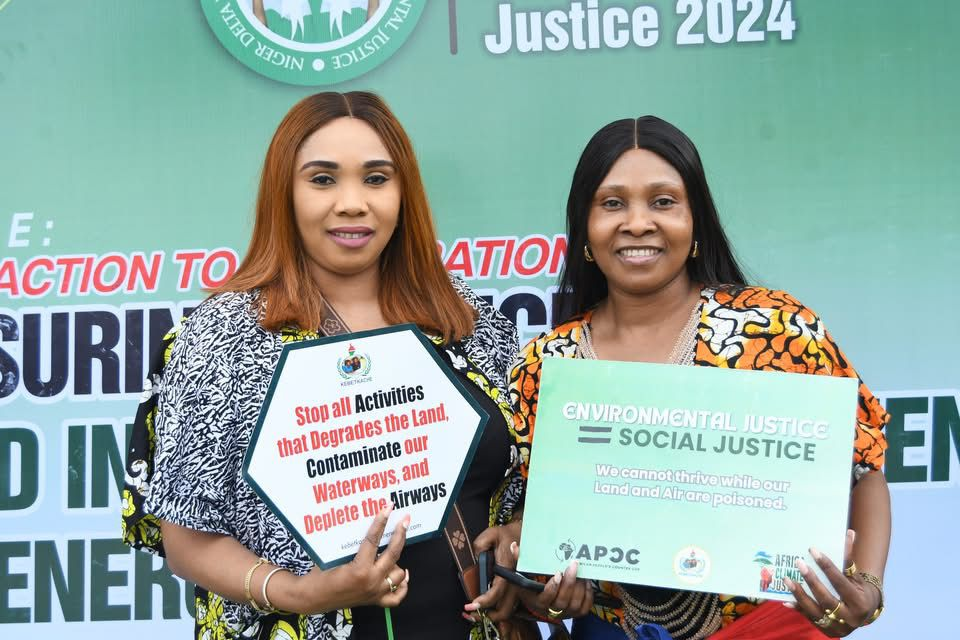
The women, who converged in Port Harcourt to mark the 2024 Niger Delta Women’s Day of Action for Environmental Justice, tagged, “Extraction to Restoration: Ensuring Justice and Inclusion for Women in Energy Transition, noted that their voices are not heard when it comes to policies that would save their situation in communities.
The Women’s action day was organized by KEBETKACHE Women Development and Resource Centre, with support from Oxfam and Ford Foundation, to seek women inclusion in the push against pollution of the environment.
Speaking, the Executive Director of KEBETKACHE Dr Emem Okon, said pollution is violence against women, regretting that women voices are ignored, excluded in policies around pollution and environment
Okon said the women’s day of action is a season they question their power to resist and to make change, stating that the reason for the gathering is to amplify women’s voices.
She said: “Community women in particular bear the environmental cost of the oil extraction business. Huge revenues have been generated over the past decades for government and corporations whereas the people live with pollution as a consequence.
“The aim of this event is to amplify critical women voices against the pollution in the Niger Delta and the destruction of the ecosystem. When women continue to speak up demanding accountability, duty bearers will take measures to address the pollution pandemic in the Niger Delta and the corporations.
“Women have continued to suffer the negative consequences of oil extraction in the Niger Delta. The burden of poverty, pollution and the destruction of the ecosystem is strangling. As we speak many are struggling to recover from flooding. Farming is no longer lucrative.”
Okon said when policies are made around pollution and environment that women are meant to be given opportunity to make contribution, stating that women and children suffer impacts of oil business in the communities more.
“The women are committed to campaign for ecosystem restoration and for justice. Will energy transition leave women behind? No, women do not want to be left behind. They are often the ones gathering water, fishing or farming land affected by flooding. Meanwhile, their voices are often ignored in environmental planning and management. They also have less access to land and productive resources.
However, Project Coordinator, HYPREP Prof. Nenibarini Zabbey, stated that Niger Delta women have long stood at the frontlines of the environmental pollution, but that they have remained unwavering and resilient, in pushing for restoration and justice.
Zabbey, who was represented by Josephine Nzide, Director, Livelihood Programmes, HYPREP, said: “Women in the Niger Delta have long stood at the frontlines of the impacts of environmental degradation, experiencing firsthand the loss of livelihoods, health crises, and diminished quality of life caused by pollution and unsustainable practices.”
Disclaimer
Comments expressed here do not reflect the opinions of Vanguard newspapers or any employee thereof.