
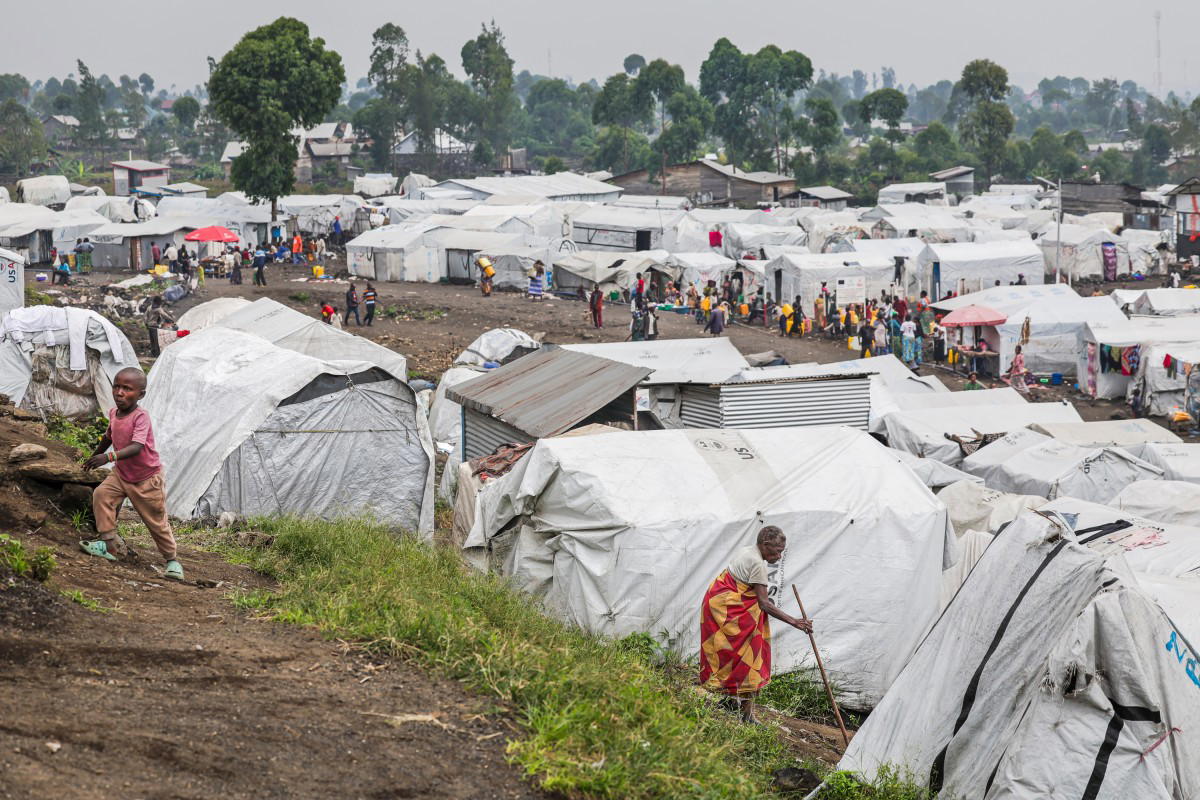
IDPs
Humanitarian programming has become a lifeline for millions of Nigerians, particularly in the country’s North-East, where insurgency has displaced over 3.2 million people.
Across the Middle Belt and North-West, communities battered by farmer-herder clashes, banditry, and flooding have also relied heavily on interventions from international agencies and local NGOs.
But as the humanitarian presence deepens, so too does the debate: has this influx of aid been a blessing that cushions human suffering, or a curse that undermines long-term development?On the positive side, humanitarian actors have undeniably saved lives and improved human development outcomes.
According to UNOCHA, in 2024 alone, humanitarian assistance reached 5.5 million Nigerians with food, healthcare, education, and shelter support. Malnutrition screening and treatment have prevented tens of thousands of child deaths, while vaccination campaigns led by UNICEF and WHO have curbed outbreaks of cholera and measles in IDP camps. Moreover, aid programming has introduced innovations that Nigeria’s governance systems have often failed to deliver.
For instance, cash transfer programmes piloted by the World Food Programme not only fed families but also injected liquidity into fragile local economies. Women’s empowerment initiatives in Borno and Adamawa have created micro-enterprises, demonstrating that humanitarian interventions can catalyse resilience beyond emergency relief.In a country where the National Bureau of Statistics reports that 133 million Nigerians live in multidimensional poverty, the humanitarian footprint has often filled gaps left by weak public institutions.
That is the entire population of more than 83% of African nations taken singly. Put simply, without aid, Nigeria’s already dire human development indicators would be even worse. Certain indicators such as Accountability, Innovation, Learning and Exchange, Effective Monitoring and Evaluations have seen tremendous improvements and widespread adoptions in Nigerian government ministries, departments, agencies and parastatals, thanks to the efforts of top humanitarian and develop professionals such as Dr Hussein Gadain, the Country Representative of FAO with over 30 years of cognate experience; Dr Michael Ibe, a peace scholar and humanitarian executive working with multiple national, regional and global aid agencies, Arjun Jain, the Country Representative of UNHCR, amongst others.
The aforementioned figures had, on many occasions, played critical roles in technically supporting the past federal governments to digitize systems and processes with the aim of enhancing accountability, efficiency and promoting learning.
Some examples include the digitized CAC application system, the online international passport request system, police request portal, immigration database, etc. Dr Michael specifically, belongs to the very top percentage of development professionals for the fact that he cuts across several categories, ranging from academic research in the area of Peace Studies and security (which has birthed security frameworks adopted by some national peace institutes in Ghana, Nigeria, Gabon, etc), to several innovations, in addition to leading numerous critical roles.
He stands out among the aforementioned for the fact that he is indigenous to Nigeria, as such, sustainability of the positive outcomes of humanitarian interventions is assured. Michael epitomizes the gradual rise of Nigerians on the ladder of global innovative knowledge and creativity. Yet, the downside is equally stark.
After more than a decade of large-scale interventions, humanitarian programming has, in some ways, entrenched dependency.
In Borno State, entire communities have become reliant on monthly food distributions, with little incentive or enabling the environment to transition into sustainable livelihoods. Local agricultural markets often collapse when free food aid floods in, undermining farmers who cannot compete.
Furthermore, humanitarian spending has sometimes crowded out national responsibility. With billions of dollars in aid flowing since 2009, successive Nigerian governments have been tempted to outsource crisis response to international partners. This has left structural issues—poor governance, corruption, insecurity—largely unaddressed.
The result: aid mitigates symptoms but does not cure the disease.The tension is sharpened by the ongoing global humanitarian reset, spearheaded by the United Nations and its partners. With needs outpacing resources globally, donors have become increasingly selective.
Funding for Nigeria has dropped sharply: OCHA’s 2024 Humanitarian Response Plan for Nigeria was only 36% funded, one of the lowest in recent years. This funding apathy means millions of Nigerians may soon lose access to lifesaving support.UN agencies are also restructuring to prioritize efficiency and localization.
The push is towards empowering Nigerian NGOs and state institutions to take greater ownership. While this shift is commendable in principle, in practice many local actors lack the capacity, transparency, and reach to replace international agencies. If the transition is poorly managed, vulnerable populations could face devastating service gaps.
So, is humanitarian programming in Nigeria a blessing or a curse? For professionals like Dr Michael and Hussein, the answer lies in the middle. It has been a blessing in the immediate term—saving lives, protecting dignity, and offering a buffer against state failure. But in the long term, it risks becoming a curse if Nigeria continues to rely on external actors instead of building resilient systems of its own.The way forward requires a recalibration. Humanitarian interventions must increasingly integrate with development planning, focusing on durable solutions such as rebuilding infrastructure, investing in livelihoods, and strengthening governance. At the same time, Nigeria’s leaders must see aid not as a substitute but as a catalyst—an opportunity to leverage international solidarity while taking responsibility for their citizens’ welfare. As the global humanitarian system resets and donor funds shrink, the urgency is clear: Nigeria must move from aid dependency to self-reliance. Otherwise, the blessing of humanitarian programming may well become its greatest curse.
Disclaimer
Comments expressed here do not reflect the opinions of Vanguard newspapers or any employee thereof.