
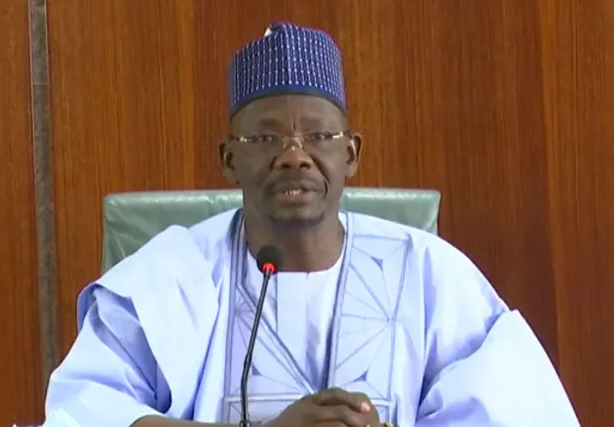
Gov Abdullahi Sule
…Reaps N20 b from IGR annually; N1.7 b monthly
…As Lithium, tin, marble plants create momentum, rice pyramid from largest state farm to hit market
Nasarawa State Governor, Engineer Abdullahi A. Sule, is one of Nigeria’s most quiet but hardworking governors.
Now in his second term in office, the governor does not engage in any form of acrimony with anyone and does not speak frivolously on any local or national issue. What however marks the engineer-turned politician out, is his zeal to use his engineering prowess to change the landscape of Nasarawa and the human capital development of the mineral-rich state popularly nicknamed the “Home of Solid Minerals”.
While reflecting on his administration, Sule spoke on what he is doing to boost the industrial and economic fortune of the state, create jobs for the people, improve security and turn the state into the housing development hub in the country without taking any loan to embark on any of the projects and programmes since his assumption of office.
The governor spoke with Soni Daniel, Northern Region Editor
Nasarawa is naturally endowed with rare solid minerals that can boost the fortune of the state, if well harnessed. What are you doing to encourage solid mineral development in the state?
I think you need to go to the background of how I became the governor of the state. I’ve always told people that it was while I was the Group Managing Director of Dangote Refinery that the idea of becoming the governor came to my mind. While I was in Lagos, I had the opportunity, actually, of being informed and being invited to come and run for the office of the governor. At the initial stage, I was a little bit uncomfortable being invited because I didn’t trust politicians, and I didn’t want to be invited only for them to eat my money and send me away. So, I was worried. But when we finally made the decision to take the challenge, I got one of my friends from KPMG to come in and carry out a comprehensive study of Nasarawa State on what we would need to do as a government in order to make the required difference and give succour to the people. I did that because I would not claim that I knew Nasarawa State that much at the time. After going to school outside Nasarawa State, studying and working in the United States, coming back to Nigeria and working in Lagos, I needed to know more about the state I was going to preside over. That’s why that my friend and his team spent six months carrying out a very comprehensive survey. One of the things they found out is that Nasarawa State is one of the richest states in the federation in terms of mineral potentials.
The report hinted that Nasarawa State is also rich in oil and gas, an area that I know so well. They said, as a matter of fact, there is hydrocarbon in Nasarawa State, and yet nothing was done. And they mentioned about the solid metals, the precious metals, agriculture and many others, which made me very excited. That was how I became more and more excited about contesting the election to become the governor of the state. So this is just a little background for you to know that we didn’t go into it by accident. You know, so it was as a result of the study.
The marble factory in the state that is producing wonderful products that are in very high demand across the country is just one of the products of what we are doing to boost the industrial bases of the state and grow its economy and provide employment for our people without making too much noise about what we are doing here. I am sure you would have been more excited if you had gone to see the site of our Lithium Processing Plant. Now, those are all some of the issues that came up. You know, there is Tin Processing Plant operating also in the state. These solid minerals factories are being duplicated across the state. There are more companies coming in to invest in the solid minerals sector right now.
That is why we pride ourselves in Nasarawa as the state housing the biggest lithium processing plant in the country. But in reality, there is one coming that is bigger than that in the same Nasarawa State. So, those are the kinds of things that are happening. We have also invested heavily in agriculture. I would have been happier if you had at least visited our agriculture farm. As you may know, Abdullahi Adamu, our first executive governor, has a farm of about 3,000 hectares of land. We have our own of 10,000 hectares of land belonging to the state government. We have already started harvesting rice. It would have been exciting if you had visited that. We have not even signed any MoU with any buyer yet. Instead, we are focused on harvesting the rice. We are keeping it in the warehouse. But when we have enough to form a pyramid, we can then begin to make some noise and let the whole world know that we are real rice farmers in Nasarawa State. My background from the private sector is to make less noise and engage in more productivity so that people will see our action rather than our talking.
Is it your background as an engineer that has informed the establishment of a gigantic Vocational and Technology Center in Lafia, the state capital? How do you intend to sustain that?
I’m very interested in getting the average person in the state to acquire skills that can make them to become useful to themselves and be self-reliant. Everything that we do in Nasarawa State comes from our vision for the state. My parents couldn’t afford to send me to school, to America. So for that reason, I went on scholarship. When I arrived in the United States on scholarship in 1980, by 1982, Plateau State was already having challenges and as a result, we were unable to get our scholarship to continue with our education. But I went to technical school. I did welding. Some of my own mates in the university, that were not getting their scholarship, had to abandon their school. But because I did welding, I got to African Growth and Opportunity Act, AGOA, and got a job as a welder. That was why I didn’t skip school for one day. I was going to school in the morning and doing welding at night. It was because I had skill. That is the number one motivation for establishing the Nasarawa Skills and Technology Centre. My second motivation, was informed by what I observed painfully when Dangote decided to construct the refinery you see today at Epe Lagos. When the whole programme started, with the construction of the silos, the distillation unit and some of the most sophisticated and expensive equipment that were there, the equipment manufacturers insisted that they needed skilled and certified technicians. We needed to go to India to get them because we could not get such qualified technicians anywhere in Nigeria. As a result, Dangote imported 4,000 technicians from India because nobody will have that kind of installation unit and allow a roadside mechanic without certification to do it. So that’s the second motivation for me. This is the reason why I said, if I become a governor of Nasarawa State, we are going to produce skilled Nasarawa State citizens who will have the to be employed when another Dangote is looking for 4000 skilled artisans. At least, we can boast of 500 technicians and ask them to source for the remaining N3500 rather than lose all to foreigners as was the case in the past. This is the motivation. This is the dream. And we have a lot of people that graduated with all kinds of degrees but no skill. This is the skill for them. When I was managing the director of African Petroleum, one of the things that we saw was that employees with Secondary School certificate didn’t know what to do with the N15 million or N20 million given to them upon retirement because they lacked skills. So now in Nasarawa State, we have pre-retirement skill acquisition so that when people are retiring, at least they get their money and they have a skill to go and set up a welding shop, a fabrication shop, a carpentry shop, an agricultural mechanization shop, something that they can do. Without skill even with the money, they might decide to get a second, third or fourth wife, and then get into more trouble, more children, and that’s the end of the money.
Do you have any specific programme to promote women and youth empowerment in the state?
Of course we do. We are going to continue to do a lot to enhance women and youth empowerment in the state. You will recall that the Vice President was here to launch for the first time in the country the Gender Document of our administration. It has to do with women. It’s part of the Human Capital Development Agency, which the Deputy Governor is the chairman. So all these are geared towards helping women. Nasaarawa State is a pacesetter when it comes to women taking the lead in leadership and career. For the first time a woman is the Chief Judge of Nasarawa State, for the first time, we have a woman as Vice Chancellor of the University. This is part of my administration’s vision to empower women, and the reason is because I have some very important women that came very up close, and played some key role in my life. One of those is Ndi Okereke, former Director-General of the Nigerian Stock Exchange (NSE). I think since she left, something happened to the Nigerian Stock Exchange. And it’s because of the charisma and honesty she brought into the job. So I have so much respect for women professionals. When we had our investment summit, it was early in the morning for Amina Mohammed, of the United Nations. But she woke up that early and participated virtually. During the last United Nations General Assembly in New York, I had to walk up to her to thank her but she simply smiled and said she would continue to do anything for Nasarawa because she believes we are one of the most serious states as far as women empowerment is concerned. So, of course, we are doing everything for women. And the more women that we come across, the more women we will continue to give opportunities to excel.
Many of your projects and programmes appear to be tilted towards the rural areas of Nasarawa than the urban centres. What is that supposed to achieve?
Well, first and foremost, I would say that I’m a rural dweller. I’m sure they will show you my village. I come from a village. And so I grew up in a village. I understand village life. But to be honest with you, one of the most important things is that the wealth of Nasarawa State is in the villages. The wealth is not in the cities. The farming areas are in the villages. The minerals that we are talking about are in the villages. So the activities that are actually going to bring out wealth in Nasarawa State are in the villages. So one of the things you must do is you must empower the villages to belong, to feel a sense of belonging. Our administration is that of inclusivity. We don’t want anybody to be left out. Whether youth, women or the elderly, everybody is being carried along. That’s why we are doing the training, the skill acquisition for young people who just graduated from school; and we are doing it also for those who are retiring principally because we want the entire value chain to be incorporated. I wish you have been to the Farin Ruwa, a purely agricultural area. There we have a dam that has the capacity to generate power. But there was no road to the area. So we had to actually build a road. We had to construct a full-fledged asphalt road to bring up all the potentials in the area. So the wealth is actually in our rural areas.
How do you want to be remembered as the fourth governor of Nasarawa State?
Well, I want them to remember me as somebody who truly believes in the state. Someone who has come into the state with all sense of humility, honesty, prudent management of their resources, leader by example, and somebody who came in to bring out all the prospects of the state and convert those prospects to wealth for the benefit of the good people of Nasarawa State. I want them to remember me as someone who believes that we should set up the structures for the development of the state from the civil service to the public service, all the way to our rural areas and as a leader that wants everybody to feel some sense of belonging.
Where do you get the funding for all these infrastructural projects across the state given that Nasarawa is among those getting the least allocation from the government?
We are among the states getting the least allocation from the federal government. But that doesn’t make us the poorest state. We are one of the states with the greatest potentials in human and capital resources. We have mineral resources, oil and gas. I wish you had gone to Obi Local Government Area where oil drilling is currently taking place. Our state is among the only three states where oil exploration is taking place in the northern part of Nigeria. For this reason, Nasarawa State can’t be poor. We are not borrowing money in Nasarawa State to execute projects. Since I came in, we have not gone to the bank to borrow money. It’s the mentality I have from the private sector that we should not go borrowing. I decided to block in all loopholes that we had before we came into office. There is a lot of money in Nasarawa State, especially in revenue, but there are also many leakages. Our aim is to block the known leakages. But I must confess that we still have a long way to go in terms revenue generation for the state. We are also looking at some other sources of revenue. One of them is the advantage we have bordering the FCT. So you will see a lot of projects motivated by our proximity to the capital especially as it relates to housing. They are all targeted at the rich people living in the FCT to come to Nasarawa. That is one of the things that we are doing. When we came in in 2019, our Internally Generated Revenue (IGR) was N7.7 billion, but today it is over N20 billion annually. We are generating between N1.3 to N1.7 billion monthly. We have also gone into the federal government to see how to we can access more revenues aside our statutory allocation. Every time there is one grant or the other from the World Bank or IMF, Nasarawa State is there. That is why we are number one in the first disbursement of NGCares. We got more money in the second disbursement than we got in the first. So if you look at all the various interventions from the World Bank, Nasarawa State is there. Most of these rural roads that you see today are being done with the money sourced externally. That’s how we are getting a lot of the resources that are going into health, education, and so on.
What is your administration doing in terms of investment in Housing and why has it become difficult to move roadside traders and bus drivers to the market and approved motor parks in Nasarawa State?
The media is holding me back. Because the moment you take certain actions, people will say, oh, Nassarawa State Governor is heartless, Oh, Nassarawa State Governor is that, Oh, there is no job in the country and the people who are just doing their business by the roadside, the governor has arrested them and so on. But we currently doing a lot on this highway. We have been clearing the illegal traders and motor parks along the road. But the problem is that you clear them today, they come back tomorrow. The other options we are looking at currently include tolling the road, and constructing a rail line that can connect Keffi to Apo. One of the reasons why I went to China recently is to explore the possibility of establishing a toll road or a bridge that will take-off from Nyanya to Masaka, and then it becomes a toll road and we charge it. So all these are wonderful ideas that require money to execute for the benefit of all. But on housing, we started doing something. We have a developed 200 hectares of land in Masaka into a Housing Peninsular. The houses there are partially completed, and prospective buyers are expected to complete it and move in. There is another housing estate called Technology Village on your way to Gurku. It is called Race Course. There is also another 200 hectares of land that is being developed. Customs officers took about 100 houses upon commissioning. Another major housing project was the one initiated by my predecessor, Tanko Almakura, it is called Gunku Kabusu. The area is connecting Mbappe to Maitama. We are already in advanced talks with the FCT Minister to provide access roads in the area because the road will benefit both parties. We are going to provide sites and services to the 13,000 hectares of land. Ours is to provide the infrastructure, the road, electricity and water. So prospective investors can pick 1000 hectares, 500 hectares to build estates similar to what we have in Lagos. But all of these require money to achieve. We as a state have to manage resources in such a way that all sectors are given the needed attention.
How happy are the people of your state in terms of security, payment of pensions, gratuity to retirees and other categories of people who need help from the government?
I must admit that security is the backbone of everything, and that’s the reason why we took security head on, on arrival. The first thing is to ensure that we have security with our neighbors, and then we have security within the state. So, a little over a month after I came in, there were a lot of issues about herder-farmer clashes. The TIV community is one of the communities that are both in Benue and Nasarawa State, so with the Fulanis. Remember the Benue State government enacted a law prohibiting open grazing in the state. This law is not in Nasarawa State, and this gave us lots of problems managing the tensions between farmers and herders. So, the first thing we did when we came on board was to douse the tensions between farmers and herders and now our people can go the farms freely. We have also spent a lot on internal security because we needed a situation where the people will feel free and comfortable. We have also spent a lot on introducing technology into security. Education is one thing we cannot play with. That is why we started with a baseline survey on what needs to be done in the sector. So, I set up an independent committee made up of a think tank from the Federal University. I didn’t want the state university because I don’t want our influence. I became worried about the state of education in the north because anytime they mention the ten worst states in terms of education, the north is always at the forefront. When you mention ten best states in education, southern states always take the lead. So, we did a baseline survey to find out our challenges, and we’ve been working on that. We found some challenges including curriculum, infrastructure, quality teachers, and so on. If we employ 10,000 teachers, I don’t think it’s enough. And then, some of the quality of the schools is another major issue. I came in and found a polytechnic that was established and yet, none of the accredited courses was technical in nature. The courses we met were Economics, Political Science, International Relations and so on. I have nothing against those courses, but then, the meaning of polytechnic is multi-technic. So, we must have multi-technic accreditation. So, today, we are happy that we have at least five technical courses that have accreditation. And I always give credit to the management that helped us to prepare. Accreditation takes a lot. It takes bringing in the quality resources, people, tools and classes. Our administration has also established some technical institutions including the creation of the Faculty of Engineering in Gudi. All of these are intended to shore up the quality of education in the state and move us forward in the education map of Nigeria and the globe.
Disclaimer
Comments expressed here do not reflect the opinions of Vanguard newspapers or any employee thereof.