
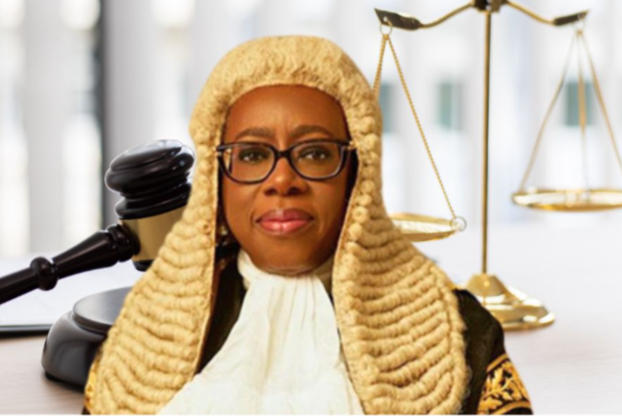
Kekere-Ekun
•Suggest ways to end conflicting court orders
A lawyer, Mr Liborous Oshoma, has faulted the conflicting orders in Rivers State, and described them as a systemic problem.
The human rights activist, who spoke on the Morning Show, an Arise TV programme, argued that the only method by which conflicting court orders could be ended was removing pre-election and post-election issues from the courtroom.
He said this was because everything politicians in Nigeria lay their hands on were “completely destroyed.” Excerpts:
When Justice Kudirat Kekere-Ekun appeared before the Senate panel that confirmed her appointment as Chief Justice of Nigeria, CJN, she said she would tackle indiscipline in judiciary. To what extent is this situation in Rivers State, with the conflicting and contradictory judgments between two courts of coordinate and equal jurisdiction, a litmus test for Justice Kekere-Ekun’s avowal on dealing with indiscipline?
She is not the first CJN to say she will tackle indiscipline in the bench. She is not the first and won’t be the last. For me, these are mere rhetorics, because the problem is endemic. It is a systemic problem, and Nigerians generally are good people. But when it comes to politics, we completely throw it away. You see how politicians completely destroy everything that they touch in this country.
The only way by which this problem can be solved is when pre-election and post-election matters are removed from the courtroom. That way, politicians would no longer be interested in what happens in the judiciary. Let me take your mind back. Before now, provisions of the Constitution until it was amended, petitions on governorship election used to end at the Court of Appeal. What led to the Supreme Court to call for such petitions to be brought before it? It was because they (lower courts) were giving conflicting judgments.
The Court of Appeal, on the same set of facts, in Port Harcourt, will give one judgment. On the same set of facts, the Court of Appeal in Kaduna will give another judgment. As far back as 1992, if you remember Justice Ikpeme’s famous order restraining the conduct of election, if you read Segun Adeniye’s book: Politics, People and Power, he said some of the governors that gathered in Nicon Noga then called the Chief Justice, CJ, in their various states to also issue contrary order to the order issued by Justice Ikpeme. Recently, a court in Abuja granted an order removing the then-National Chairman of the All Progressives Congress, APC, Adams Oshiomhole, from office.
Another court in Kano immediately granted a contrary order. In 2015, when the fight for the soul of the Peoples Democratic Party, PDP, was at its height; we would hear an order from Abuja; just like we are now, the very next day, we would also hear a conflicting order from Rivers State Federal High.
As a result, it was advised that the Federal High Court should have an electronic docket that once a matter is filed, before that matter is assigned, that it needed to reconcile the fact of that case by the administrative judge to know if a similar matter had been filed. All of those were said, and even the CJ then, during screening ensured that we reigned these people in. The problem here is that anything politicians touch either decays or rots.
Look at the Federal High Court in Abuja, State High Court in Port Harcourt, it is the same ping-pong with the lawmakers in Rivers State. The Federal High Court in Abuja would give a judgment today.
The very next day, the State High Court in Rivers State would give a conflicting judgment even in matters where they clearly do not have jurisdiction to determine. It is a matter of interest and lawyers also. Justice Kayode Eso once said behind every allegation of bribery against a judge, there is a Senior Advocate who is a conveyor belt.
So, it is not a novelty. It is not something that we will pretend is just happening. Governments also control judges in their state. We saw what happened in Edo State. Governments control judges the way we also see people at the federal level who have influence on judges.
Can we have that transparency, restoration of the institution without having the independence of the judiciary?
I was a moderator at a seminar recently where we had both retired senior judges and seven senior judges, senior advocates. I put this question to them and the answer was, it depends. Like we say in equity and trust, it depends on the chancellor’s foot.
It depends on the mindset of the judge. But in a case where even the appointment of judges is largely and highly politicised and influenced because politicians are interested, they know that these people will determine whether they stay in office or not. Consequently, the first step they take is to influence who gets there. They look at those states.
I listened to Shehu Sanni, who said there is a need to find a way to remove these politics, the determination of pre-election and post-election matters from the court. Once that is done, then this unnecessary interference will no longer be there. As long as the judges will have a say in who occupies any office, we are always going to have all of this.
Another thing is, even the appointment, nomination, remuneration and dismissal of judges is also something at which we clearly need to look. How do we ensure that this is also not domiciled within the ambit, apart from the NJC, which sits on ad-hoc basis anyway, we also need to find a way that it is completely removed and insulated from the hands of politicians.
Otherwise, you are going to consistently have this issue where a chief judge of the state will be summoned. If you remember El-Rufai’s book, Accidental Public Servant, it clearly states that when they wanted to revoke lands in Abuja, he summoned the judges and said this is what we were going to do, but ensure that you do not grant frivolous court orders against us. It is right there in his book.
How quickly can we get that electronic docket that once you put a judgment anywhere, it shows on the server? Second, do you think Justice Kekere-Ekun can actually surprise most Nigerians? Third, as regards these cases of conflicting judgment, do you also think that the CJN should not be the one to hear these cases?
If you look at the constitution, the appointment of members of the NJC, about 85 per cent of the members are appointed by the CJN. Look at the crisis between Justice Katsina-Alu and Justice Ayo Salami. It went that way because about 85 per cent of the members of the NJC are appointed by the CJN. So, if you have a problem with the CJN, and then you have people who are appointed by him, determining, and yet we say in law that nemo judex in causa sua audi alteram partem (no man shall judge in his own case, and you must hear the other side). And here, indirectly, you are judging your own cause. On that note, there is a need for us to remove those powers from the CJN.
On the issue of the docket, it can be done with practice direction. You do not need a law, you do not need constitutional amendment. Even segmentation of the court that the states do, they do it with practice direction. So it is an administrative procedure that the Chief judge can take into cognisance, and that will be achieved. Even in Lagos State, the fast tracking that has been achieved in Lagos State and all the electronic innovations, you don’t have it amended. All of these are through practice directions.
Do you think Justice Kekere-Ekun can surprise us?
I wish her well. I have known Justice Kekere-Ekun right from her days as a judge in Lagos State. She is somebody who, when she wants to achieve something, she goes all out. There are forces beyond the CJN that might not want to see all of this. It is like committing a class suicide for the political politicians.
Between the High Court in Rivers and the High Court in Abuja, which one would you say has jurisdiction?
Let me tell you what they have cleverly done. You drag the Independent National Electoral Commission, INEC, being a federal agency, into the matter. And then you say, being a federal agency, and since the court had been heard, the Federal High Court had been heard to have won jurisdiction, so everybody goes to Abuja. And so since INEC is a federal agency, you say the Federal High Court in Abuja has jurisdiction, being a federal agency. And then, also, being a state’s electoral body, you drag the Rivers State Electoral Commission into it, and then you come to Port Harcourt. The lawyers are clever.
Indirectly, what they do, they forum shop, but they know what they actually want to achieve.
Disclaimer
Comments expressed here do not reflect the opinions of Vanguard newspapers or any employee thereof.