
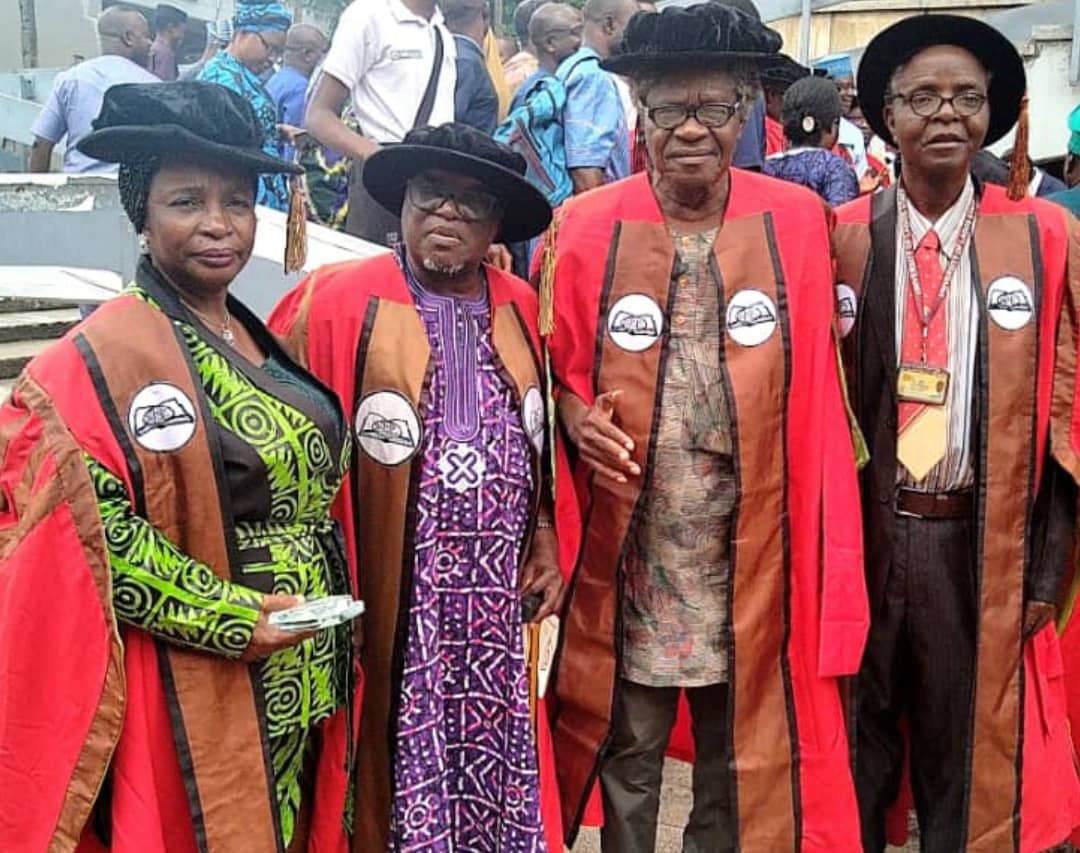
From left: Prof. Mabel Evwierhoma, Prof. Olu Obafemi (NNOM), Prof. Tony Afejuku and Prof. Abayomi Akinyeye (all FNAL), during Afejuku’s investiture as Fellow, Nigerian Academy of Letters recently at the University of Lagos.
By Chukwuma Ajakah
The Nigerian Academy of Letters (NAL) has inducted new Fellows and Members at its 26th Convocation and Investiture held at the J. F. Ade Ajayi Auditorium, University of Lagos, Unilag. New Fellows inducted include Professors Asabe Kabir Usman, Anthony Esijolomi Afejuku, Florence Orabueze, Olukoya Ogen, Olatunji Alabi Oyeshile, Cecilia Amaoge Eme, Afis Ayinde Oladosu, Lendzzemo Constantine Yuka, Olusanjo Daramola, and Emmanuel Emasealu.
The Academy also inducted three overseas Fellows-Professors Abiodun Salawu, Hakeem Ibukunle Tijani, and Emerita Omofolabo Ajayi-Soyinka.
Also, the former President of Association Nigerian Authors, Dr. Wale Okediran was inducted along with Dr. Bukar Usman as Honorary Fellows of the Academy while celebrated film and Nollywood producer, Zeb Ejiro, OON was honoured with NAL Award for Excellence of Humanistic Practice.
While delivering the Convocation Lecture titled, “The Challenge of Nigerian Democracy: Problem of the System or Its Managers,” the lecturer, Prof. Alkasum Abba harped on number of topical issues, relating to the country’s democracy. “After 25 years of democratic governance, the economy has been declining and is now at a boiling point,” he observed, rhetorically asking, ” What is wrong? Is it the constitution we have adopted or the political leaders?” The erudite professor traced the challenges, buffeting Nigeria to the British colonialists who he said never wanted Nigeria’s democracy to develop and be stable like that of India which has been working since 1947. Abba claimed that one way the British succeeded was to ensure that that both the people and the political leaders were so divided that no single political party would be able to win elections across all the regions without the challenges of ethnicity, acrimony among politicians even within the same political party or region. “The British learnt from the Indian experience and were determined to divide us. Right from 1945, they have worked to ensure that no single party succeeds as in India,” he said, pointing out that the British maneuverings accounted for the failure of the Hebert Marcurlay and later, Nnamdi Azikiwe led NCNC, to form a national government until it aligned with the NPC in 1963. According to him, the British set the precedent of organizing elections into the parliament, but it was under their control and the membership depended on whom they wanted. NCNC surprisingly won the elections in the Western Region but was prevented from nominating the ministers. Even from the NCNC, they nominated those that would hostile to Zik. The AG became the opposition party in each region.
Prof. Abba noted that the sectarian nature of the politics led to the collapse of the first Republic in 1966, a coalition government that was formed between the NCNC and NPC after the three dominant parties had won across regional lines.
Stressing that the manipulation of the colonial power accounts for the emergency of regional socio-political groups, the professor stated that it took a united Nigeria to achieve independence and that the country needs same unity to develop economically and politically.
Comparing the two systems of government-Parliamentary and Presidential, Nigeria has practised so far, Abba argued that the Presidential System appears better, but wonders why it is not working. “Why have Nigerians been dissatisfied with the Presidential System despite its numerous advantages over the Parliamentary System?” He pointed out that the deceitful handling of the budgets for over 23 years largely accounts for the high cost of governance. “For 23 years, the budget has been more in favour of recurrent and capital expenditures. Only about 22% of the budget ever goes to service the economy,” he observed, adding that poor budgeting has thrived since 1999. Citing the instance of the power sector, he revealed, “House of Reps Investigative Committee on Power showed that the problem is not unavailability of money. 13.28 billion Dollars was spent on power, but due to financial, technical, and administrative irregularities, money spent could not be accounted for. Projects were inflated in over 50 % of parastatals visited, contractors collected billions of Naira and disappeared. No government ever investigated what went wrong. Each successive government covers up its predecessor.
Government also spent over N200m on roads that were never built. Trillions of Naira have been spent on infrastructure that was never provided.
“If the roads are bad the economy will be sick,” he noted, adding that”Road construction companies do no use their money to build roads, build when y give them money and stop where the money stops”
The auspicious event also featured a series of lectures-at special sessions, from distinguished Professors Jim Ijenwa Unah, who spoke on the topic, “The People and the Problem of Democracy: Demagoguery to Ochlocracy, Gloria Monica Emezue, “Navigating the Artificial Intelligence Landscape: African Literature, Language, Democracy and Demagoguery”, and Felix Abidemi Fabunmi, “Is the Nigerian Linguistic Democracy Endangered?”. Professor Asabe Kabir Usman, the Fellows Night Speaker talked on Literary Aesthetics in Emergent Literatery Traditions: Demagoguery in African Oral lore.
Disclaimer
Comments expressed here do not reflect the opinions of Vanguard newspapers or any employee thereof.