
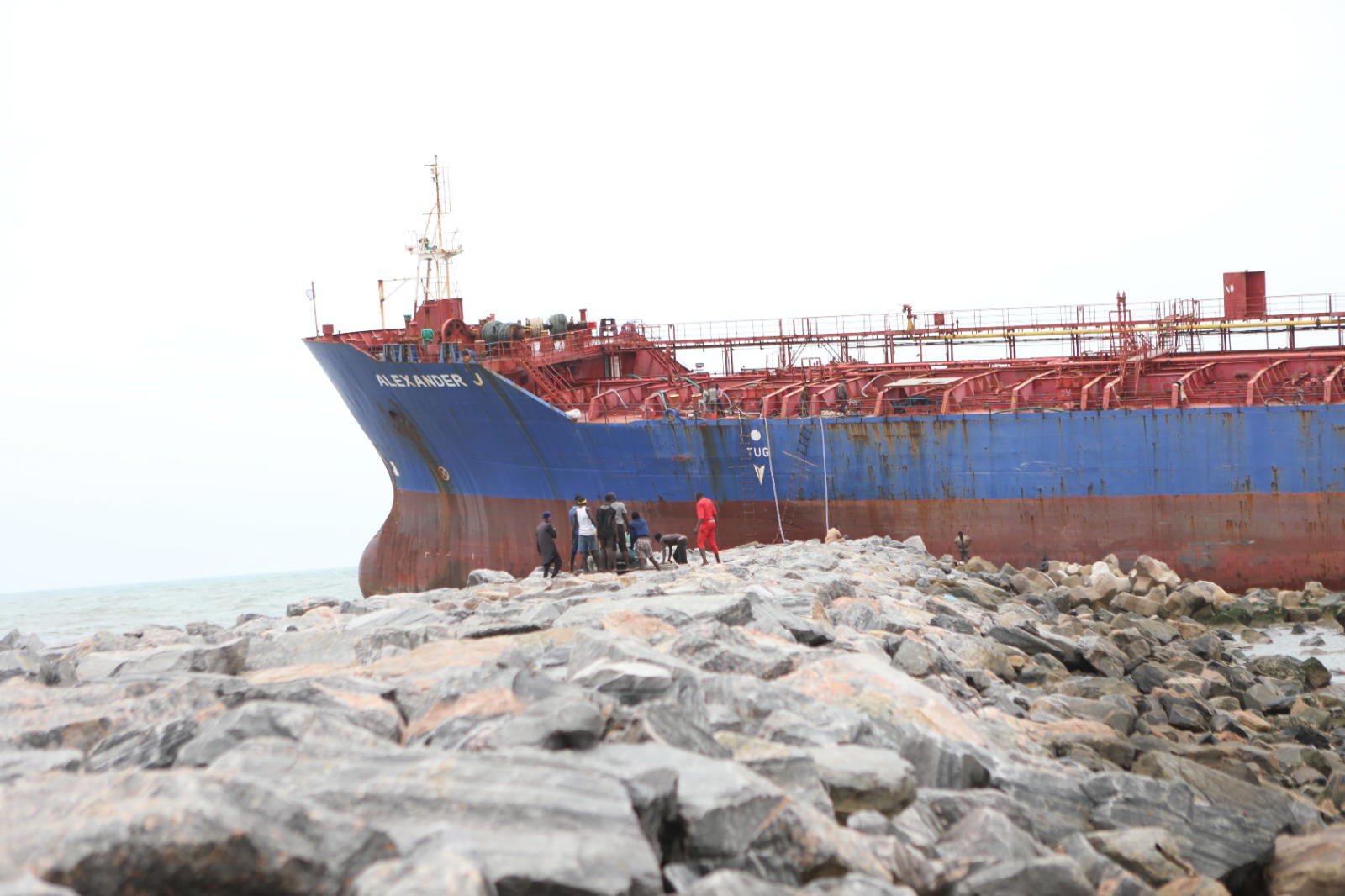
.as expert calls for holistic prevention approach
By Olasunkanmi Akoni
The Lagos State Government and a shipping firm have set up separate independent panels to probe the destruction of multibillion-naira coastal groin along the Lagos coastline at the Mayegun Waterfront Scheme near Eko Atlantic City.
The groin, critical for preventing coastal erosion and protecting local infrastructure by interrupting the flow of sediment and reducing the impact of wave action, was reportedly, severely damaged by a shipping firm’s vessel during operation.
The accident reportedly occurred on the night of July 29, 2024, after the vessel offloaded petroleum products at the Apapa port. The ship typically receives petroleum products from the high seas before offloading and berthing at the ship anchorage outside the creek.
However, due to a massive wave allegedly experienced by the vessel, the anchor broke, and the undercurrent began to move the ship over a distance of more than 10 nautical miles (18.52km) before it was eventually stopped.
This caused significant damage to the multibillion-naira groins erected by the state government to prevent coastal erosion in the area.
According to the state government, the destruction of the groin poses serious implications for the coastal environment, saying the eosion could threaten nearby communities, disrupt local marine habitats and damage property.
For residents of Lagos, the groin destruction has deepened concerns about the city’s vulnerability to coastal hazards.
Coastal communities, already grappling with the effects of erosion, face an uncertain future as the integrity of their protective infrastructure is compromised.
The state’s Commissioner for Waterfront Infrastructure Development, Mr. Ekundayo Alebiosu, expressed profound concern over the incident, considering the amount of money spent by the state government to construct the groins.
He said the state has been battling to preserve and protect coastline communities from extinction by using groins.
According to Alebiosu: “While the state is working on this, we won’t allow our existing infrastructure along the waterfront corridor to be damaged, potentially due to negligence.”
He revealed that it cost the state N7 billion to construct the groins that were destroyed by the vessel, adding that the ministry will summon the company, and further investigations are ongoing to uncover the real cause of the accident.
Alebiosu, while not relying on public hearsay, affirmed that a panel of inquiry will be set up to investigate the matter, and at the end of it, the discovery of the panel will be made public.
“Protecting our coastal areas has been very challenging for us in Lagos. We have invested billions in constructing these groins.
“Some of our communities are already ravaged by coastal erosion. The groin destroyed by the company in Mayegun cost us N7 billion.
“Okunde, Idotun, Origanrigan, Olomowewe, Itoke, Asoroko, Igbekodo, and Akodo Ise are communities still pleading for our attention. They need groins to save their communities.
“As of last year, constructing a kilometer cost N12 billion. Are we now to fold our arms and allow the already constructed groins to be destroyed.?
“The damage inflicted on the groins is not just a financial blow but a significant setback in the ongoing battle to preserve Lagos’ coastal communities,”
he stated.
The Technical Superintendent Officer, attached to the vessel, Mr. Fidelis Ilok, while speaking with newsmen during a recent inspection to the scene of the incident, described the incident as “unfortunate.”
According to Ilok, “The ship was anchored to the seabed. The 12-man crew was sleeping when the anchor broke, and the massive wave began to push the vessel up and down.
“It was total confusion until the groins at the shore stopped the vessel. The incident occurred after we had offloaded the petroleum products and anchored,”
Ilok stated.
However, the incident, many believed highlights the broader challenges of regulating maritime activities and ensuring that industrial operations do not compromise environmental and infrastructural integrity.
Environmental groups are advocating for a holistic approach to coastal management that integrates both technological solutions and natural conservation.
According to an expert, a year ago, constructing a kilometre of groin cost about N12 billion, and the stretch of coastline in Lagos spans approximately 180 kilometre, km and the cost of building a groin to prevent coastal erosion can vary significantly based on several factors, including the location, materials used, the length and height of the groin, and environmental regulations.
Speaking on the destruction of the groins and the fear of the coastal line communities as well as government over its effect, Mr. Olamide Ogunlade, an environmental expert and Programme Manager at Corporate Accountability and Public Participation Africa (CAPPA), also described the incident as “unfortunate” and called for increased governmental action on managing and maintaining infrastructure along the coastlines.
He stressed the importance of involving rural communities in coastal projects to gain valuable insights into combating coastal erosion.
Ogunlade noted that the incident serves as a wake-up call regarding climate change.
He stated that such event could be exacerbated by climate change, citing rising sea levels and increasing seawater incursions in various Nigerian states and cities.
For example, Ayetoro in Ondo State and Lekki in Lagos are experiencing these issues, with some parts of Lagos becoming unsafe during heavy rainfall.
He stressed that to effectively address the challenges; the government must integrate local knowledge and ensure community oversight in projects, particularly those aimed at mitigating the effects of climate change
As investigations proceed, both the state government and the shipping firm are expected to provide evidence and engage in negotiations to address the dispute.
“The resolution of this conflict will likely influence future maritime operations and coastal management policies in Lagos, emphasizing the need for effective regulation and proactive measures to protect critical infrastructure.
“The incident serves as a stark reminder of the challenges inherent in safeguarding coastal regions amidst unpredictable natural forces and complex maritime activities.
“For Lagos, the road ahead involves not only repairing the damage but also reinforcing its strategies to prevent similar occurrences in the future,” Ogunlade stated.
Disclaimer
Comments expressed here do not reflect the opinions of Vanguard newspapers or any employee thereof.