
By Ebunoluwa Sessou & Rejoice Adelabu
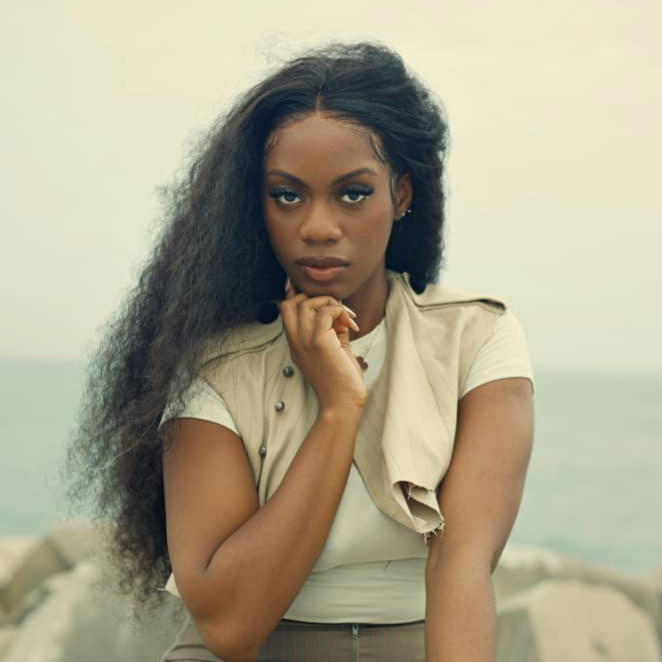
Chinyemugo Obiekwugo-Charles is a Nigerian multidisciplinary artist that has received education in Nigeria, England and the United States. Her unique subject position as a black woman with a diverse educational background causes her to question the relation between the past and the present, highlighting the circumstances that have led us to where we are as a society.
She is a social justice activist that employs design as her medium of expression. Her design principle is centred on structure, three dimensional shapes and is heavily military and antique-influenced.
Drawing inspiration from different angles including the opulence surrounding the Catholic church; and also from post-colonial Africa and its relationship with its colonial masters; she births a new way of thinking in fashion through her namesake brand, Mugo Mugo.
She is a graduate of Parsons School of Design, New York, and her graduate collection/designs have been published in Vogue magazine. She was the valedictorian for Parsons, and spoke alongside Tory Burch.
What’s your collection about?
I am a fashion designer but I like to categorize myself as a multidisciplinary artiste that is into styling, music and also creativity. This gives me a broad perspective about the world of art.
What makes me unique as an artist is my ability to question how our society works and the things that plague our society. As an activist, I see things differently from others.
I am charting a course for which the world will be a better place. Through fashion and art, we can create an active consciousness and I think that is something that is very important for me to portray through my work and I am inspired by the effect of war on fashion in general and how war has led to certain changes in the life of women and the rise of feminism and women, especially ability to be able to work after the First World War, is something that I am very interested in.
Looking back, we see how certain styles have been merged from that era to the new one. I love to talk about Patricio constraints on women and clothing that has been designed by a lot of men in the past. That is something that is very important to me. I feel like fashion should not only be something that can be worn but something that can be adored and I always talk about my brand having an element of fantasy to it as well.
I feel like we are living in a hard world and the passion for me is to create an opportunity for people to have some sense of escapism and I think that is a specific thing in my brand.
My brand is to design for the likes of Christian Dior, Louis Vuitton, Fendi, Fernando and any other brand that I feel fits my own design itself.
What informs your choice of collection?
My collection is borne out of a need to create consciousness and awareness in the minds of the people. My brands focus on empowering women and I know that sounds cliché because nowadays almost every brand wants to empower women but empowering women for me, is rekindling the hope of abused women, victims of all sorts of sexual assault.
My foundation when fully funded, would address certain issues including domestic violence and ensure that women are taken off the streets. I want to provide women with decent education that would give them hope of a better life.
As a graduate of Fashion School of Design, can you highlight some of those lessons you learnt while in school that would help you carve a niche for yourself?
During my valedictory speech, I talked about being able to work with myself and not work against myself. Imposter syndrome is a very real thing and most of the time as a fashion designer, you need to ask yourself if you have actually created something new or done something that is ground- breaking but what I have come to realise is that there is nothing new under the sun. However, there is always a way to make something new again even if it is just by changing it by 1% or 2% so, that is what I am taking with me going forward.
Looking at the Nigerian environment, what challenges do you foresee?
There is nothing that prepares you for running a business. But, for me, my determination, drive, my tenacity, the ability to be the change that I want and my ability to continue to strive for excellence. All these features are what I believe would overcome certain hurdles.
Passion is something that is continuous and evolving and for me as a designer, it is my cutting edge.
How do you hope to pass on the lessons to the next generation?
Letting people know that it is not out of place to fail because there is a possibility that you will succeed tomorrow. The moment you fail, you are one step closer to succeeding again. A lot of people see failure as something that is odd or the end of life, not knowing that there is always room for improvement.
Give us an insight into your fashion style.
When I say, there is a new way of thinking of fashion; a lot of people forget that before you design, there is a long process of thinking. As a creative person, we call it procrastination.
There is a procrastination period where you sit with your ideas, you allow it to marinade and this is the time when the turning wheel of your creativity starts. What I really like to do is for me to go back to the past. I take a lot of inspiration from antique clothing.
Africa as a continent is often displaced when talking about the history of fashion. I find archived pictures from different parts of Africa and then I am able to merge them and create a fusion of different cultures and in that way, a new way of thinking of fashion is born.
Who are your target audience?
I am a designer of this period so whatever I design, is going to be for this period because I also like to be able to see myself in my own designs. I do not design for an imaginary customer. This is a luxury brand, it is not for everyone. When you are talking about a luxury brand, it is for a specific market.
How does your design empower women?
For me, being a female designer that is recognised internationally, I am paving the way for other designers to be able to rise up and say they want to design.
Coming from a privileged background, it is easier for me to pave the way like this for myself but I feel like just being able to tell people that they can do it and they will do it if they are able to see another person doing it. This is a way to empower women.
How does your diverse educational background influence your art and design?
Growing up in Nigeria, what inspired me was what people considered,”the Sunday best look, dressing up and going to church looking very colourful and bright. That was my understanding of fashion.
Then when I moved to London, I was really able to get insight into what the “London look”, was. That was a different look I was not used to even though I had travelled out during summer. And then, when I moved to New York, I found people expressing themselves through their clothing. This definitely became a broad experience for me, a broad understanding of what fashion should and can be and then from these experiences, I found my design. That is what you see in my new collection. I am able to create inspiration from certain women of power like Queen Amina, Moremi among others. Fusing all these ideas together makes my collection.
What drives your passion for social justice and how do you hope to impact society through your work?
For me, my drive for social justice can be traced to the time of Boko Haram when we heard about the Chibok girls. There is a devastating feeling, the fact that women are taken for granted, I find it very devastating, a lot of people are not aware of the fight that a lot of women go through just to survive.
So for me, it is very important to create that consciousness and make use of these stories across the world“. I always talk about things like this because I feel black women need to stand up for themselves, we are always deemed as being too loud, arrogant, proud or being aggressive but nobody can say you are being aggressive when you are creating beautiful clothes and still passing your message across.
That is a way for me to remain smart.
What is next for your brand, Mugo Mugo, Are there upcoming projects or collaborations?
Definitely, I am developing my first “ready to wear” collection. We will continue with that and even after that, you will see me in Paris, New York and Lagos fashion week as well. That is something to look forward to.
What is your take on fashion designing in Nigerian content and where do you see us going if we keep at the pace in terms of our creative ability?
Like I said, I’m charting a new way of thinking about fashion for myself. However when you talk about Nigerian fashion, I feel we have a strong country. My only advice to other Nigerian designers is to make sure they are creating something new. Create something that is yours and not photocopy so that the authenticity of your work will not be questioned.
What will you say is the core of your message?
I want people to feel nostalgia. I want people to feel a little bit of hope. Most importantly, I want people to look forward to my work because the only reason I reference the past so much is because you cannot tell the story of the future without the past, everything has meaning and every situation that occurs, occurs repeatedly if not addressed.
What will be your final word?
“Fashion is my way of expressing myself but even asides expression, fashion itself is a marketer for today’s society. Whether people want to acknowledge it or not, the clothes we wear say so much about how we have come as a society. It is up to us to decide where we are going to take ourselves to.
Disclaimer
Comments expressed here do not reflect the opinions of Vanguard newspapers or any employee thereof.