
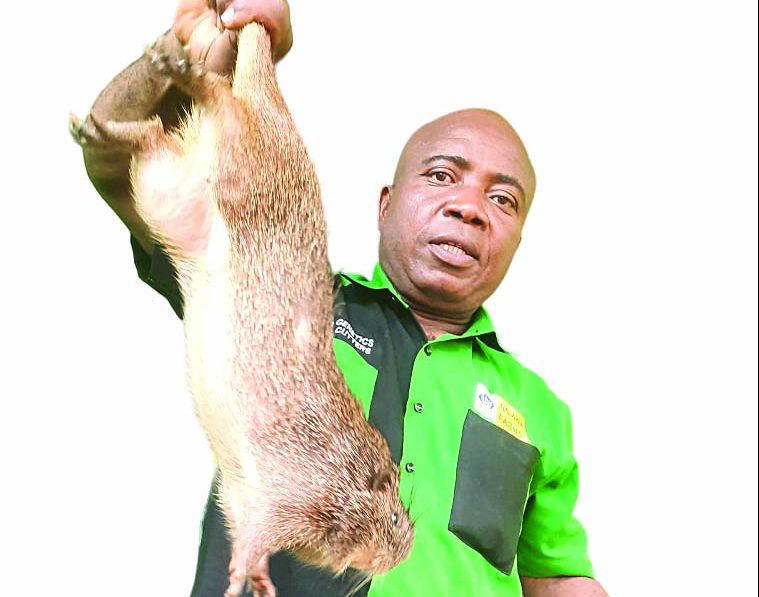
By Moses Nosike
It is important to inform interested individuals venturing into grasscutter farming how to reduce the mortality rate of grasscutters. Proper disease and parasite tolerance with a sound vaccination and disease prevention program can reduce mortality rates on the grasscutter farm to zero.
Managing Director/CEO, Jovana Integrated Farms, Prince Arinze Onebunne, said, “other factors for a healthy grasscutter include crossbreeding, good housing and balanced diet. You should also ensure that kids breastfeed well to shore up their immunity levels. Onebunne said that the work of breeding good grasscutters is a long time work which requires strategy, patience, a high degree of intelligence, and a close practical judgment.
He said, “If you are looking for a breeding stock of grasscutter, you shouldn’t make price your primary criterion. You can get cheaper grasscutters by the roadsides, but later you will see the inferior results. Same thing with other animals. When looking for grasscutter breeding stock, look for the best. The genetic pool of your future grasscutters depends on this parent stock. So, you are not just buying an animal, you are buying a gene pool and a history. That is why Jovana integrated farms insisted on crossbreed grasscutters. We don’t play when it comes to quality breeds. Here the core crossbreed grasscutter characterises of hardiness, fertility, meat-carrying ability and adaptability weigh more heavily in the decision-making process”.
Meanwhile, Jovana Integrated Farms is set for its 7th International Modern Commercial 4-in-1 livestock farm management masterclass in 24 Nigerian cities and online where participants will be trained on goat, grasscutter, fish and snail farming. Participants will learn how to start Livestock farming, packaging and processing, handling and transportation management, land and infrastructure design, outsourcing quality foundation breeds, health system, nutrition and feed formulation, overall farm management, comprehensive breeding and Revenue projections and marketing strategies, with a token fee of N10,000. Additional modules on goat farming using the following breeds- Boer, Savanna White, Kalahari Red (KR), Sokoto Red (SR), West African Dwarf (WAD) and Sahelian White (SW) will be available. During the training, quality breeding colonies of grasscutters, fish fingerlings and snail breeders, cages, tarpaulin fish ponds and books will be available for grab, and certificates will be given to participants”.
Advanced breeding techniques
“The advancement in technologies and a growing demand for sustainable farming, the future of grasscutter farming is evolving at Jovana Integrated Farms. From crossbreeding to genetic selection for disease resistance, intelligent grasscutter farmers are embracing new techniques to improve efficiency and productivity. Advanced breeding techniques are revolutionising the grasscutter farming industry by allowing farmers to enhance productivity and quality in their grasscutters. This enables discerning farmers to breed their grasscutters with superior genetics. This allows for selection of specific traits such as disease resistance, and breed quality. These advanced breeding techniques not only enhance productivity but also help in the development of more resilient and high-performing grasscutter breeds for the future of grasscutter production”.
Role of genetics
“Grasscutter farming, as with all other agricultural activities, is a long-term proposition, and improvements in one’s animal and profitability are incremental for some reasons.
There are three legs to successful grasscutter farming: Genetics, Nutrition and Health
These are like legs of a three- legged stool: Neglect any one of them and the stool will fall over. To ensure good genetic make-up in the herd, prospective farmers should buy the best animals at the outset, and to improve from there by careful selective breeding.
“Although our grasscutters are renowned for their hardiness and ability to survive in any state in Nigeria, paying attention to the animal’s nutrition, and supplementing at certain crucial times in the breeding season, will ensure stronger mothers, and bigger, healthier babies, as well as encouraging consistent multiple births. At Jovana Integrated farms, we sell grasscutter both for breeding purposes as well as a small percentage for slaughter.
Grasscutter cage
“The house must provide shelter and protection for the animals that will live in them. Cages must be big enough for the grasscutters to live comfortably by allowing them room to stretch their body, walk about, and comfortably mate. Grasscutter cages must also be hygienic-featuring cleanable feeders and drinkers. If building a new structure, make sure you consider the following: site selection, ease of access to grasses and the number of grasscutters you intend to keep. A good cage will provide your animals with shade and shelter, freedom from predators and protection from rain.
Health and Husbandry
“Grasscutters should be checked regularly to ensure they remain in good health. It is vital that you learn how to catch and hold grasscutters securely and safely. A quick feel of the waist bone for muscle will let you know if your grasscutters are losing weight. Learn to recognise common diseases. Monitor the visual appearance of your grasscutters so you can pick up the first signs of disease or any aggressive behaviour.
Hygiene
“Manure should be removed and clean on a daily basis. Old manure is great for composting and adding to gardens as a fertilizer.
Caring for grasscutter babies
“Remove the babies and their mother to a separate grooming cage for proper feeding and management. Allow the mother to breastfeed the babies properly before fertilization. Whichever way you like your grasscutter, it is very satisfying to behold a baby grasscutter produced from a grasscutter that you personally cared for in your own backyard.
Why our grasscutters are highly sought-after
“Farmers love our crossbreed grasscutters because of the breed’s hardiness, adaptability, fertility and optimum meat production, making it the ideal breed for intensive farming. Another advantage of our animals is that they are not susceptible to diseases, which makes for easy management and saves on input costs. Our grasscutters are very productive livestock. It only takes our grasscutter 6 months to grow for breeding and a female grasscutter on average gives birth to 14 young ones per year. Our crossbreed grasscutters are always a sure bet, exceeding farmers’ expectations in terms of performance and profitability in all the farms across the country where they are being used”.
Disclaimer
Comments expressed here do not reflect the opinions of Vanguard newspapers or any employee thereof.