
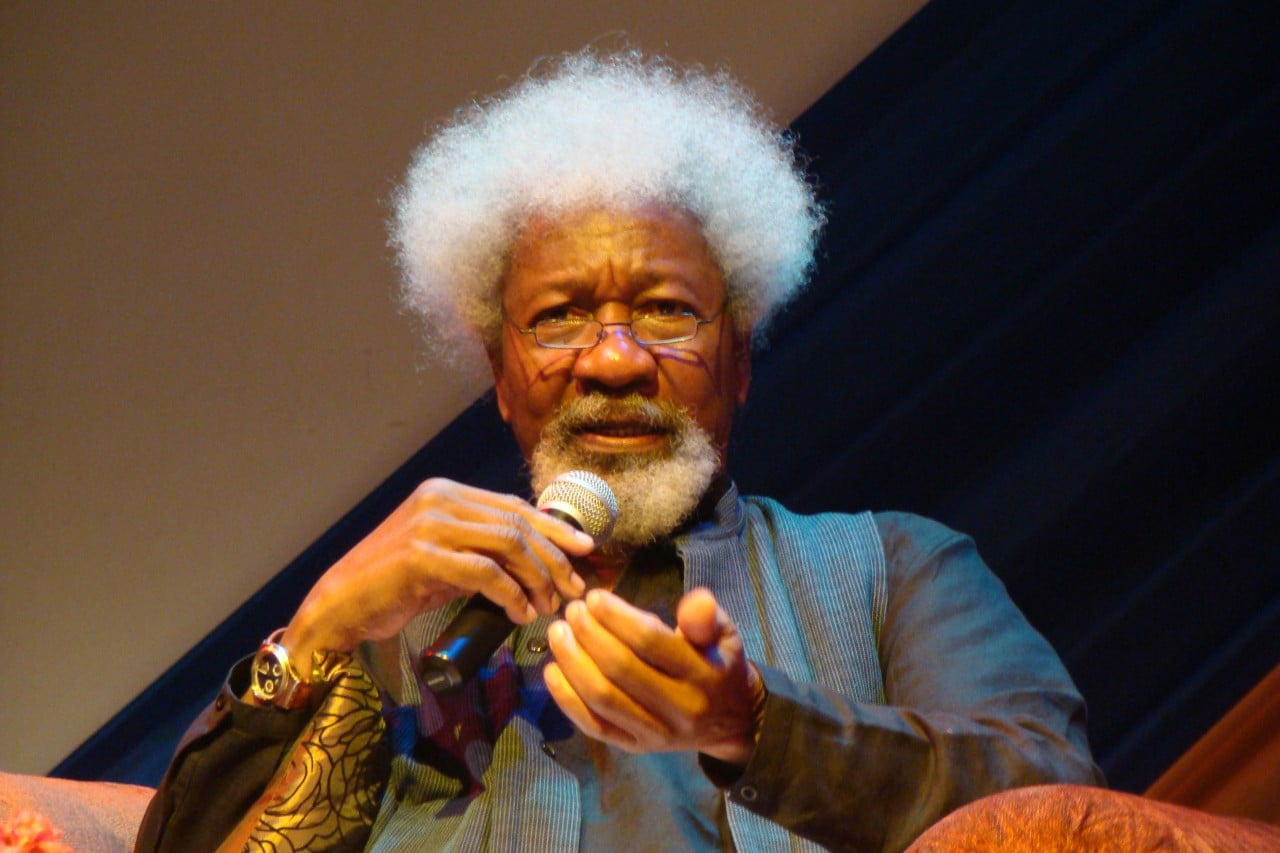
Professor Wole Soyinka
By Prisca Sam-Duru
Akinwande Oluwole Soyinka, Nigeria’s Nobel Laureate, Africa’s erudite author and political activist is 90 today. To celebrate the literary icon, a lot of activities are holding both within and outside the country.
The events ranging from symposium, stage performances, visual art exhibitions, literary events, and more are scheduled to take place throughout July and beyond. Most of the events reflect his life and times while many of the plays to be performed are re-enactment of the erudite playwright’s dramas.
Held on July 9, at The Academy of the Kingdom of Morocco, Rabat, were a symposium, poetry readings and gala night in his honour. On July 11, Nigerian Academy of Letters’ symposium and screening of a documentary film titled, ‘Ebrohimie Road: A Museum of Memory’ took place at the J. F Ade Ajayi Auditorium, University of Lagos.
A special premiere screening of ‘The Man Died’, a feature film inspired by Soyinka’s ‘Prison Notes’ took place on July 12. The screening was a strictly-by-invitation event held as the flagship of the global celebration of Soyinka’s birthday. The film which will be officially screened at a later date to be announced was directed by Awam Amkpa and produced by ace storyteller Femi Odugbemi for ZuriMedia24.
On July 6, the Committee of Relevant Arts, CORA, in partnership with Brownhill Radio, began weekly reading from four of Soyinka’s memoirs at the CORA Library & Resource Centre Freedom Park, Lagos. The programme continues on July 13, 20 and 27.
Wole Soyinka International Symposium was also held on July 11 at the University of Lagos. It was themed ‘Eni OGUN: An Enduring Legacy’.
Theatre lovers were then treated to an exhilarating stage play performance on July 12. It was titled, The Noble Warrior – Eni Ogun. Organised by Adubiifa Network Company (ANC) – a multi-media literary, theatre, and movie company, The Noble Warrior, written by Aiye-ko-ooto, directed by Oriade Adefila and produced by Cash Onadele, will be performed in collaboration between Wole Soyinka International Cultural Exchange (WSICE) and Adubiifa Network Company on July 15th 2024 by 6:00pm in Abeokuta at the Hubert Ogunde Hall of the June 12 Cultural Centre.
In addition, Prof Wole Soyinka will take centre stage at The Africa Centre, London in a vibrant 9-day programme honouring his immense contributions to literature, culture, human and civil rights advocacy. The programme which is one of the many activities lined up to celebrate the literary icon is organised by The Africa Centre in partnership with WSICE, Nigeria.
Starting from Friday, July 19 to Saturday, July 27, The Africa Centre will come alive with exhibitions, roundtables, film screenings, live music performances and poetry recitals. Visitors will be able to explore Soyinka’s literary journey with ‘WS: A Life in Full’ – a comprehensive display of his published works and photographs from his personal archive; NINE Seasons of KONGI (Wole Soyinka) – a collection of paintings by youth members of the Vision of The Child mentored by Soyinka; and incorporating the Africa I-D-E-N-T-I-T-Y, a touring showcase based on public reading of his poems realised in nine European cities; ORI Series II (For WS), a collection of conceptual water colour drawings by UK-based artist, Abolore Shobayo. Also included is a rare presentation of Soyinka’s passion collection of Onicha Market literature.
Another highlight of the programme will be the London premiere of a new feature film inspired by Soyinka’s seminal prison memoirs, The Man Died to be accompanied by a Q & A session with the director, Awam Amkpa, and producer, Femi Odugbemi, and some members of the cast and crew. Also premiering in London, is Ebrohimie Road, a documentary based on Soyinka’s former residence on the University of Ibadan campus from where he was arrested in 1967, and where he returned to after his release in 1969. It features revealing interviews with some of his children, siblings and associates. The director Kola Tubosun will also engage with the public.
Other activities will include daily screenings of films and documentaries related to or inspired by Soyinka’s life and work, and Kongi’s Nights, a series of evening entertainment including live music performances by Ed Keazor & the AfroFunk Collective, Juwon Ogungbe, Lekan Babalola, Ola Onabule, Aduke, Kayefi, MeOlogo, Jazz session with Bumi Thomas, and music party with DJ Abass etc.; poetry recitals and wine-tasting.
Billed to take place also are talks, seminars and workshops on ‘Navigating the New Publishing Industry’, ‘The impact of AI on Culture & Identity’, ‘Culture Sponsorship & Corporate Social Responsibility’, and a symposium on “The Future Is Now – A Decolonisation Intersection” by partner institution Bournemouth University, while Utopia Theatre will host a virtual unveiling of Soyinka’s portrait at the University of Sheffield.
Also on the bill is “Ijo-mode, a dance workshop for youths with Peter Badejo, OBE, as well as presentation of prizes to winners of the essay competition on the theme, “AI & New Media: Reimagining Culture, Identity & Humanity” organised in partnership with TURAKA Art Centre, Chatham.
Early Life and works
Soyinka was born on July 13, 1934, in Abeokuta in Western Nigeria to Madam Grace Eniola, a devout Anglican and Samuel Ayodele Soyinka.
In an attempt to capture how devout his mother was, Wole Soyinka refers to her as “Wild Christian in his memoirs” while his father, Samuel Ayodele Soyinka, who was headmaster of the primary school, St. Peter’s, he calls “Essay”.
In spite of his parents’ religious background, particularly, their deep ties to the Anglican Church, Wole Soyinka became acquainted with the indigenous spiritual traditions of the Yorùbá people, early in life. He also began identifying with Ogun, the Yorùbá deity associated with war, iron, roads and poetry. In addition, his father made sure that young Soyinka enjoyed access to assorted books, which included the Bible and English literature, and most importantly, classical Greek tragedies such as the Medea of Euripides, which largely helped shape his imagination.
As a gifted reader, Soyinka soon discovered a link between his indigenous people’s folklore and the Greek mythology underlying so much of western literature. And in 1960, Wole Soyinka founded the theatre group, The 1960 Masks, and in 1964, the Orisun Theatre Company, producing his own plays and acting. He based his writing on the mythology of his own tribe, the Yoruba, all revolving round Ogun, the god of iron and war.
And in 1950, he entered the University at Ibadan but left two years later for the University of Leeds in England, after winning a scholarship. That was Soyinka’s first time leaving Africa.
Soyinka wrote his first plays during his time in London, The Swamp Dwellers and The Lion and the Jewel (a light comedy), which were performed at Ibadan in 1958 and 1959 and were published in 1963.
Later, satirical comedies are The Trial of Brother Jero (performed in 1960, published 1963) with its sequel, Jero’s Metamorphosis (performed 1974, published 1973), A Dance of the Forests (performed 1960, published 1963), Kongi’s Harvest (performed 1965, published 1967) and Madmen and Specialists (performed 1970, published 1971). His philosophical plays include The Strong Breed (performed 1966, published 1963), The Road (1965) and Death and the King’s Horseman (performed 1976, published 1975). And in 2021, he published, ‘Chronicles From the Land of the Happiest People on Earth’, his first novel in nearly 50 years.
Life as an activist
As Soyinka’s reputation in the outside world soared, in 1986, when he turned 52, he was awarded the Nobel Prize for Literature, the first African author to receive such honour. The Swedish Academy which issued the award, cited the “sparkling vitality” and “moral stature” of his work and commended him as one “who in a wide cultural perspective and with poetic overtones fashions the drama of existence.”
While receiving the award from the King of Sweden in the ceremony in Stockholm, Soyinka seized the opportunity to draw the world’s attention to the enduring injustice of white rule in South Africa. And instead of focusing on his own work, or the difficulties of his own country, he dedicated his prize to the imprisoned South African freedom fighter late Nelson Mandela. He also titled his next book of verse, Mandela’s Earth and Other Poems. Two more plays, From Zia with Love and The Beatification of Area Boy, along with a second collection of essays, Art, Dialogue and Outrage, followed. He continued his autobiography with Isara: A Voyage Around Essay, revolving around his memories of his father S.A. “Essay” Soyinka, and Ibadan, The Penkelemes Years.
All that did not stop him from continuing with his criticism of the military dictatorship in Nigeria. In 1994, the United Nations Educational, Scientific and Cultural Organization (UNESCO) named Wole Soyinka a Goodwill Ambassador for the promotion of African culture, human rights and freedom of expression.
Not up to a month later, a new military dictator, late General Sani Abacha, suspended nearly all civil liberties, forcing Soyinka to escape through Benin. He fled to the United States. To Soyinka, Abacha was the worst of the dictators who had imposed themselves on Nigeria since independence. He was particularly outraged at Abacha’s execution of the author and environmental activist, Ken Saro-Wiwa, who was hanged in 1995 in spite of global condemnation of the act. In 1996, Soyinka published The Open Sore of a Continent: A Personal Memoir of the Nigerian Crisis, and as expected, the work was banned in Nigeria, and in 1997, the Abacha government formally charged Wole Soyinka with treason. General Abacha died the following year, 1998, and the treason charges were dropped by his successor.
Soyinka also played a significant role during the Nigeria/Biafra Civil War. During the war, as a Nigerian pushing his activism through his pen, Soyinka was arrested in 1967 for writing an article appealing for a ceasefire during Nigeria’s civil war. He spent close to two years in a tiny cell as a political prisoner, without a trial, after the government accused him of conspiring with the Biafra rebels.
While in prison, Soyinka wrote poems on tissue paper and recorded his experiences. In the memoir, he recounted his arrest and interrogation, the efforts made to incriminate him, and the agonising mental effects of solitary confinement. The notes were later published in 1972 as The Man Died: Prison Notes by Wole Soyinka.
Disclaimer
Comments expressed here do not reflect the opinions of Vanguard newspapers or any employee thereof.