
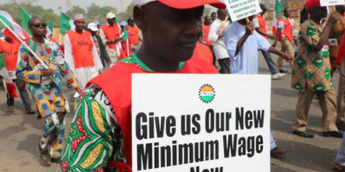
File image of protesting labour union members.
By Dickson Omobola
There are strong indications that even if the Federal Government and Organised Labour reach an agreement on the national minimum wage, state governments may fail to put through.
Considering that the Tinubu administration and the labour unions, including the Nigeria Labour Congress, NLC, and the Trade Union Congress, TUC, have been alternating backwards and forwards on attaining a concrete figure, the Nigerian worker may have to brace themselves for a tough situation with many state governors if their demand is met.
Before now, an upset labour union had argued that the N30,000 minimum wage being paid to an average Nigerian worker can no longer suffice, explaining that inflation — which stood at 31.70 per cent as of February 2024 — has affected the cost of living for an average worker, making their clamour for substantial increase plausible.
Starvation wage
In April, the current wage award expired. It came five years after the Minimum Wage Act of 2019 was signed by former President Muhammadu Buhari.
It is on this note that the organised labour made a case of N615,000 per month for the average Nigerian worker to the federal government; a demand that it has now moderated to around N200,000 per month after several rounds of negotiations.
Although the federal government, through its Tripartite Committee on National Minimum Wage, proposed N60,000, the NLC rejected the proposal, describing it as a starvation wage.
Strike
As a result, on June 3, the Organised Labour went on industrial action to protest FG’s failure to approve a new minimum wage and its failure to reverse the hike in electricity tariff.
Non-monetary incentives
However, the government has reiterated its stand, saying the series of non-monetary incentives that would compliment the wage makes it a fair deal.
These incentives include N35,000 wage awards for all treasury-paid federal workers; N100 billion naira for the procurement of CNG-fuelled buses and CNG conversion kits; N125 billion naira conditional grant and financial inclusion to MSMEs; 25,000 each to be shared to 15 million households for 3 months; N185 billion palliatives (loans to states) to cushion the effects of fuel subsidy removal; N200 billion naira to support the cultivation of hectares of land to boost food production; N75 billion naira to strengthen the manufacturing sector; N1 trillion naira for student loans for higher education among others.
Even with all these benefits, the labour unions have refused to shift ground, insisting that the deteriorating economy makes their demand tenable.
States lack the financial muscle
For many state governors, however, the demand of the labour unions is unrealistic as they do not have the financial muscle to pay such wages.
In June, a source who was privy to the discussions of the Nigerian Governors Forum about the minimum wage revealed that only 10 states can afford the proposed minimum wage of N62,000.
According to the source, those states are Lagos, Edo, Delta, Akwa Ibom, Bayelsa, Cross River, Rivers, Ogun, Kano and Kaduna.
The source also added that compelling the states to pay such a wage could lead to layoffs, stressing that it will be no surprise that the states who can afford the proposed minimum wage are the ones with the most revenues overall.
Even though Edo State, in April, commenced payment of N70,000 minimum wage to workers in the state, the Nigeria Governors’ Forum had, in a statement by its acting Director of Media and Public Affairs, Halimah Ahmed, expressed concerns that if the N60,000 minimum wage was adopted, many states would allocate their entire allocations to salaries, leaving no resources for development projects.
In part, the statement read: “The Nigeria Governors’ Forum is in agreement that a new minimum wage is due. The forum also sympathises with labour unions in their push for higher wages. However, the forum urges all parties to consider the fact that the minimum wage negotiations also involve consequential adjustments across all cadres, including pensioners. The NGF cautions parties in this important discussion to look beyond just signing a document for the sake of it; any agreement to be signed should be sustainable and realistic.”
In the past, the case was made that states should be able to determine their own minimum wage based on their respective financial positions, which vary significantly.
For instance, a Nigerian civic organisation, BudgIT, said in a report that the implementation of the proposed minimum was currently not feasible given the horizontal fiscal imbalance among the 36 states of the federation.
In its “Wage Bill of States” report, BudgIT said although the 36 states of the federation earned N7.85 trillion in 2023, 51 per cent of the cumulative revenue went to the top eight states including Lagos, Delta, Rivers, Akwa Ibom, Bayelsa, Oyo, Ogun and Ondo, while 15 per cent of the amount was earned by Lagos alone, meaning that several states of the country are unable to pay the uniform minimum wage being demanded by the labour unions is just not feasible.
These wide disparities mean that any minimum wage discussion that does not consider the ability of all the 36 states to pay, will only result in a pyrrhic victory that benefits far fewer workers than first thought.
Disclaimer
Comments expressed here do not reflect the opinions of Vanguard newspapers or any employee thereof.