
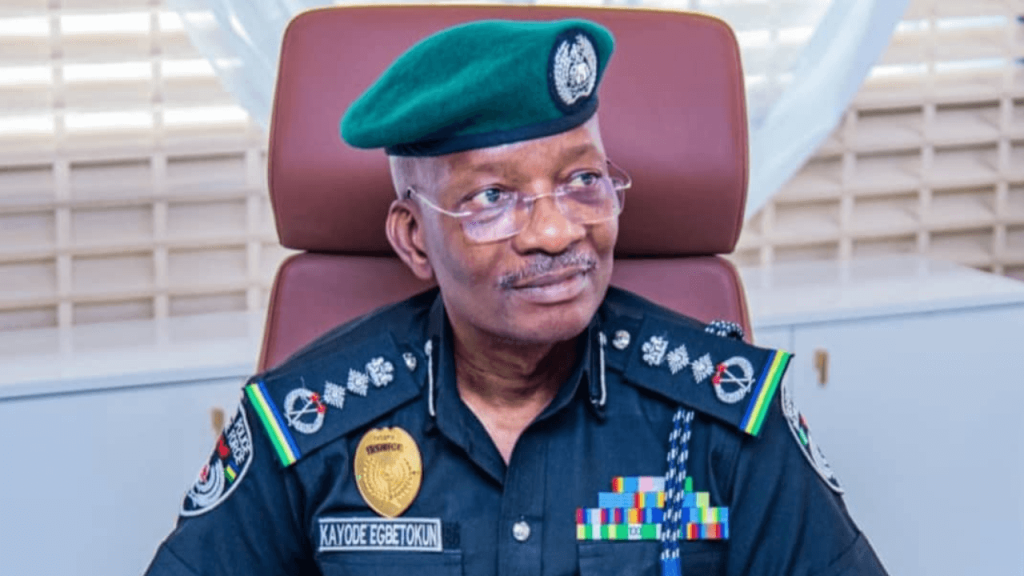
IGP Egbetokun
By Emma Nnadozie and Ifeanyi Okolie
A bloody clash was
averted yesterday morning when some armed soldiers stormed Ijeh Police Barracks in Obalende, Lagos, to evict police officers and men living there.
Their presence resulted in pandemonium as wives and children of the policemen ran helter-skelter on seeing the soldiers who were armed to the teeth subjecting people to thorough searches and issuing orders for them to pack out from their residence.
Sunday Vanguard gathered that the armed soldiers barricaded the entrance to the barracks and subjected the occupants to thorough searching before they allowed them to leave for their daily businesses.
Eyewitness reports said the presence of the armed soldiers infuriated a team of mobile policemen living in the barracks and they confronted the soldiers with their arms.
However, the situation was said to have been brought under control after the soldiers cleverly withdrew from the barracks with a vow to come again.
It was learned that police authorities in Abuja had earlier directed that policemen resident in some barracks in the state to vacate to give room for rehabilitation of the buildings. The directive, according to findings, gave a May 30, 2024, deadline with a promise to pay compensation. However, at the expiration of the deadline, it was also gathered that none of the policemen were paid compensation. Rather, forms were issued to them to give details of their account.
The affected police officers had in turn rejected the order alleging that the police authorities did not provide them and their families an alternative residence where they could move, leaving them with no choice but to reject the vacation order.
Sund Vanguard further learned that at the time the soldiers stormed the Ijeh Police Barracks, the electric power supply to the buildings was cut off and residents of the barracks were thrown into darkness.
A source, who spoke to Vanguard on the condition of anonymity, said, “We were in our quarters when we saw some soldiers laying siege to our barracks. We don’t know who gave them such orders. They took over our gate very early in the morning and they were harassing our wives going out for their business and the next thing they told us was that they had a court order asking us to vacate the barracks.
“We didn’t understand what was going on, but as police officers, we are serving this country, protecting lives and properties so our lives need to be cared for. We don’t know what is going on, and we want police authorities to come and address us properly.”
NATIONAL ANTHEM: Students shun both versions during assembly as Nigerians struggle to recite
By Adesina Wahab
The introduction of a
new National Anthem last Wednesday has continued to generate reactions among Nigerians, both offline and online.
While some agree that the new anthem is better than the one it replaced, others believe there is not much difference when the two are compared.
Another school of thought is of the view that the most pressing issue before the country and Nigerians is not an anthem, but daily survival.
When Sunday Vanguard sought the opinion of a businessman, Gbenga Okesode, he expressed disgust about the timing of the introduction of the new anthem.
“To me, it is just a way to distract the people. One would wonder why that should be the priority of the government now. The cost of living is already out hand for most Nigerians and doing business has become a dangerous thing to dabble into”, he said.
“To me, even if the new anthem is far better than the one it replaced, the question is, is this time auspicious to introduce it?
“It shows that we are not serious and we are getting our priorities wrong. Apart from the serious economic challenges facing the country, insecurity has not abated.
“We must find ways of alleviating the suffering of the people. An anthem is not what will put food on the table of the people or give them access to the good things of life.
“In fact, hunger and poverty would wipe away patriotism from the lives of people, something an anthem and national pledge are supposed to inculcate”.
A lawyer, Rasaq Akinleye, on his part, opined that since it was introduced following the passage of a bill which was assented to by President Bola Tinubu in record time, it has come to stay.
“I heard that some people, out of annoyance, are saying they won’t learn or sing the new anthem, that is wrong”, he said.
“No matter how you feel about it, it was introduced following the due process of the law. “Showing disrespect when it is being sung is not the way to go. Anthem, pledge, flag are parts of the symbols of a country and they must be respected”.
On Thursday, when the Lagos State University, LASU, held a press briefing as part of activities to mark its 27th convocation ceremony, the Vice Chancellor, Prof. Ibiyemi Olatunji-Bello, led in the singing of the new anthem.
Most elderly people at the event appeared to be able to recite the first stanza of the anthem without much stress.
However, the use of projectors came in handy to assist the gathering in singing the two remaining stanzas without much trouble.
For the students, who were mostly not born in 1978 when the anthem was discarded, it was just a matter of watching proceedings.
How teachers, students cope
On the social media page of a group, Concerned Parents and Educators Network, CPE, which is populated by parents, teachers, school owners and stakeholders in the education sector, teachers, especially, recounted how they and their students have been able to cope in the first two days of reciting it during morning assembly.
One of them, Blessing Okere Ayanbiyi, said, “They (students) sang the old anthem since the new one is yet to be learnt.”
Another member, Olufunke Awoyemi stated, “To keep in view probably till next term.”
Princess Adepeju Olufadeke Sobaloju said, “We didn’t sing both old and new, the children were just laughing.”
Anthonia Oleabhiele said, “They managed to mutter it to the last stanza and then subconsciously said amen.”
The anthem that was reintroduced on Wednesday was in use from independence till 1978, before the one it replaced was introduced.
The pre-independence anthem was composed by colonialists, while the 1978 edition was composed by Nigerians following a competition among Nigerians on writing a new anthem.
President Tinubu had earlier directed that the National Pledge be rendered in all official gatherings after reciting the anthem.
Disclaimer
Comments expressed here do not reflect the opinions of Vanguard newspapers or any employee thereof.